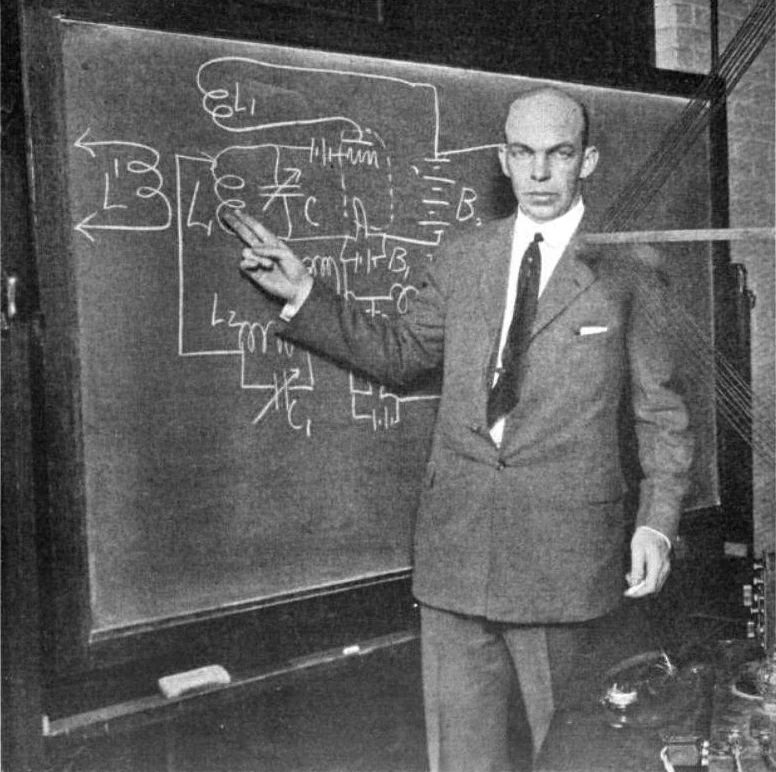
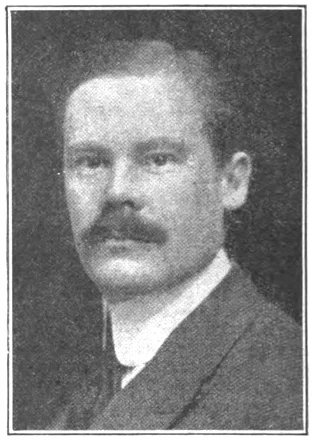
In this biography
Quick facts
- Born
- 1866
- Died
- 1932
- Birthplace
- Not independently established
- Country
- Canada
- Nationality
- Not independently established
- Known for
- Early experiments transmitting speech by radio
Why this life matters
His experiments separated the problem of carrying a voice from the problem of sending a sequence of telegraph signals.
Timeline
Key moments
Edison enterprise
Joins Edison Machine Works as a tester.
Cobb Island trial
Sends speech across a short wireless link.
New institutional setting
Leaves the Weather Bureau and works with private backers.
Brant Rock
Carries out transatlantic radio trials.
From electrical shops to field experiments
Fessenden grew up in Canada and studied at Bishop’s College before leaving for work. He found a place in Edison’s enterprise in 1886, first testing equipment and later taking on laboratory responsibilities. Teaching followed his early industrial work. The movement between workshops and classrooms matters because his later experiments required both a physical installation and a way to decide whether it had worked.
The United States Weather Bureau gave him a specific reason to improve wireless communication. Information for forecasting had to move between stations, including places where a wire was an awkward connection. The bureau’s coastal experiments combined antenna building, equipment design and reception tests.
Sources for this section: [1]
Speech over a short link
In December 1900, at Cobb Island, Fessenden sent intelligible speech across a short radio link. That was a different test from sending coded pulses. A receiving operator had to recognise a changing voice, so distortion mattered as well as whether any signal arrived. At Roanoke Island he continued wireless trials, including transmission from Cape Hatteras.
A disagreement over inventions ended his Weather Bureau arrangement. With private backing he moved to work through the National Electric Signaling Company. The Brant Rock installation and its transatlantic trials were a change in scale, supported by a new institution with commercial purposes.
The engineering record
His 1902 wireless patent describes tuning a transmitting arrangement so that its electrical response and the generator frequency work together. That specific document supports an account of design intent. It cannot establish how clearly a listener heard a particular test. Reading a patent beside a station account is a way to preserve both achievements without making them interchangeable. Fessenden also pursued underwater sound work and died in Bermuda in 1932.
Quick answers
Frequently asked questions about Reginald Fessenden
- What did Fessenden test at Cobb Island in 1900?
- He sent intelligible speech across a short wireless link while working for the U.S. Weather Bureau.
Keep exploring
Lives connected to this story
- Ernst Alexanderson
Follow the engineer who built high-frequency alternators for early wireless work.
- Thomas Edison
Compare the electrical workshop in which Fessenden first worked.
Sources and further reading
Explore the evidence
These references support the biography and offer further reading. Official records, first-person accounts and independent reporting provide different perspectives; image records document attribution and licensing.
- 1. National Park ServiceReginald Fessenden
- 2. McGill UniversityWho was Reginald Aubrey Fessenden?
- 3. U.S. Patent OfficeWireless telegraphy, US706737A
Selected specification passages on matching generator and transmitting-circuit frequency. The patent is not a station log.