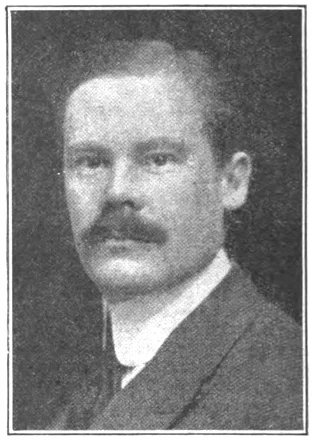
In this biography
Quick facts
- Born
- 1890
- Died
- 1954
- Birthplace
- Not independently established
- Country
- United States
- Nationality
- Not independently established
- Known for
- Regeneration, superheterodyne reception and wideband FM
Why this life matters
His career links three separate engineering problems: amplifying a signal, selecting a station and changing how sound is carried.
Timeline
Key moments
Regeneration experiments
Tests feedback while a Columbia student.
Receiving patent
The wireless receiving system patent is issued.
Superheterodyne
Develops a method of frequency conversion in receivers.
Radio signaling patent
A patent records his work on frequency modulation.
An experiment on an existing tube
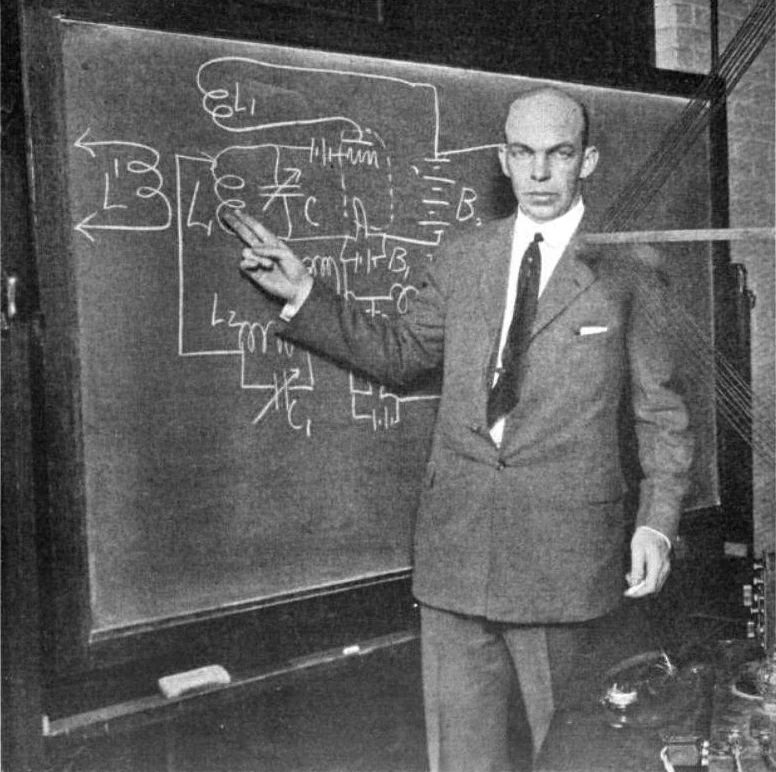
As a Columbia engineering student, Armstrong experimented with Lee de Forest’s Audion. He found that returning a portion of the amplified signal to an earlier point in a tuned circuit could make a weak transmission easier to receive. The Smithsonian preserves part of his experimental arrangement. The use of De Forest’s tube makes the division of work visible: a component maker and a circuit designer can make separate contributions to the same working object.
He received a patent for a wireless receiving system in 1914. Disputes over priority and rights extended beyond the bench experiment. A patent, an artifact and a later lawsuit are different sources for the history of that circuit.
Changing the receiver architecture
During World War I he worked on the superheterodyne receiver. The approach makes a selected incoming station easier to process by converting it to a chosen intermediate frequency. Much of the receiver can then be designed for that common frequency. This was a different improvement from returning part of a signal through a loop.
Armstrong’s Columbia collection preserves professional files covering these distinct projects. The sequence matters because each project changes a different step between the transmitting station and the listener.
FM and the broadcasting system
His subsequent work on wideband frequency modulation tackled noise by changing the method of carrying the sound signal. The 1933 patent sets out a radio signaling method. Making that method useful for broadcasting also meant operating transmitting and receiving equipment as a system. Armstrong became a Columbia professor in 1934 and continued his radio work there. His disputes with RCA appear in the archive alongside the technical material and deserve to be read on their own terms.
Quick answers
Frequently asked questions about Edwin Howard Armstrong
- Are Armstrong’s regeneration and FM the same invention?
- No. Regeneration returns part of a signal through a receiving circuit; FM varies a transmitted carrier’s frequency to encode information.
Keep exploring
Lives connected to this story
- Lee de Forest
Read about the Audion device used in the feedback experiments.
- David Sarnoff
Follow the separate institutional history of RCA and broadcasting.
Sources and further reading
Explore the evidence
These references support the biography and offer further reading. Official records, first-person accounts and independent reporting provide different perspectives; image records document attribution and licensing.
- 1. Columbia UniversityEdwin Howard Armstrong
- 2. Columbia University LibrariesOur Growing Collections: Armstrong Foundation gift
- 3. National Museum of American HistoryExperimental radio wave detector
The object description uses both late 1912 and 1913 for the experimental work; the chronology describes the beginning of the experiments, not a precise construction date for every component.
- 4. U.S. Patent OfficeWireless receiving system, US1113149A
- 5. U.S. Patent OfficeRadio signaling, US1941069A