
The short answer
A radio transmitter can generate an electrical oscillation without efficiently sending it into space. Fessenden’s early wireless specification helps explain why the circuit and its source had to be considered together.
Reading the evidence
The source, the circuit and the listener
Each record describes a different part of the link.
| Stage | What the evidence records | Question left open |
|---|---|---|
| Source | Generator speed affects drive frequency. | Where does the circuit respond best? |
| Circuit | Electrical properties set its response. | How well does this arrangement radiate? |
| Reception | A field test can record intelligible words. | Which conditions would reproduce the result? |
Identify the two frequencies
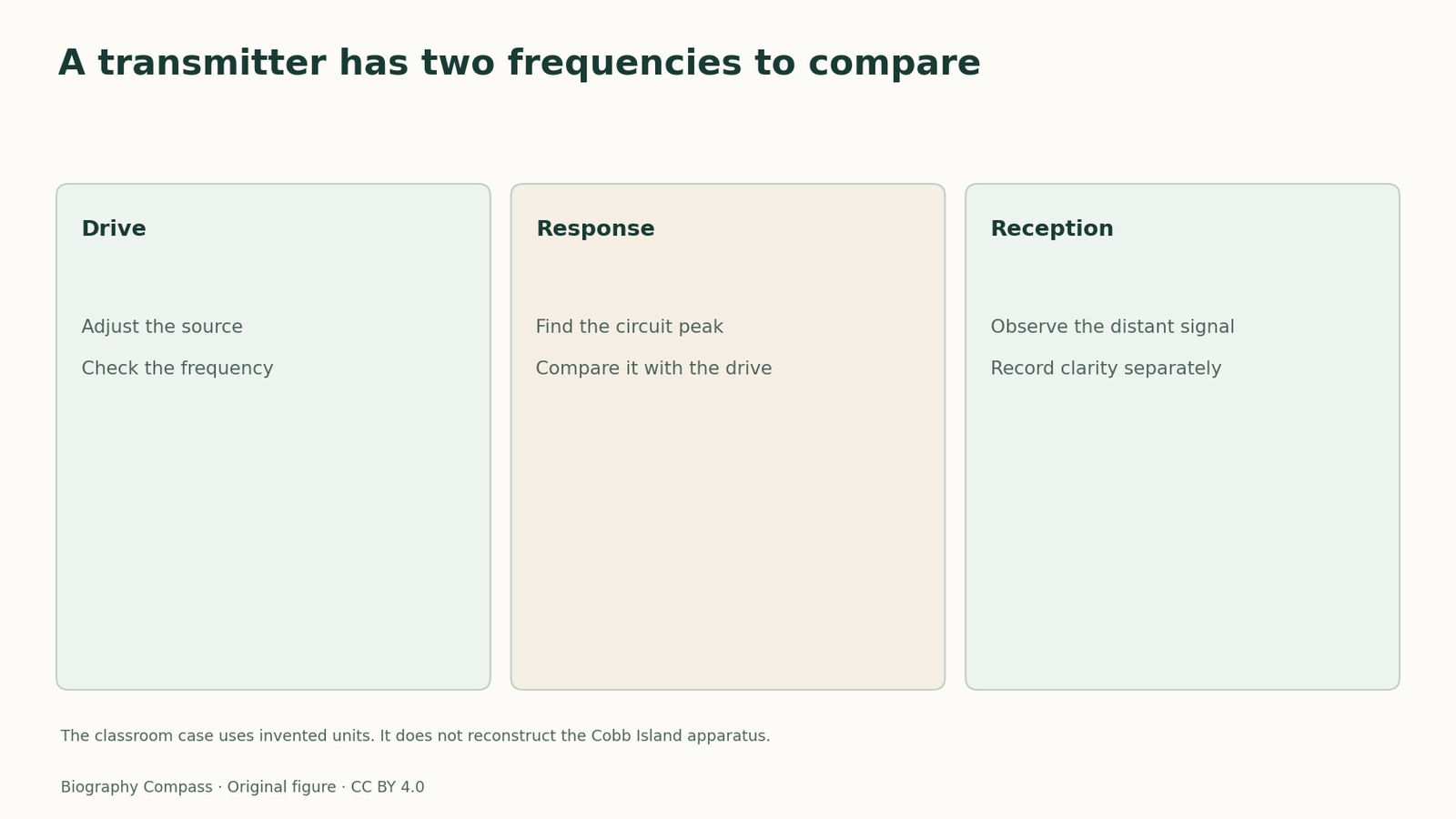
In the 1902 specification, the source may be an alternator and the transmitting conductor has an electrical response of its own. Fessenden describes adjusting the source to approach the natural frequency of the radiating arrangement. The useful distinction is between the rate at which a source drives the system and the rate to which the system responds most strongly.
The document discusses changes to inductance and capacitance as part of shaping that response. Those are properties of the circuit. Turning the generator faster is a change to the driving side. In a diagram, draw the two as separate boxes before adding an arrow between them.
Sources for this section: [2]
Put reception in a separate column
The National Park Service account describes short-range speech work at Cobb Island and later experiments between coastal stations. That evidence concerns a signal that could be observed at the receiving end. It answers a question the patent alone cannot answer. A field trial has a particular transmitter, aerial, receiver and set of conditions.
It is easy to move directly from a patent description to a conclusion about the quality of speech. A patent may explain why adjustment is plausible. To establish the clarity of an actual trial, look for a report describing the message, route, and what the receiver heard.
Try a deliberately simplified case
Imagine an invented source adjustable from 8 to 12 units and a circuit whose peak response is at 10. Compare a trial at 8 with a trial at 10 while holding the receiving setup fixed. A stronger response near 10 would support a tuning explanation. If the listener still cannot distinguish the words, write down a second problem to investigate. Better transfer at the transmitter and understandable speech at the destination are different observations.
Continue the chronology
Related history guides
Biography context
Explore Canada through connected lives
Connected biographies
People in the records
1866–1932
Reginald Fessenden
Wireless engineer and inventorFessenden tested speech transmission and proposed ways to tune a wireless transmitter.Read biographyQuick answers
Common questions
- Does a tuned transmitter prove speech was intelligible?
- No. Tuning concerns the sending circuit; a reception record is needed to assess whether listeners understood the speech.
Primary and institutional sources
How this history was checked
Dates, legal milestones and historical claims are checked against the official and institutional records below. This article was reviewed on 5 November 2026.