
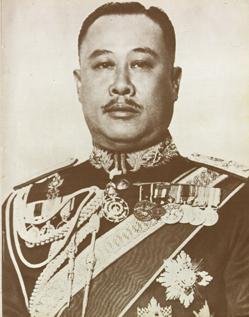
In this biography
Quick facts
- Born
- 25 November 1912
- Died
- 18 August 1997
- Birthplace
- Udon Thani, Siam
- Country
- Thailand
- Nationality
- Thai
- Known for
- Building the coercive and provincial machinery of Thailand’s 1957–1973 military order
- Interior minister
- 1957–1971 and 1972–1973
- Deputy prime minister
- 1958 and 1963–1973
- Army commander
- 1964–1973
- Political fall
- October 1973 uprising
Why this life matters
Praphas connected military command to the Interior Ministry’s nationwide administration, making him essential to understanding how Thailand’s Cold War authoritarian state operated beyond the premiership.
Timeline
Key moments
Born in Udon Thani
Born on 25 November in northeastern Siam and later trained for an army career.
Entered the army
Began service during the unstable first years of constitutional government.
Joined Sarit’s governing network
Became interior minister after the September coup displaced Phibun and Phao.
Backed the second coup
Remained inside the military order as Sarit abolished parliament and constitutional competition.
Became army commander
Combined command of the Royal Thai Army with senior cabinet and Interior Ministry authority.
Helped manage a controlled constitutional return
Retained decisive influence as a new constitution and election restored a limited parliament.
Joined Thanom’s self-coup
Helped suspend the constitution, dissolve parliament and restore direct military rule.
Fell with the military government
Left Thailand with Thanom and Narong after mass protest and lethal street confrontation.
Returned without regaining power
Came back after the 1976 coup but did not recover his former political position.
Died in Bangkok
Died on 18 August at the age of eighty-four.
Army formation and entry into the Sarit network
Praphas Charusathien was born in Udon Thani in 1912 and entered military service during the unsettled years after the 1932 revolution. He became an infantry officer and advanced within the army network associated with Sarit Thanarat. His career was therefore built not only through rank but through the personal and institutional alliances that organised Thailand’s postwar armed forces.
The February 1957 election and September coup broke the Phibun–Phao–Sarit balance. Praphas moved into the Interior Ministry after Phao’s police-centred network collapsed. That appointment mattered because the ministry reached from Bangkok into every province through governors, district officers, police and local administration. It gave Sarit’s faction a nationwide political instrument as well as command of troops.
Interior power under Sarit and Thanom
Praphas remained a central official when Sarit’s second coup abolished parliament and the constitution in October 1958. Under the 1959 interim charter, executive power operated through decrees, an appointed assembly and exceptional security authority. Praphas helped translate that concentrated power into provincial administration, policing and anti-communist organisation.
After Sarit died in December 1963, Thanom Kittikachorn became prime minister and Praphas became deputy prime minister. He took command of the Royal Thai Army in 1964 while retaining influence over the Interior Ministry. Contemporary diplomatic reporting described the ministry as an extensive bureaucracy reaching from provincial capitals to villages and treated Praphas as the strongest figure after Thanom—sometimes as a potential rival, sometimes as the government’s indispensable organiser.
Controlled parliament and the 1971 self-coup
The 1968 constitution and 1969 election restored a parliament without dislodging the military establishment. An appointed Senate dominated by officers constrained the elected House, while Praphas’s administrative and military offices preserved coercive leverage outside it. Allegations of patronage and opaque commercial interests also made him a focus of urban criticism, demonstrating the limits of a constitutional façade that left the governing network intact.
On 17 November 1971, Thanom, Praphas and allied leaders dissolved parliament and suspended the constitution. In a meeting recorded by the United States embassy, they argued that legislative politics obstructed government and that direct rule was necessary for security. Calling the action a restructuring did not change its substance: officials already in power used military authority to destroy the institutions that nominally limited them.
October 1973, exile and historical responsibility
The arrest of constitution campaigners in October 1973 transformed accumulated opposition into a student-led mass movement. When security forces attacked demonstrators on 14 October, the government lost control amid public outrage and fractures within the armed establishment. Thanom resigned; Praphas, Thanom and Thanom’s son Narong left the country. Their departure ended the military order they had inherited from Sarit, though only temporarily.
Praphas returned in 1977 after another coup had closed the democratic opening, but he did not regain national power. His biography broadens the story beyond prime ministers and coup dates. The 1958–1973 regime depended on officers who controlled ministries, provinces, police and army commands. Praphas’s long accumulation of those offices shows how authoritarian government became an administrative system—and why demands for a constitution were also demands to dismantle concentrated personal power.
Quick answers
Frequently asked questions about Praphas Charusathien
- Who was Praphas Charusathien?
- Praphas Charusathien was a field marshal, interior minister and deputy prime minister. Praphas connected military command to the Interior Ministry’s nationwide administration, making him essential to understanding how Thailand’s Cold War authoritarian state operated beyond the premiership.
- What is Praphas Charusathien best known for?
- Praphas Charusathien is best known for building the coercive and provincial machinery of Thailand’s 1957–1973 military order.
- When and where was Praphas Charusathien born?
- Praphas Charusathien was born on 25 November 1912 in Udon Thani, Siam.
- When did Praphas Charusathien die?
- Praphas Charusathien died on 18 August 1997.
Sources and further reading
How this biography was checked
Core dates and offices are checked against the sources below. This profile was last reviewed on 3 October 2026.
- Office of the Historian, U.S. Department of StateOctober 1958 coup and Revolutionary Council
- Office of the Historian, U.S. Department of StateThailand under the 1959 interim constitution
- Office of the Historian, U.S. Department of StatePolitical influence of the Interior Ministry and Praphas
- Office of the Historian, U.S. Department of StateThanom and Praphas explain the November 1971 self-coup
- Office of the Historian, U.S. Department of StateReappraisal of the fall of the Thanom government
- Ministry of Interior of Thailand / Chonburi Province130 Years of the Ministry of Interior, volume 2
- Wikimedia CommonsPraphas Charusathien portrait and public-domain record


