In this biography
Quick facts
- Born
- 11 December 1935
- Died
- 31 August 2020
- Birthplace
- Mirati, Bengal Presidency, British India (now West Bengal, India)
- Country
- India
- Nationality
- Indian
- Known for
- Finance, defence and foreign-affairs portfolios, coalition negotiation and the 2012–2017 presidency
- Education
- Postgraduate study in history and political science; law degree, University of Calcutta
- Entered Parliament
- Rajya Sabha, 1969
- President of India
- 25 July 2012–25 July 2017
- Major portfolios
- Finance, defence, commerce and external affairs
Why this life matters
His career connects party organisation, parliamentary bargaining and the constitutional presidency. It shows how substantial influence can come from building agreements and managing institutions even when the politician concerned never becomes prime minister.
Timeline
Key moments
Born in Mirati
Born on 11 December into a family involved in the independence movement.
Enters Rajya Sabha
Begins a parliamentary career that later includes five Upper House and two Lower House terms.
Finance minister
Takes charge of the finance ministry in Indira Gandhi’s government.
Planning, diplomacy and Parliament
Serves in the Planning Commission and cabinet before winning a Lok Sabha seat in 2004.
Signs the civil nuclear agreement
Signs the bilateral agreement with US Secretary of State Condoleezza Rice on 10 October.
Constitutional presidency
Leaves ministerial office, wins the presidential election and serves one five-year term.
Dies in New Delhi
Dies on 31 August, aged 84.
Teaching and journalism preceded a long parliamentary career
Mukherjee was born in Mirati on 11 December 1935. His father, Kamada Kinkar Mukherjee, was a Congress activist imprisoned during the independence struggle. The presidential profile records postgraduate study in history and political science and a law degree at the University of Calcutta. Teaching and journalism were early occupations before elected national office became the centre of his life.
He entered Rajya Sabha in 1969 and advanced under Indira Gandhi, becoming a minister in the 1970s and finance minister in 1982. His route to influence initially ran through the Upper House and cabinet rather than a personal national electoral campaign. Later Lok Sabha victories broadened that experience; the official parliamentary record distinguishes his different terms and offices.
Political setbacks did not end his influence
Mukherjee’s relationship with Congress leadership was not uninterrupted. After Indira Gandhi’s death he fell out with Rajiv Gandhi and left the party for a period before returning. Reuters’s obituary places that episode beside the larger frustration of a highly experienced minister who never secured the premiership. It is a political assessment, not proof that any particular succession was owed to him.
Under P. V. Narasimha Rao he served as deputy chairman of the Planning Commission and held commerce and external-affairs responsibilities. In the Congress-led governments formed from 2004, he handled defence, foreign affairs and finance. The variety matters: his authority rested partly on familiarity with the machinery of government and the ability to negotiate among people with different institutional interests.
Coalition management accompanied important diplomatic work
Mukherjee chaired numerous groups of ministers and led the Lok Sabha from 2004 to 2012. These duties connected policy formation with the problem of sustaining parliamentary support. The presidential biography praises his consensus building, while an independent account helps distinguish that official reputation from a claim that every negotiation succeeded or every policy commanded agreement.
As external-affairs minister, he signed the US–India civil nuclear cooperation agreement with Condoleezza Rice on 10 October 2008. Prime Minister Manmohan Singh, American counterparts, diplomats, legislators, the IAEA and the Nuclear Suppliers Group all had separate roles in the process. Mukherjee’s signature was an important ministerial act within that collective sequence, not sole authorship of the entire diplomatic opening.
Finance decisions also attracted sustained criticism
His second period as finance minister, from 2009 to 2012, followed the global financial crisis and placed him at the centre of arguments about growth, expenditure and investment. One controversial decision was the 2012 retrospective tax change affecting transactions such as Vodafone’s acquisition. Reuters describes the dispute as a significant blemish in the record of a minister often praised for administrative skill.
A reputation for negotiation therefore should not be confused with universal approval of his policies. The same politician could be effective at assembling support and make decisions challenged by investors, opponents or later administrations. Assessing him requires attention both to the office he held and to the concrete choices made while exercising it.
The presidency required a different constitutional position
Mukherjee resigned from the finance ministry to contest the 2012 presidential election. He defeated P. A. Sangma and took office on 25 July, succeeding Pratibha Patil. The election was conducted by an electoral college with weighted votes, not by a nationwide popular ballot. His previous party experience did not make the presidency another cabinet portfolio.
He served until July 2017 and died on 31 August 2020. The range of his career explains why he is remembered as both a political operator and a constitutional officeholder. Those identities involved different responsibilities: securing agreements for a government, leading parliamentary business and representing an office whose authority is defined by the Constitution.
Quick answers
Frequently asked questions about Pranab Mukherjee
- Was Pranab Mukherjee ever prime minister?
- No. He held major cabinet offices and became president, but never held the prime ministership.
- What was his role in the 2008 nuclear agreement?
- As external-affairs minister he signed the bilateral agreement with Condoleezza Rice on 10 October 2008. The wider process also required other Indian and American officials, legislators and international institutions.
- How was he elected president?
- An electoral college of elected parliamentarians and state and specified Union Territory legislators used weighted votes. He defeated P. A. Sangma in July 2012.
- Were all his economic decisions uncontroversial?
- No. The 2012 retrospective tax change, including its implications for Vodafone, attracted substantial criticism.
Keep exploring
Lives connected to this story
- Manmohan Singh
Read about the prime minister whose governments included Mukherjee’s defence, foreign-affairs and finance work.
- Indira Gandhi
Place his early ministerial rise within the government that first appointed him finance minister.
- Pratibha Patil
Compare the constitutional career of the president he succeeded in 2012.
Sources and further reading
Explore the evidence
These references support the biography and offer further reading. Official records, first-person accounts and independent reporting provide different perspectives; image records document attribution and licensing.
- 1. President’s Secretariat, IndiaPranab Mukherjee: official career and family profile
Career and education passages read. The historical profile’s present-tense age and praise are not current information or independent evaluation.
- 2. President’s Secretariat, IndiaPranab Mukherjee: former president and life dates
- 3. Lok Sabha SecretariatPranab Mukherjee: parliamentary biographical record
- 4. Reuters / Investing.comPranab Mukherjee, India’s former president who never became PM, 31 August 2020
Selected succession, party split, ministerial and retrospective-tax passages read; no claim to adjudicate tax litigation or every decision of his presidency.
- 5. US Department of StateCivil nuclear cooperation agreement signed, 10 October 2008
- 6. US Department of StateRice and Mukherjee at the signing, 10 October 2008
- 7. International Atomic Energy AgencyBoard approves India safeguards agreement, 1 August 2008
- 8. Vivek K. Agnihotri / Canadian Parliamentary ReviewHow India Chooses its Head of State: procedure and 2012 result
- 9. NDTVPranab Mukherjee will be 13th President of India, 22 July 2012
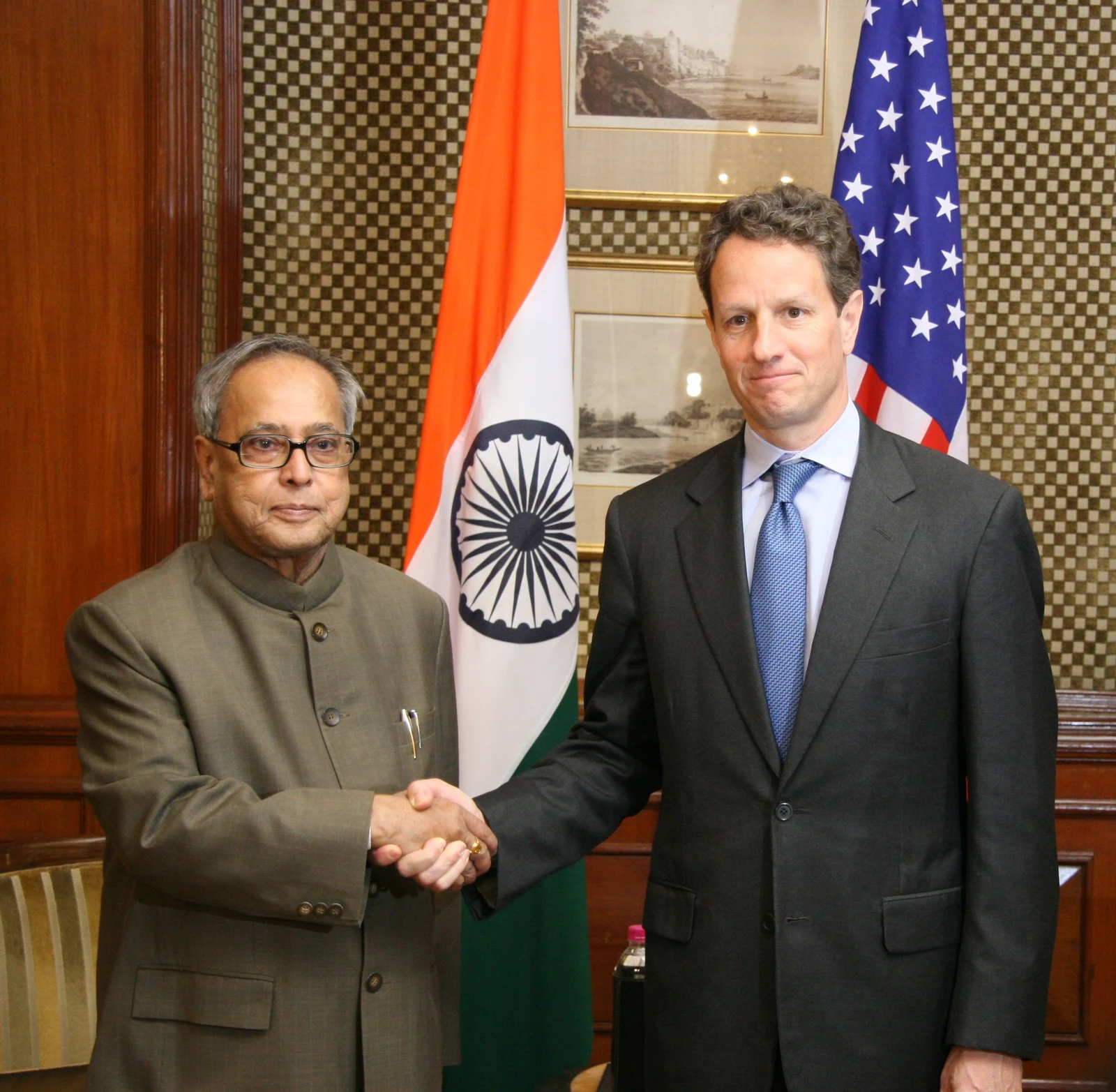
- 10. US Department of the Treasury / Wikimedia CommonsMukherjee and Timothy Geithner in New Delhi, 6 April 2010: complete photograph and rights
- 11. Creative CommonsPublic Domain Mark 1.0