In this biography
Quick facts
- Born
- 31 March 1945
- Birthplace
- Patna, Bihar Province, British India (now Bihar, India)
- Country
- India
- Nationality
- Indian
- Known for
- Becoming the first woman Speaker of the Lok Sabha in 2009 and contesting the 2017 presidential election
- Education
- Master’s degree in English literature and law degree
- Diplomatic service
- Joined the Indian Foreign Service in 1973
- Parliament
- Five Lok Sabha terms before the 2014 election
- Speaker
- Elected 3 June 2009; served during the Fifteenth Lok Sabha
Why this life matters
Her career connects diplomatic service, the political inheritance of Jagjivan Ram and the responsibilities of presiding over a contested legislature. The symbolic importance of representation sits alongside the practical demands of maintaining debate, procedure and order.
Timeline
Key moments
Born in Patna
Born on 31 March to Jagjivan Ram and Indrani Devi.
Enters diplomatic service
Joins the Indian Foreign Service and subsequently serves abroad.
Parliamentary career
Enters electoral politics and represents constituencies in Uttar Pradesh, Delhi and Bihar over successive terms.
Social justice ministry
Serves as minister of social justice and empowerment in the first UPA government.
First woman Speaker
The House unanimously adopts the motion electing her on 3 June.
A difficult final session
Presides during disorder surrounding the Telangana legislation as the Fifteenth Lok Sabha approaches its end.
Presidential candidate
Contests as the opposition nominee and loses to Ram Nath Kovind.
A political family did not preclude a separate professional beginning
Meira Kumar was born in Patna on 31 March 1945. The Lok Sabha Secretariat’s account identifies her parents as Jagjivan Ram and Indrani Devi. Her father’s national political prominence and work against caste discrimination provided an important family context, while her mother was also associated with freedom-struggle and social work. A family connection explains opportunity and inheritance, not every later decision.
Kumar earned a master’s degree in English literature and a law degree before joining the Indian Foreign Service in 1973. She served in diplomatic postings including Spain, Britain and Mauritius. That professional experience preceded her entry into electoral politics and provides a useful distinction between her own public-service record and the prominence of her father.
Electoral and cabinet work preceded the speakership
She entered parliamentary politics in 1985 and became a five-term Lok Sabha member, with her career including Bijnor, Karol Bagh and Sasaram. These were different constituencies in different states or territories, rather than continuous representation of a single seat. Her later public association with Sasaram should not be substituted for the Patna birthplace given in the parliamentary biography.
From 2004 to 2009 she was minister of social justice and empowerment in Manmohan Singh’s government. After the next election she briefly held the water-resources portfolio before being selected for the speakership. The move changed the nature of her responsibility: a cabinet minister advances the government’s programme, whereas the Speaker must administer the House and its procedures.
The House elected its first woman Speaker on 3 June 2009
Sonia Gandhi moved the motion choosing Kumar as Speaker, and Pranab Mukherjee seconded it. The official Journal records that all the notices received proposed her name, and the House elected her unanimously. The election took place on 3 June, a date established by both the debate and contemporary reporting despite inconsistent dates in some later summary tables.
Manmohan Singh’s felicitation emphasised the significance of a woman from the Dalit community taking the chair. Those remarks are evidence of how members presented the event. They do not establish that every barrier to women or Dalits in politics had disappeared, or that all parties had agreed on the government’s wider policies.
Representation and procedural authority involved different challenges
Kumar presided over the Fifteenth Lok Sabha during a period of sharp political disagreement. The Speaker’s work involves recognising members, conducting business and applying procedural rules. Her diplomatic background and the courteous image associated with her did not remove the conflicts generated by party competition or disputes over legislation.
In February 2014, as the Telangana issue produced extraordinary disorder, she suspended eighteen members from Andhra Pradesh for the remainder of the session. The episode illustrates the limits of treating the office only as an inspirational first. Authority to maintain order also invites scrutiny of fairness, the space for dissent and the conditions under which a legislature can deliberate.
A later presidential contest returned her to open party competition
Kumar’s speakership ended with the Fifteenth Lok Sabha. In 2017 opposition parties nominated her to contest the presidency against the NDA’s Ram Nath Kovind. She lost the electoral-college vote on 20 July. Having been the first woman Speaker did not make her president, nor did a presidential nomination confer that office.
Her career remains significant for the combination of professional diplomacy, elected service, ministerial responsibility and a historic institutional appointment. A balanced account can recognise that breakthrough while asking how the House functioned under her chairmanship and distinguishing the speakership’s procedural role from her subsequent political campaign.
Quick answers
Frequently asked questions about Meira Kumar
- Was Meira Kumar the first woman Speaker of the Lok Sabha?
- Yes. The House elected her unanimously on 3 June 2009.
- Was she born in Sasaram?
- The parliamentary sources used here identify Patna as her birthplace. Sasaram was an important constituency in her political career.
- Was she a diplomat before entering politics?
- Yes. She joined the Indian Foreign Service in 1973 and served abroad before entering electoral politics in 1985.
- Did she become president in 2017?
- No. She was the opposition candidate and lost to Ram Nath Kovind in the electoral-college vote.
Keep exploring
Lives connected to this story
- Sumitra Mahajan
Compare the next woman to preside over Lok Sabha and her separate parliamentary research initiative.
- Sonia Gandhi
Read about the Congress leader who moved the motion electing Kumar as Speaker.
- Mayawati
Compare another Dalit woman’s route to political power and a different institutional role.
Sources and further reading
Explore the evidence
These references support the biography and offer further reading. Official records, first-person accounts and independent reporting provide different perspectives; image records document attribution and licensing.
- 1. Lok Sabha SecretariatSpeakers of Lok Sabha: selected Meira Kumar biographical passages
Indexed birth, family and career passages consulted; the complete book was not read. Its Patna birthplace is corroborated by the contemporary parliamentary journal.
- 2. Lok Sabha SecretariatJournal of Parliamentary Information, September 2009: election and biographical passages
Indexed election narrative and biographical passages, including pages 322 and 335, consulted. No claim to have read the complete issue.
- 3. The Indian ExpressWho is Meira Kumar? 22 June 2017
- 4. The Indian ExpressMeira Kumar becomes first woman Speaker, 3 June 2009
- 5. Lok Sabha Debates / Indian KanoonMotion electing Meira Kumar as Speaker, 3 June 2009
The short election motion was read alongside the official journal. Felicitations are members’ contemporary statements, not independent evaluation of her completed term.
- 6. Lok Sabha Debates / Indian KanoonFelicitations to the newly elected Speaker, 3 June 2009
- 7. Deccan HeraldEighteen Andhra Pradesh MPs suspended amid Telangana disorder, 13 February 2014
- 8. The New Indian ExpressRam Nath Kovind defeats Meira Kumar, 20 July 2017
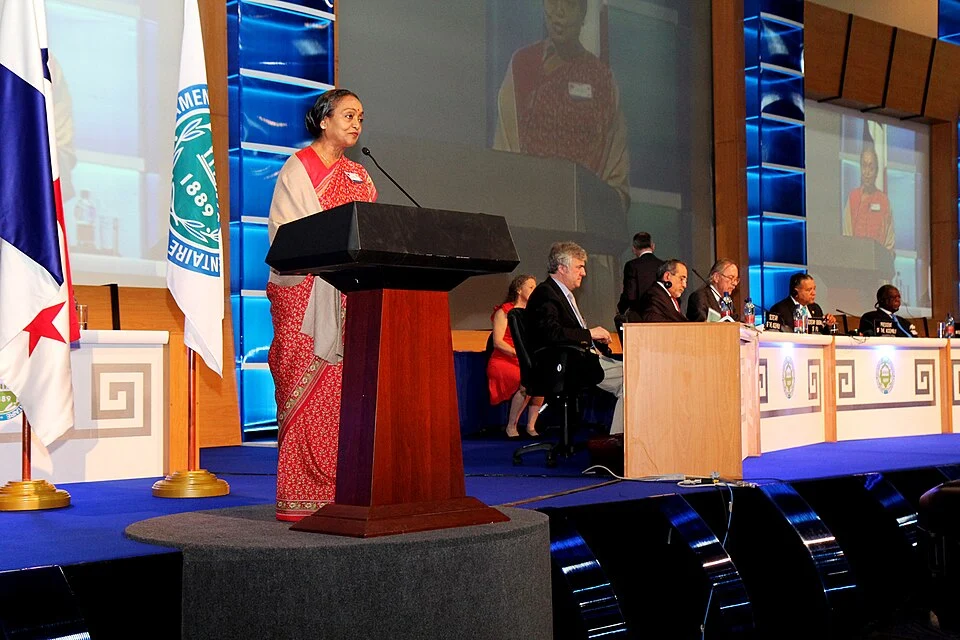
- 9. Ministry of Parliamentary Affairs / Press Information Bureau / Wikimedia CommonsMeira Kumar addresses the assembly in Panama, 16 April 2011: PIB photograph 34571
- 10. Government of IndiaGovernment Open Data Licence–India
- 11. Press Information Bureau, IndiaCopyright policy: reproduction, source credit and third-party exclusion