In this biography
Quick facts
- Born
- 26 September 1932
- Died
- 26 December 2024
- Birthplace
- Gah, Punjab, British India (now Punjab, Pakistan)
- Country
- India
- Nationality
- Indian
- Known for
- The 1991 economic reforms and the 2004–2014 UPA governments
- Prime minister
- 22 May 2004–26 May 2014
- Finance minister
- 1991–1996 under P. V. Narasimha Rao
- RBI governor
- 1982–1985
- University education
- Panjab University, Cambridge and Oxford
Why this life matters
Singh linked expert economic administration to parliamentary government. His record connects the opening of the economy under P. V. Narasimha Rao with a later effort to combine growth, social entitlements and coalition politics.
Timeline
Key moments
Born in Gah
Born in undivided Punjab, in a village now in Pakistan.
Economics training
Completed postgraduate study at Panjab University, a Cambridge economics degree and an Oxford doctorate.
Senior economic administration
Served in advisory and finance posts and became RBI governor in 1982.
Finance minister during crisis
Presented the July budget within Rao’s wider reform programme.
Prime minister
Became head of the UPA coalition government on 22 May.
Social legislation and nuclear diplomacy
RTI and rural employment legislation accompanied negotiations on US nuclear cooperation.
Second government
A renewed mandate was followed by mounting corruption allegations and governance criticism.
Died in New Delhi
Died on 26 December at the age of 92.
An economist trained across the partition generation
Manmohan Singh was born on 26 September 1932 in Gah in undivided Punjab, now in Pakistan. His education took him from Panjab University, where he completed a master’s degree in 1954, to Cambridge and then Oxford. He completed the economics Tripos in 1957 and an Oxford doctorate in 1962, developing expertise before seeking elected political influence.
He taught economics at Panjab University and the Delhi School of Economics. The transition from university work to government brought him into institutions responsible for trade, public finance and development. This was a career grounded in economic analysis and administration, rather than the mass campaigning through which many Indian national leaders first became prominent.
Public administration prepared him for the 1991 crisis
Singh entered central government as an economic adviser in 1971 and became chief economic adviser in the finance ministry the following year. Further responsibilities included the economic affairs department, the Planning Commission and the governorship of the Reserve Bank of India from 1982 to 1985. These offices exposed him to the machinery and constraints of economic management.
In 1991 Prime Minister P. V. Narasimha Rao appointed him finance minister during a severe balance-of-payments crisis. External pressures, including the Gulf crisis, interacted with domestic imbalances. Singh was a central designer and public advocate of reform, but Rao supplied essential political authority; ministries, the RBI and Parliament also made the changes possible.
The July budget belonged to a wider reform programme
His budget of 24 July 1991 explained the crisis and proposed changes in taxation, expenditure and trade policy. Alongside it, industrial-policy reform removed licensing requirements for most industries and widened space for private and foreign investment. Exchange-rate adjustment had already begun earlier in July, demonstrating that the reform process was broader than one budget speech.
The programme altered incentives and the relationship between government and business without abolishing the state’s economic role. Later growth cannot be assigned to one minister or one day, and earlier changes in the 1980s also mattered. His importance lies in helping turn an emergency into a more sustained change of direction, while arguing that reform remained compatible with social justice.
The premiership depended on coalition and party leadership
After the 2004 election, Congress president Sonia Gandhi declined the premiership and supported Singh as head of the United Progressive Alliance government. He took office on 22 May. The arrangement divided important political and governmental responsibilities between the prime minister, Congress leadership and coalition partners rather than giving him an independent presidential mandate.
The first UPA government combined economic policy with a stronger language of social rights. Parliament enacted the Right to Information Act and rural employment guarantee legislation in 2005. Campaigners, the National Advisory Council, ministers and legislators all contributed. Singh’s government provided the executive setting, but the laws were collective political achievements whose value depended on implementation.
Nuclear diplomacy tested the coalition
The civil nuclear initiative with the United States became a defining foreign-policy project. Singh and President George W. Bush announced their shared vision in July 2005; US legislation approving the cooperation agreement followed in October 2008. The arrangement sought to open nuclear cooperation while addressing safeguards and non-proliferation concerns.
Pursuing the agreement involved disagreement within the coalition’s support base and a test of Singh’s political resolve. It also illustrates the distinction between an agreement’s diplomatic significance and a claim that it solved every energy problem. Implementation required technical arrangements, commercial decisions and international institutions beyond the personal relationship between two heads of government.
A second term faced accountability disputes
Singh returned as prime minister after the 2009 election, but his second term was damaged by allegations over resource allocation and corruption within the government. In 2012 the Supreme Court cancelled 122 telecom licences. That constitutional and administrative decision was distinct from the criminal 2G trial, in which the defendants were acquitted in December 2017 after the prosecution failed to prove its case.
Neither allegations against ministers nor a licence cancellation establish Singh’s personal criminal guilt. They do raise questions about a prime minister’s supervision and political authority. He left office in May 2014 and died in New Delhi on 26 December 2024. His legacy combines major economic and diplomatic changes with the unresolved difficulty of making coalition administration both effective and accountable.
Quick answers
Frequently asked questions about Manmohan Singh
- Was Singh prime minister during the 1991 reforms?
- No. He was finance minister under Prime Minister P. V. Narasimha Rao. Singh became prime minister in 2004.
- How long was he prime minister?
- He served from 22 May 2004 to 26 May 2014, leading two UPA governments.
- Was he born in present-day India?
- He was born in Gah in British India in 1932. The village became part of Pakistan after partition.
- Do the 2G allegations establish his personal guilt?
- No. Political accountability, cancellation of licences and proof of individual criminal offences are different questions. The 2017 criminal trial ended in acquittals, while the Supreme Court had separately cancelled licences in 2012.
Keep exploring
Lives connected to this story
- Sonia Gandhi
Explore the party and coalition leadership alongside Singh’s premiership.
- Narendra Modi
Follow the national political transition after the UPA lost power in 2014.
- Jawaharlal Nehru
Compare the earlier planning framework with the reforms Singh helped introduce.
- Amartya Sen
Explore another economist associated with the Delhi School of Economics.
Sources and further reading
Explore the evidence
These references support the biography and offer further reading. Official records, first-person accounts and independent reporting provide different perspectives; image records document attribution and licensing.
- 1. Union Cabinet / Prime Minister’s Office, IndiaCondolence resolution: Manmohan Singh’s education, offices and death in 2024
Official condolence resolution establishes dates and offices; its praise is not treated as independent assessment.
- 2. Deutsche WelleFormer prime minister Manmohan Singh dies, 26 December 2024
- 3. Ministry of Finance, IndiaManmohan Singh’s Budget Speech, 24 July 1991
- 4. Arvind Panagariya / International Monetary FundIndia in the 1980s and 1990s: selected sections on industrial and trade reforms
- 5. Reserve Bank of IndiaHistorical external-sector data: crisis and exchange-rate adjustment in 1991
- 6. Indian National CongressSonia Gandhi: historical party profile; its present-tense offices are outdated
- 7. India CodeRight to Information Act 2005: enactment, commencement and statutory sections
- 8. India CodeNational Rural Employment Guarantee Act 2005: enactment and scheme framework
- 9. George W. Bush White House archiveStatement on signing US–India nuclear cooperation legislation, 8 October 2008
- 10. The Indian Express2G spectrum trial: acquittals and prosecution criticism, December 2017
Reports the December 2017 trial judgment. No assertion is made here about every later appeal or a personal criminal finding against Singh.
- 11. The Indian ExpressSupreme Court cancels 122 telecom licences, February 2012
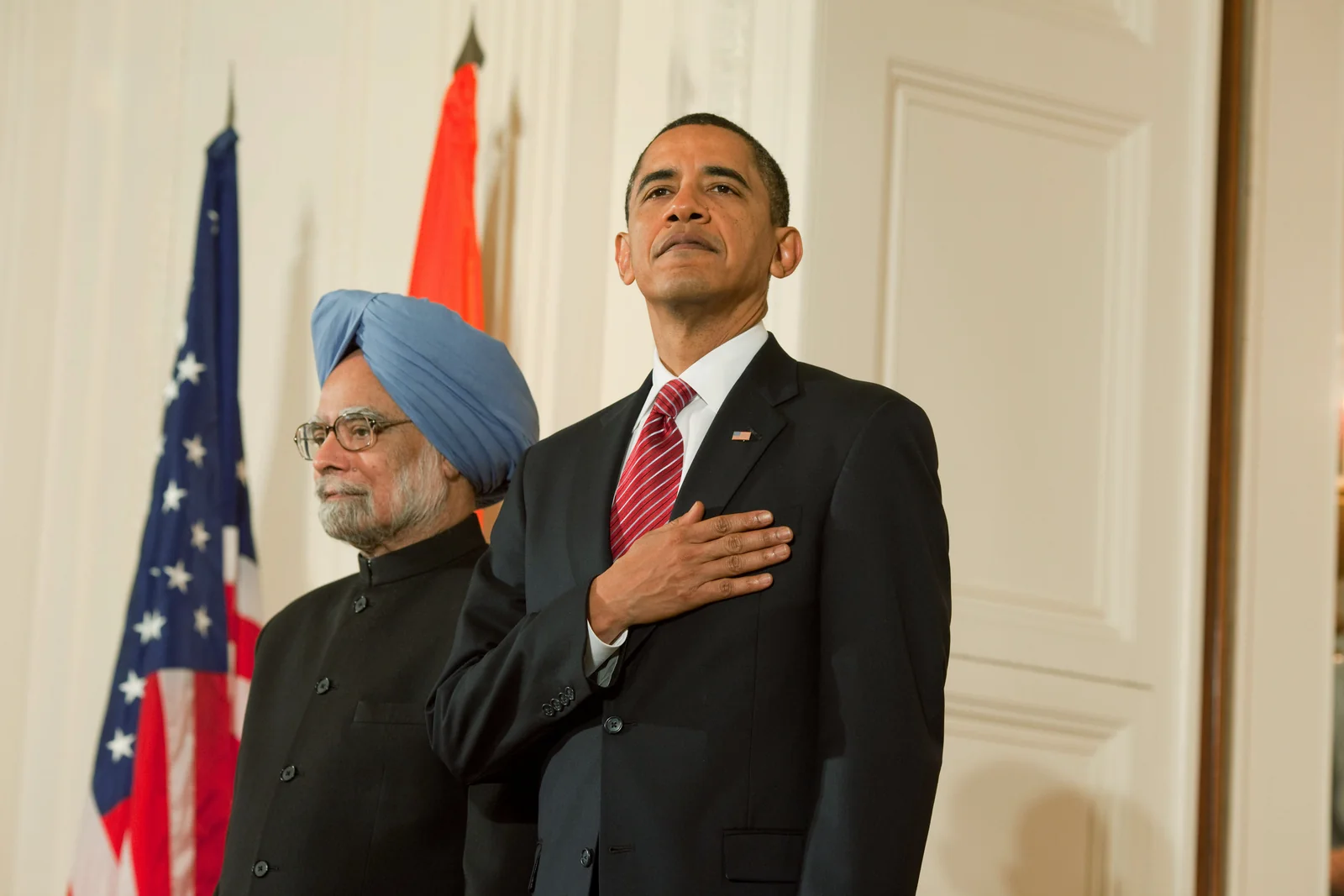
- 12. Samantha Appleton, White House / Wikimedia CommonsObama and Singh at the state arrival ceremony, 24 November 2009
- 13. US Code / Cornell Legal Information Institute17 USC 105: United States Government works
- 14. Creative CommonsPublic Domain Mark 1.0