In this biography
Quick facts
- Born
- 19 November 1917
- Died
- 31 October 1984
- Birthplace
- Allahabad, United Provinces, British India (now Prayagraj, Uttar Pradesh, India)
- Country
- India
- Nationality
- Indian
- Known for
- India’s 1971 war leadership, political centralisation and the 1975–1977 Emergency
- Prime minister
- 1966–1977 and 1980–1984
- Congress president
- Party office first held in 1959; distinct from the premiership
- Parents
- Jawaharlal Nehru and Kamala Nehru
- Marriage
- Married Feroze Gandhi in 1942
Why this life matters
Her leadership expanded the authority of the prime minister and reshaped Congress politics. The Emergency’s censorship, detention and coercive campaigns make the rights of citizens central to assessing her record, alongside foreign-policy and economic decisions.
Timeline
Key moments
Born in Allahabad
Born on 19 November into the Nehru family.
Study and nationalist involvement
Entered Somerville College in 1937; married Feroze Gandhi and was imprisoned in 1942.
Party and ministerial offices
Became Congress president, then information and broadcasting minister, before becoming prime minister on 24 January 1966.
Consolidated political power
Her government nationalised major banks; a large election victory and the Bangladesh war followed in 1971.
Emergency
Civil liberties were curtailed under a proclamation signed on 25 June 1975.
Defeat and return
Lost the 1977 election; returned as prime minister on 14 January 1980.
Operation Blue Star and assassination
Ordered army action at the Golden Temple complex in June; was killed by two bodyguards on 31 October.
Family connections opened a path that she made her own
Indira Gandhi was born on 19 November 1917, the daughter of Jawaharlal and Kamala Nehru. Nationalist politics entered family life through campaigning, absence and imprisonment. Her education crossed schools in India and Europe; in 1937 she entered Somerville College, Oxford, to study history. Attendance should not be confused with the honorary qualifications she later received.
She married Feroze Gandhi in 1942 and had two sons, Rajiv and Sanjay. That year she was imprisoned during the independence struggle. Later work in Congress and public organisations gave her experience, while her father’s position gave her exceptional access. Both the advantages of family and her own political choices matter in explaining her rise.
The premiership was different from her earlier party office
Gandhi became Congress president in 1959 and served as information and broadcasting minister in 1964–1966. After Lal Bahadur Shastri’s death she became prime minister on 24 January 1966. The distinction matters: chairing a political party in 1959 did not make her head of government. Her first premiership continued until March 1977.
She increasingly concentrated political authority around her leadership and a direct electoral appeal. Economic intervention formed part of that programme. In 1969 the government nationalised fourteen major commercial banks, seeking to redirect credit towards development and groups underserved by private banking. The policy expanded public control, while its implementation and later performance require assessment beyond the announcement itself.
The 1971 war linked humanitarian crisis with strategic power
A decisive electoral victory in 1971 strengthened her position. Later that year India confronted a regional crisis following the Pakistani army’s violent repression in East Pakistan and the flight of refugees into India. Bengali resistance and aspirations were central to the struggle; Bangladesh was not simply a creation of an Indian leader.
India supported Bengali forces and signed a treaty with the Soviet Union. Pakistani air attacks in December brought open interstate war, ending with the defeat of Pakistani forces in the east and the emergence of Bangladesh. Gandhi’s diplomacy and military decisions enhanced India’s regional position. The outcome also reflected Bengali mobilisation, military action and international calculations, including the Nixon administration’s support for Pakistan.
The Emergency concentrated power at severe human cost
Economic distress, protest and challenges to government authority intensified during the mid-1970s. In June 1975 the Allahabad High Court invalidated her 1971 election; a conditional stay followed. On her advice, President Fakhruddin Ali Ahmed proclaimed an Emergency on 25 June, using the constitutional ground then described as internal disturbance.
Censorship restricted newspapers, opponents were detained and access to judicial protection was curtailed. Police and administrative abuses, coercive sterilisation drives and demolitions affected people far beyond senior opposition politicians. Sanjay Gandhi exercised influence without an elected governmental mandate. Indira Gandhi’s responsibility as prime minister cannot be displaced onto him or local officials. Claims of discipline and development do not answer the loss of liberty, bodily autonomy and protection from arbitrary power.
Defeat demonstrated the political force of accountability
Gandhi called an election in 1977. Congress lost power and she lost her own seat, while the Janata coalition formed a government. The verdict ended her first premiership and made the Emergency a central issue in India’s democratic memory. It also showed that repression had not extinguished the capacity of voters to remove a government.
The Janata administration later fractured. Gandhi rebuilt her political position and returned as prime minister on 14 January 1980. A renewed mandate did not retrospectively erase Emergency abuses. Her two periods in office should therefore be separated by the experience of opposition and defeat, rather than presented as one uninterrupted eighteen-year premiership. Party leadership during the intervening years was a different form of power.
Punjab’s crisis and her assassination shaped the final year
In June 1984 Gandhi ordered Operation Blue Star against armed militants inside the Golden Temple complex at Amritsar. The army assault caused deaths and damage at a sacred Sikh site, deepening anger and trauma. The UK government’s later investigation describes the operation and distinguishes limited British advice in February from the substantially changed Indian army plan executed in June; it does not settle every disputed casualty estimate.
On 31 October two of her bodyguards, Beant Singh and Satwant Singh, shot her in New Delhi. Anti-Sikh mass violence followed her death, extending the tragedy beyond the assassination itself. Her life ended with the consequences of a security crisis and profound communal distrust. A balanced account must retain the agency of those harmed by state decisions and subsequent violence, as well as the political leader’s achievements and authority.
Quick answers
Frequently asked questions about Indira Gandhi
- Was Indira Gandhi related to Mahatma Gandhi?
- She was Jawaharlal Nehru’s daughter and acquired the surname Gandhi through marriage to Feroze Gandhi. The shared surname does not make Mahatma Gandhi her father.
- When did she serve as prime minister?
- From 24 January 1966 to 24 March 1977, then from 14 January 1980 until her assassination on 31 October 1984. Congress party offices were separate.
- What was the Emergency?
- The 1975–1977 period of exceptional government powers involved censorship, detention and severe restrictions on rights, alongside coercive campaigns affecting ordinary citizens.
- Why is Operation Blue Star controversial?
- The 1984 army assault against militants in the Golden Temple complex caused deaths and damage at a sacred site. Its planning, human consequences and disputed accounts remain central to debate.
Keep exploring
Lives connected to this story
- Jawaharlal Nehru
Trace the family and institutional background from which her political career developed.
- Mahatma Gandhi
Read about the independence movement in which she participated before entering government.
Sources and further reading
Explore the evidence
These references support the biography and offer further reading. Official records, first-person accounts and independent reporting provide different perspectives; image records document attribution and licensing.
- 1. Prime Minister’s Office, IndiaIndira Gandhi: offices and biographical outline
- 2. Somerville College, University of OxfordIndira Gandhi: Somerville alumna
- 3. Reserve Bank of IndiaEvolution of Bank Licensing Norms in India: 1969 and 1980 nationalisation
- 4. Office of the Historian, US Department of StateThe South Asia Crisis and the Founding of Bangladesh, 1971
- 5. Ministry of Home Affairs, IndiaGazette notification of 26 June 1975 reproducing the 25 June proclamation: indexed text
The Gazette wording was read in an indexed excerpt; direct PDF opening returned 404. The proclamation and 27 June order are independently reproduced in the 1977 Supreme Court judgment.
- 6. Supreme Court of India / Indian KanoonUnion of India v Bhanudas Krishna Gawde, 25 January 1977: proclamation and presidential order reproduced
- 7. Press Information Bureau, IndiaThe Emergency in India: retrospective government timeline, 24 June 2025
A retrospective government account published in 2025, with an explicitly condemnatory framing. Its chronology is checked against primary legal text and independent reporting.
- 8. Vikas Pathak / The Indian ExpressExplained: the story of the Emergency
- 9. UK Foreign Secretary / GOV.UKStatement on the Indian operation at Sri Harmandir Sahib in 1984, 4 February 2014
The 2014 British statement concerns the scope and effect of UK advice. It is not treated as an independent investigation of every Indian operational decision or death.
- 10. The Indian Express31 October 1984: recalling the assassination of Indira Gandhi
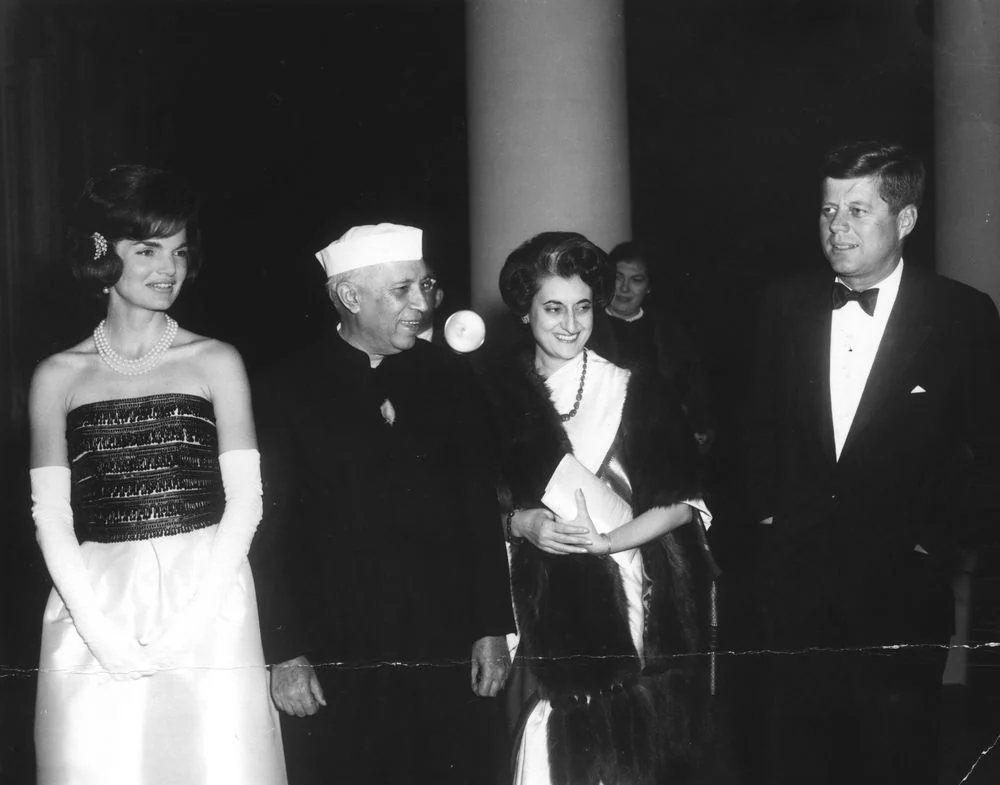
- 11. Abbie Rowe / Wikimedia CommonsDinner in honour of Nehru, 7 November 1961: complete group photograph
- 12. US National Park ServiceAbbie Rowe: federal employment and presidential photographic duties, 1941–1967
- 13. US Code / Cornell Legal Information Institute17 USC 105: United States Government works
- 14. Creative CommonsPublic Domain Mark 1.0