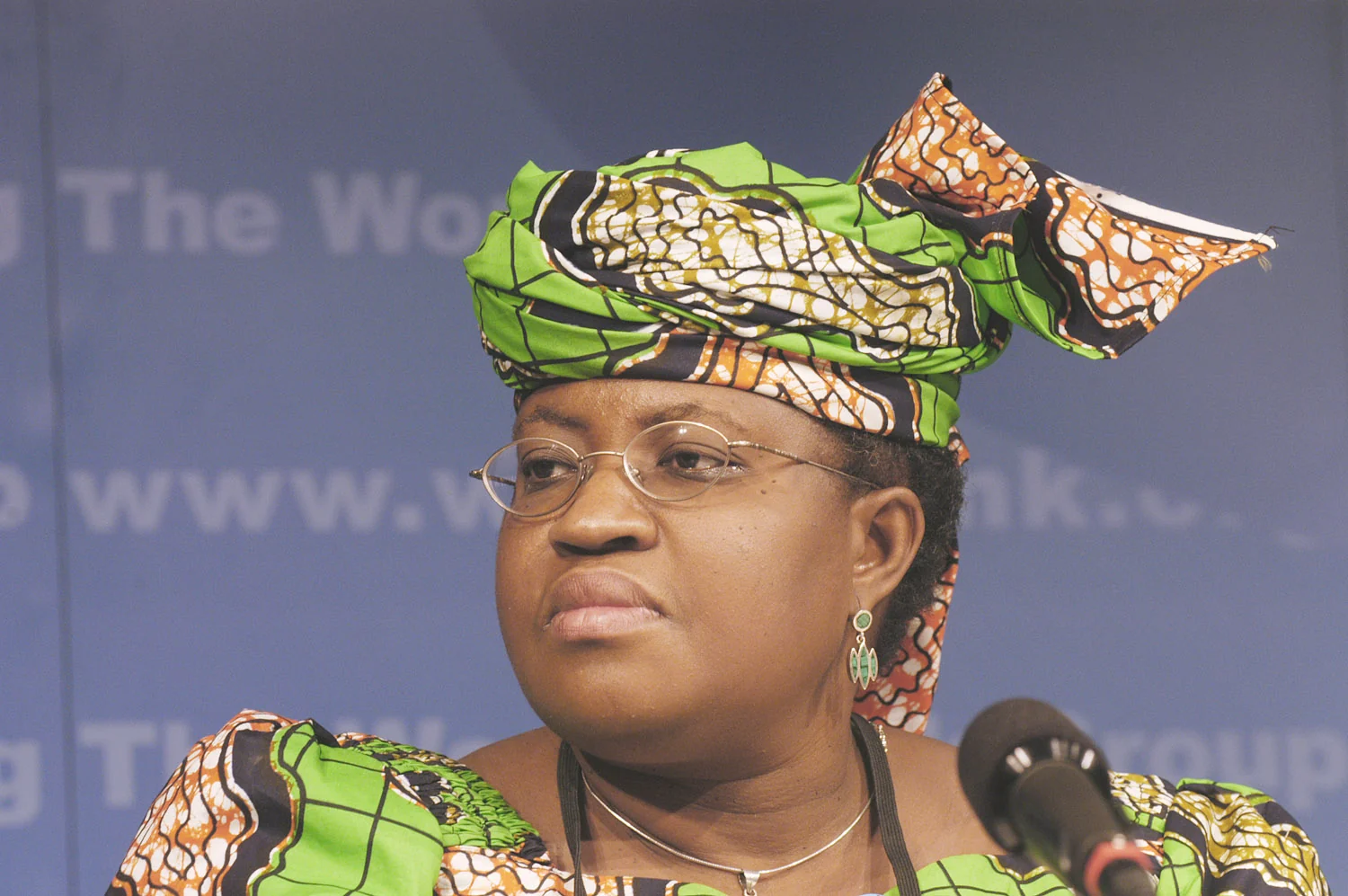
In this biography
Quick facts
- Born
- 13 June 1954
- Birthplace
- Ogwashi-Uku, present-day Delta State, Nigeria (reported; some accounts give Ibadan)
- Country
- Nigeria
- Nationality
- Not independently established
- Known for
- Nigeria’s debt negotiations, public finance reform and international trade leadership
- Finance minister
- 2003–2006 and 2011–2015
- WTO leadership
- First term began 1 March 2021; second term began 1 September 2025
- Gavi Board chair
- January 2016–December 2020
- Doctorate
- Regional economics and development, MIT, 1981
Why this life matters
Her work shows how economic expertise operates through governments, creditor negotiations and member-led institutions, where political consent and implementation determine what a reform can achieve.
Timeline
Key moments
Born in Nigeria
Born on 13 June; biographical accounts differ on the precise birthplace.
Doctorate and development banking
Completes her MIT doctorate in 1981 and enters the World Bank in 1982.
First finance ministry
Serves in President Olusegun Obasanjo’s administration and heads Nigeria’s Paris Club delegation in October 2005.
World Bank management
Returns to senior World Bank work before rejoining Nigeria’s government.
Second finance ministry
Works on public accounts and economic coordination under President Goodluck Jonathan.
Gavi governance
Chairs the Vaccine Alliance’s board.
WTO leadership
Takes office on 1 March 2021 and starts a second four-year term on 1 September 2025.
Training for development work
Ngozi Okonjo-Iweala was born in Nigeria in 1954 and trained in economics at Harvard before earning a doctorate in regional economics and development at the Massachusetts Institute of Technology in 1981. Her professional formation concerned the workings of developing economies, rather than trade diplomacy alone. A contemporary World Bank biographical record identifies rural financial markets and rural–urban links among her research interests.
She entered the World Bank through its Young Professionals Program in 1982. Early assignments included agricultural economics in African and Asian countries and, later, agricultural operations in the Middle East. These responsibilities required attention to institutions and implementation: how finance reached producers and how national policy affected livelihoods.
Negotiating Nigeria’s debt exit
Her first term as Nigeria’s finance minister ran from 2003 to 2006 under President Olusegun Obasanjo. The Paris Club’s own record names her as head of Nigeria’s delegation at the October 2005 negotiations. The settlement combined debt cancellation with substantial Nigerian payments; the roughly US$18 billion write-off should not be confused with the roughly US$30 billion in obligations cleared through the whole operation.
This was a governmental and creditor agreement. Obasanjo’s diplomacy, the economic team, the Debt Management Office, legislators, campaigners and creditor governments all contributed. Okonjo-Iweala’s negotiating role was central, but it did not make the resulting relief her unilateral decision.
Public accounts and the politics of reform
After returning to senior management at the World Bank, she served again as finance minister from 2011 to 2015, this time under President Goodluck Jonathan. Her responsibilities included economic coordination and reforms to government financial and payroll systems. The purpose was to make transactions and personnel spending more traceable, although introducing systems and achieving lasting public accountability are different tests.
The government’s attempted removal of petrol subsidies in January 2012 exposed the political limits of fiscal reform. Prices rose sharply, protests and a national strike followed, and the government partially reversed the measure. IMF records describe both the budgetary argument and public distrust that savings would benefit ordinary people. As finance minister, she defended reform within a government whose choices imposed immediate costs on households.
Vaccine finance and collective governance
From January 2016 through December 2020, Okonjo-Iweala chaired Gavi’s board. The alliance brought together governments, international agencies, technical organisations and private partners to support immunisation. Chairing its board involved setting direction and building agreement across that partnership; it was distinct from the chief executive’s operational responsibilities.
Gavi’s 2020 succession announcement credits her involvement in the design of the COVAX Facility during the coronavirus pandemic. That record documents an institutional contribution, not a claim that one chair delivered vaccines or determined coverage. Vaccination also depended on manufacturers, funders, health workers, national systems and communities.
Leading a member-driven trade organisation
She became WTO Director-General on 1 March 2021, the first woman and first African to hold the post. The General Council agreed by consensus in November 2024 to reappoint her, and her second four-year term began on 1 September 2025. These dates are confirmed by the organisation’s current leadership record.
Her office offers a platform to convene negotiations and argue for trade’s contribution to development. Its power also has a clear boundary: WTO governments make major decisions, normally by consensus; they do not delegate that authority to the Director-General. Her career is best assessed through specific agreements, administrative changes and their consequences, alongside the constraints of the institutions she has led.
Quick answers
Frequently asked questions about Ngozi Okonjo-Iweala
- How much Nigerian debt did the Paris Club cancel?
- The 2005 agreement estimated cancellation at roughly US$18 billion. Nigeria also committed substantial cash payments to clear its remaining Paris Club obligations; the whole exit was not a US$30 billion gift.
- Is she still WTO Director-General?
- The WTO’s current record confirms that her second four-year term began on 1 September 2025; this profile was reviewed on 27 October 2026.
- Did she run Gavi as its chief executive?
- No. She chaired Gavi’s board from 2016 to 2020. Board governance and the chief executive’s operational responsibilities are separate.
- Why is her birthplace qualified?
- Biographical accounts differ between Ogwashi-Uku and Ibadan. The visible field retains that uncertainty, and the precise place should be withheld from structured birthplace data pending stronger evidence.
Keep exploring
Lives connected to this story
- Calestous Juma
Compare another career connecting development research with the practical work of international institutions.
- James Mwangi
Explore a different approach to finance and development through commercial banking rather than sovereign debt negotiations.
- Adebayo Adedeji
Compare an earlier Nigerian scholar’s different responsibilities in regional integration and international development policy.
- Tony Elumelu
Compare public financial-policy responsibility with a distinct private banking and investment career.
Sources and further reading
Explore the evidence
These references support the biography and offer further reading. Official records, first-person accounts and independent reporting provide different perspectives; image records document attribution and licensing.
- 1. MunzingerNgozi Okonjo-Iweala: biographical entry (public preview)
Public preview read; no subscriber content claimed. Ogwashi-Uku is its birthplace, while another Nigerian reference gives Ibadan. Use birthplaceVerified false.
- 2. World BankParticipants’ bio-data: Okonjo-Iweala’s early agricultural and regional development work
- 3. Harvard Kennedy SchoolNgozi Okonjo-Iweala named the next Angelopoulos Global Public Leaders Fellow (2020)
- 4. World Trade OrganizationDirector-General Ngozi Okonjo-Iweala: current biography and term dates
Current official biography checked for term dates. Its broad wording about US$30 billion being wiped out is clarified with the creditor record: cancellation and Nigerian payments were different components. Harvard class-of-1977 wording differs from Harvard Kennedy School’s 1976 graduation statement; the draft avoids choosing a graduation year.
- 5. Paris ClubNigeria: debt treatment of 20 October 2005
- 6. Debt Management Office, NigeriaAnnual Report and Statement of Accounts 2005, chapter four
- 7. Paris Club / University of Texas Africa archiveParis Club press release of 20 October 2005, preserved contemporary reproduction
- 8. International Monetary FundNigeria: 2012 Article IV consultation, Country Report 12/194, including Appendix II
- 9. International Monetary FundNigeria: Selected Issues, Country Report 22/34, discussion of the 2012 reform
Historical discussion of a contested government policy, corroborated by the contemporary 2012 IMF report. The text makes no allegation of personal criminal misconduct.
- 10. Gavi, the Vaccine AllianceJosé Manuel Barroso named as new Chair of the Gavi Board (29 September 2020)
- 11. Gavi, the Vaccine AllianceGavi Board reappoints Chair and CEO (10 July 2017)
- 12. World Trade OrganizationGeneral Council reappoints Ngozi Okonjo-Iweala (29 November 2024)
- 13. World Trade OrganizationUnderstanding the WTO: Whose WTO is it anyway?
- 14. Yoruba EncyclopediaNgozi Okonjo-Iweala: biographical account with differing birthplace
Indexed entry explicitly says born in Ibadan, unlike Munzinger’s Ogwashi-Ukwu. That discrepancy is the reason for the visible qualification and withholding a precise structured birthplace.
- 15. World BankExecutive Director annual report 2008: senior management appointments