In this biography
Quick facts
- Born
- 1962
- Birthplace
- Kangema, Kenya
- Country
- Kenya
- Nationality
- Not independently established
- Known for
- Leading Equity’s transition from a struggling building society into a regional banking group focused on wider financial access
- Education
- Bachelor of Commerce, University of Nairobi
- Professional qualification
- Certified Public Accountant
- Chief executive
- Appointed in 2004, according to Equity’s historical investor record
- International recognition
- EY World Entrepreneur Of The Year, 2012
Why this life matters
His career links the design of everyday banking services with the organisational challenges of expanding a commercial financial institution.
Timeline
Key moments
Born in Kangema
Harvard’s oral-history record gives Kangema, Kenya, and the year 1962.
Accounting and banking
Develops a career in accounting and financial services after university.
Equity’s crisis
Joins the recovery effort around the period when the building society faced insolvency.
Commercial bank and CEO
Equity converts from a building society to a commercial bank; Mwangi becomes chief executive.
Stock-exchange listing
Equity lists in Nairobi.
EY award
Receives the EY World Entrepreneur Of The Year award.
Group leadership
Equity’s October 2026 company notice identifies him as group managing director and CEO.
Kangema, university and an accounting career
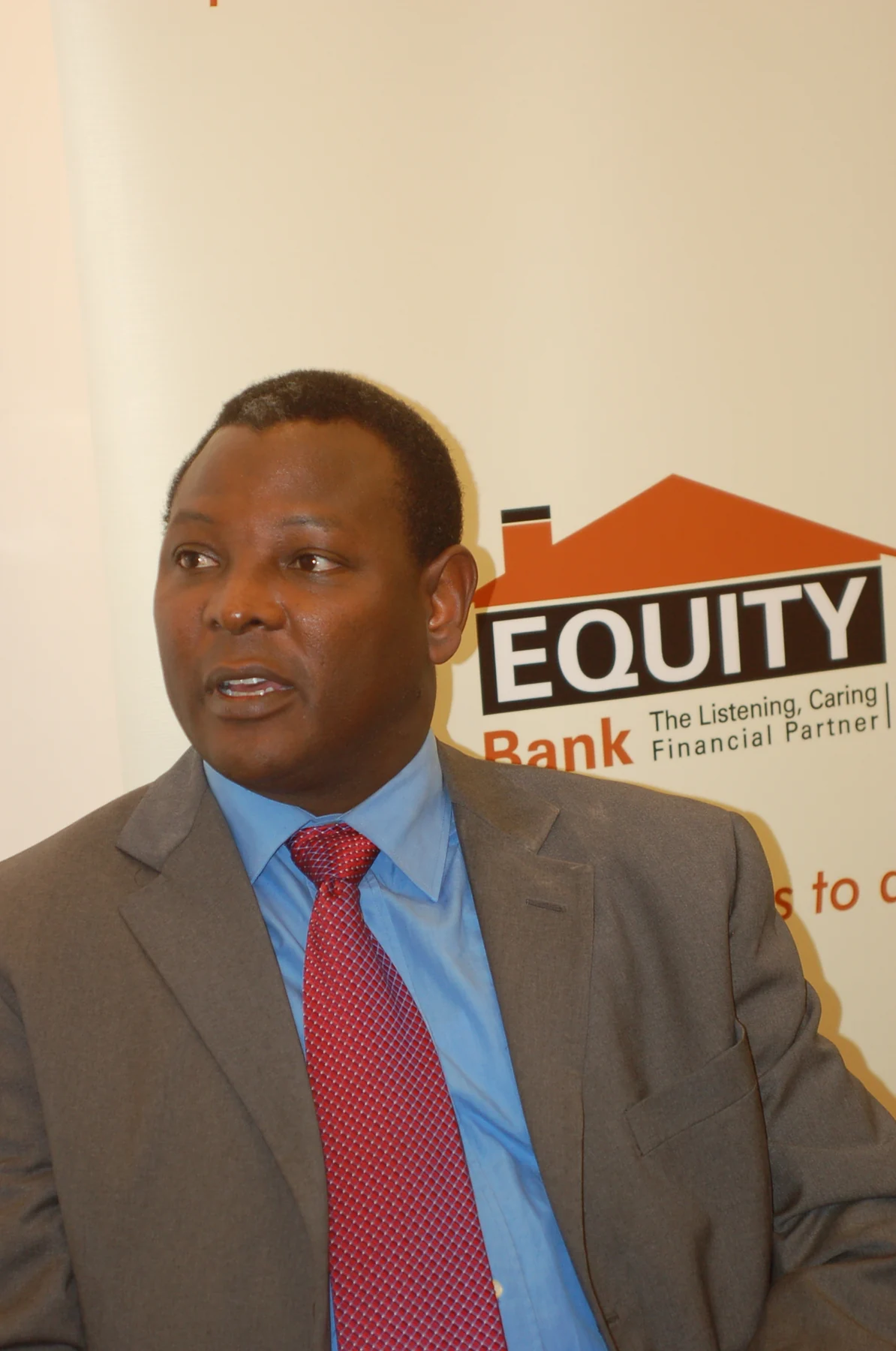
James Mwangi was born in Kangema, Kenya, in 1962. Harvard Business School’s oral-history catalogue records his Bachelor of Commerce from the University of Nairobi. Equity’s shareholder documentation also identifies him as a Certified Public Accountant. The doctorates commonly associated with his public title are honorary; they should not be presented as research degrees earned before entering banking.
He developed his career in accounting and banking during the 1980s. In later interviews he connected his interest in financial access with the experience of rural households, including his own family’s difficulty using conventional banks. Those recollections explain how he presents his motivation. They are personal testimony rather than an independent measurement of exclusion across all Kenyan communities.
Joining an institution in difficulty
Equity began in 1984 as a building society, well before Mwangi became its best-known executive. By 1993 it faced insolvency. His involvement in its recovery brought him together with existing leaders, staff, shareholders and depositors. Describing him as the original founder would erase both the institution’s earlier history and the other people involved in its survival.
In his Harvard interview, Mwangi recalls leaving a better-paid position to join the struggling institution and concentrating on the savings of its customers. The account presents a difficult organisational choice: the society needed to regain trust while changing how it operated. Recovery required management decisions and the cooperation of customers and employees; it cannot be reduced to an award-winning executive’s intentions.
Making a commercial service easier to use
Mwangi’s description of Equity’s strategy centres on obstacles that made ordinary banking difficult: account requirements, charges and the distance between customers and service points. The recovery programme treated people with small balances as a substantial market when served together. This was a commercial proposition about reaching customers at lower cost, alongside a stated purpose of widening participation.
Technology and distribution mattered to that proposition. IFC’s 2012 project disclosure describes Equity’s use of ATMs, point-of-sale services, mobile banking and agents to extend access. These channels could reduce dependence on a conventional branch visit. The disclosure records the bank’s operating model and expected development benefits; it does not prove that every customer’s income rose because they obtained an account.
From building society to regional group
Equity converted to a commercial bank in 2004. Its historical investor presentation dates Mwangi’s appointment as chief executive to the same year. A Nairobi stock-exchange listing followed in 2006. These are separate changes in legal form, leadership and ownership access, even when company histories group them together as a single transformation.
The bank subsequently expanded beyond Kenya, and Equity developed into a regional group. The chief executive’s work therefore came to include coordinating operations across different markets, rather than managing only the original savings institution. The group’s October 2026 announcement still identifies Mwangi as managing director and chief executive.
Recognition and education initiatives
In 2012 Mwangi received EY’s World Entrepreneur Of The Year award. EY’s own record identifies the award and explicitly dates its accompanying account figures to June 2012. Those historical figures should not be repeated as the group’s current scale. The recognition established his international prominence without making every statement in an awards profile an independent impact evaluation.
Mwangi has also promoted education and leadership development through Equity-related initiatives and partnerships. At an African Development Bank dialogue in 2024 he described scholarship collaboration with the Kenyan government. The Bank’s event report attributes the scholarship total to him. That is evidence of what he told the forum, rather than an externally audited count of programme completions or subsequent employment.
Assessing the career through different records
Mwangi’s distinctive contribution lies in helping reshape a troubled Kenyan institution around a mass retail market and leading its later growth. That achievement was shared with other managers, workers, investors and customers. Keeping their roles visible also makes the biography more informative: it shows how financial services were organised, rather than turning a company’s entire history into a story of one person.
Quick answers
Frequently asked questions about James Mwangi
- Who is James Mwangi?
- James Mwangi is an accountant, banker and Equity Group executive. His career links the design of everyday banking services with the organisational challenges of expanding a commercial financial institution.
- What is James Mwangi best known for?
- James Mwangi is best known for leading Equity’s transition from a struggling building society into a regional banking group focused on wider financial access.
- When and where was James Mwangi born?
- James Mwangi was born in 1962 in Kangema, Kenya.
Keep exploring
Lives connected to this story
- Aliko Dangote
Compare banking services and manufacturing as different organisational approaches to building an African enterprise.
- Ngozi Okonjo-Iweala
Contrast commercial financial inclusion with the work of public finance and international negotiations.
- Peter Munga
Distinguish Equity’s founder chairman and board role from its chief executive’s work.
Sources and further reading
Explore the evidence
These references support the biography and offer further reading. Official records, first-person accounts and independent reporting provide different perspectives; image records document attribution and licensing.
- 1. Harvard Business School, Baker LibraryJames Mwangi: Creating Emerging Markets oral-history interview, 24 April 2018
Catalogue and interview summary read. Separate PDF transcript download failed in the browser, so the draft does not claim to have read that PDF. Distinguish this Kangema-born Equity executive from Dalberg executive James Mwangi and runner James Mwangi Wangari.
- 2. Harvard Business School, Ranjay Gulati / Deep PurposeFrom Rags to (Shared) Riches: interview transcript, 27 November 2023
Full public transcript inspected for his stated motivation and institutional crisis. Mwangi is the witness: narration in a Harvard-hosted interview is not independent causal proof of all social impact.
- 3. International Finance CorporationEquity Bank Ltd, project 29600: 2012 investment disclosure and corporate history
A proposed/approved investment disclosure is used for corporate dates and distribution channels. Its forecasts and dated customer/asset totals are not presented as realised personal achievements or current scale.
- 4. EYJames Mwangi: World Entrepreneur Of The Year 2012; information dated June 2012
- 5. Equity Group HoldingsDr. James Mwangi appointed to the South-North Commission on Development, 8 October 2026
October 2026 company release used only to verify the executive title as of this review. Its development forecasts, customer totals and promotional claims are not adopted.
- 6. Equity Group HoldingsCircular to shareholders, 2020: BCom, CPA and honorary-doctorate distinction
Indexed company circular identifies BCom, CPA and honorary doctorates. The manuscript does not recast honorary awards as earned PhDs or invent a degree year.
- 7. Equity Bank2013 investor briefing: 1984 foundation, 2004 conversion and CEO appointment, 2006 listing
Company historical presentation gives the CEO appointment in 2004. References vary on his precise joining year, so the draft says involvement around the 1993 crisis rather than inventing a day or implying he founded the society.
- 8. African Development BankAnnual Meetings dialogue on tertiary education, 28 May 2024: attributed scholarship statement
The scholarship figure is explicitly introduced as a statement by Mwangi at the event, not AfDB’s independent audit. The manuscript omits the number rather than laundering a speaker’s claim into a measured result.