
The short answer
Was Nigeria’s Paris Club debt simply forgiven? The 2005 agreement combined cancellation, payment of arrears and a discounted buyback, implemented in stages. Separating a debt stock from cash payments and later budget savings makes the agreement intelligible—and shows why clearing one creditor group’s claims did not mean Nigeria had no debt or no development constraints.
Original accounting exercise
Stock, cancellation, cash and a later saving
Editorial classification of dated official figures; this is a reading aid rather than a reconstructed audit of the final settlement.
| Figure in the records | Kind of quantity | What it describes | What not to infer |
|---|---|---|---|
| US$30.066bn | Debt stock, 15 September 2005 | Paris Club claims treated by the agreement | Not Nigeria’s entire public debt. |
| About US$18bn | Estimated cancellation | Creditor claims extinguished through the treatment | Not a cash grant received by Nigeria. |
| About US$12.4bn | Planned cash payments | Total payments envisaged for the Paris Club exit | Not an additional cancellation. |
| About US$6.3bn + US$6.1bn | Components of the cash plan | Arrears regularisation plus remaining exit payments | Do not add these again to US$12.4bn. |
| At least US$1bn a year | Expected recurring saving | Debt service no longer needed, as stated in December 2005 | Not proof that equivalent services were delivered. |
Chronology
A timeline of the turning points
Agreement in principle
Creditors announce readiness for a comprehensive treatment linked to a policy programme and Nigerian payments.
Policy Support Instrument approved
The IMF approves Nigeria’s two-year PSI.
Paris agreement
Nigeria and participating creditors agree a phased comprehensive debt treatment.
First review and completion
The first PSI review enables the remaining treatment; the Nigerian central bank’s retrospective account dates the final payment to 21 April.
Who negotiated and whose claims were involved?
The Paris Club brought together official bilateral creditors. Its agreement record identifies fifteen participating creditor countries and Ngozi Okonjo-Iweala, Nigeria’s finance minister, as head of the debtor delegation. Xavier Musca chaired the session. These were negotiations between a government and creditors, not a personal settlement by the minister.
Nigeria’s Debt Management Office credits President Olusegun Obasanjo’s diplomatic campaign, the finance ministry and economic team, legislators, the DMO and wider advocacy. That distribution of work matters: the President pursued political backing, the minister led the delegation, officials reconciled claims and organised implementation, and creditor governments agreed relief. Clearing their claims did not automatically cancel debts owed to other lenders.
Read the numbers as different kinds of quantities
The creditor record puts the debt treated at US$30.066 billion as of 15 September 2005. The contemporary release estimated cancellation at about US$18 billion and payments at US$12.4 billion, including roughly US$6.3 billion to regularise arrears and US$6.1 billion for the remaining exit steps. The latter two figures are parts of the payment total, not additional payments to add on top of it.
These are dated and partly rounded estimates. Currency valuations, interest and the timing of the stock measurement matter, so US$18 billion plus US$12.4 billion should not be forced to reconcile exactly to a differently dated US$30.066 billion stock. Likewise, a cancelled claim is not cash paid into Nigeria’s treasury.
Why the relief came in stages
The agreement tied implementation to the IMF’s Policy Support Instrument. In the first phase, Nigeria paid arrears and creditors cancelled part of eligible debt. Following the first PSI review, further cancellation, repayment of specified later debt and a discounted buyback would complete the exit. The published 33 and 34 percent cancellation tranches applied to eligible debt; they were not two percentages of every Nigerian liability.
The PSI supplied monitoring and an assessment of policy implementation. It should not be described as a new IMF loan financing the Paris Club payoff. In the Nigerian policy statement included in the first review, the government reiterated that it was not requesting IMF resources for the programme. Its obligations were implemented with creditors through bilateral arrangements.
From an agreement to completed payments
The distinction between an announcement and execution is visible in the dates. June 2005 established a basis for negotiations; October produced the comprehensive treatment. The first PSI review, initially expected in March, was completed in April 2006, according to the IMF’s annual report. A later presentation by Nigeria’s central bank dates the final Paris Club payment to 21 April.
An agreement’s planned schedule is therefore not proof that every step occurred on that date. The sources also serve different purposes: the creditor term sheet defines treatment, the IMF review records programme assessment, and Nigerian administrative accounts describe implementation. Their rounded totals should be cited with their context instead of being treated as one uniform transaction ledger.
What debt-service savings could—and could not—show
A UK minister told Parliament in December 2005 that at least US$1 billion a year would be freed for poverty reduction. Nigeria’s policy statement in the IMF review likewise earmarked debt-service savings for Millennium Development Goal spending. Both document an intention to redirect resources that would otherwise service debt.
An annual saving is a flow over time. It is neither the US$18 billion reduction in claims nor the US$12.4 billion cash cost of securing exit. A spending commitment also does not by itself establish how much reached schools or clinics, whether projects worked, or which households benefited. Those questions require budget execution, procurement, service and evaluation records beyond the settlement documents.
An original accounting exercise and the limits of exit
Classify the figures in the table before making any claim about the deal. Exercise: if arrears payments of US$6.3 billion are part of a US$12.4 billion payment plan, what remains for other exit payments? The answer is US$6.1 billion. Adding all three numbers would count the same cash twice. A separate question asks whether US$18 billion cancellation was a treasury receipt: it was a reduction in creditor claims.
The completed agreement substantially changed Nigeria’s external debt position, but it did not erase domestic borrowing, all other external obligations, or dependence on oil revenue. Paying creditors also used resources that had alternative public uses. The historical question is how that immediate cost compared with avoided future obligations and the use of subsequent fiscal space. The agreement alone cannot settle that counterfactual or guarantee lasting debt sustainability.
Biography context
Explore Nigeria through connected lives
Ngozi Okonjo-Iweala
Place the debt negotiations within her wider work in public finance and international institutions.
Explore the biographiesTaxation and voiceAbeokuta Women’s Revolt
An earlier Nigerian case study in public resources, political organisation and demands for representation.
Explore the biographiesConnected biographies
The head of Nigeria’s delegation
1954–present
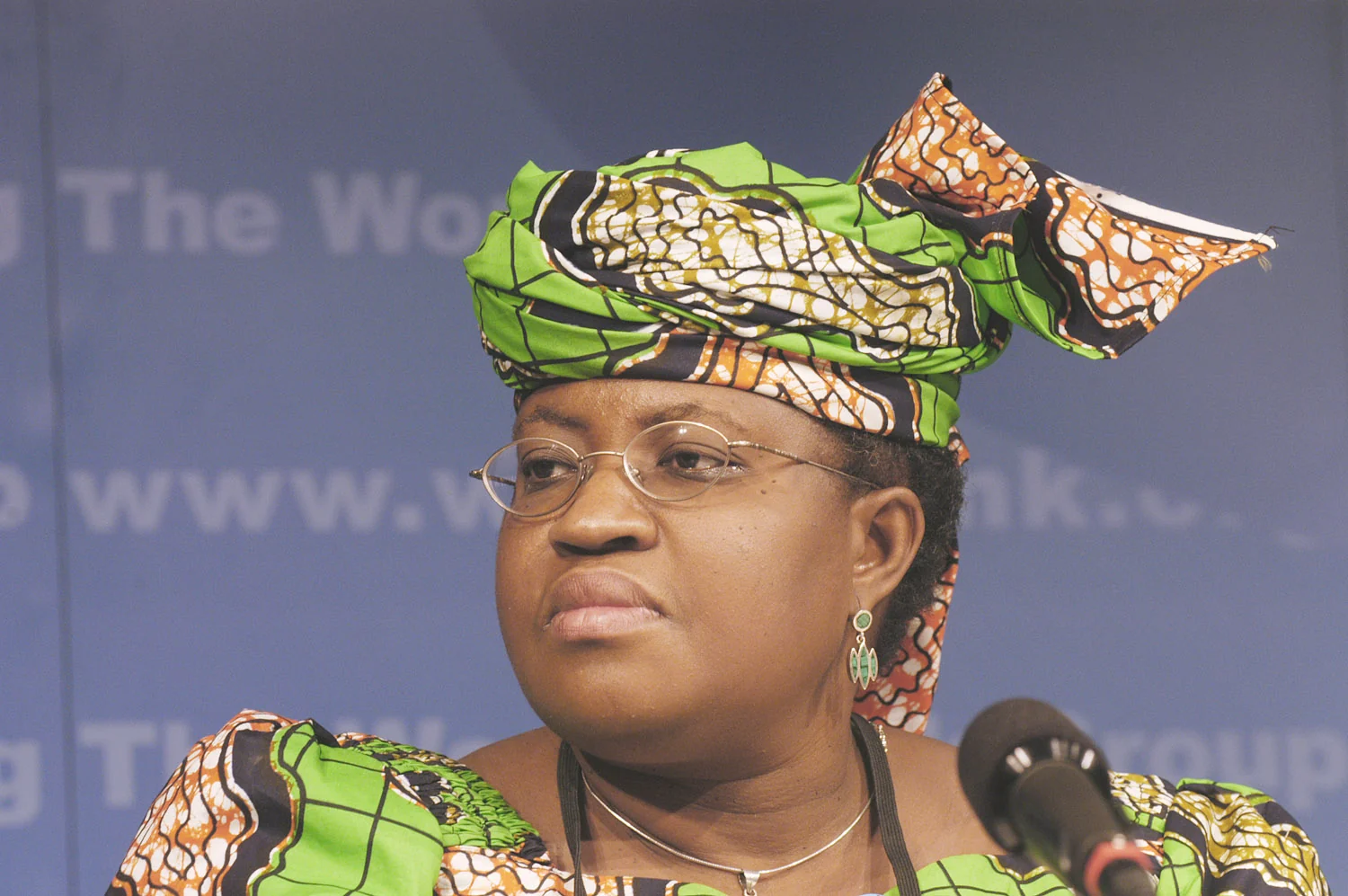
Ngozi Okonjo-Iweala
Economist, former Nigerian finance minister and WTO Director-GeneralNgozi Okonjo-Iweala is a Nigerian economist whose career links development banking, public finance and international trade. Twice Nigeria’s finance minister, she led its delegation in the 2005 Paris Club debt agreement and became the first woman and first African to head the World Trade Organization in 2021.Read biographyQuick answers
Common questions
- Was all US$30 billion simply written off?
- No. The agreement combined roughly US$18 billion in estimated cancellation with substantial Nigerian cash payments and a discounted buyback to extinguish the Paris Club obligations.
- Did the IMF lend Nigeria the money for this deal?
- The Policy Support Instrument was a monitoring and policy-support arrangement. Nigeria’s policy statement reiterated that it was not requesting IMF resources for that programme.
- Did Nigeria become entirely debt-free?
- No. Exiting Paris Club obligations did not erase domestic debt or every claim held by other external creditors.
- Why do published totals differ slightly?
- They may use different dates, currencies, interest conventions and levels of rounding, or describe an agreement estimate rather than final implementation. Each figure needs its own label and source.
- What is the answer to the payment exercise?
- US$12.4bn minus US$6.3bn equals US$6.1bn. These rounded plan figures illustrate components of one payment total, not three separate totals.
Primary and institutional sources
How this history was checked
Primary creditor terms, Nigerian administrative accounts, IMF programme records and parliamentary answers are compared by function. This is a historical explanation of a completed sovereign-debt operation; the table does not recommend a present financial decision. This article was reviewed on 27 October 2026.
- Paris ClubNigeria: debt treatment of 20 October 2005
- Paris Club / University of Texas Africa archiveParis Club press release of 20 October 2005, preserved contemporary reproduction
- Debt Management Office, NigeriaAnnual Report and Statement of Accounts 2005, chapter four
- Debt Management Office, NigeriaNigeria’s debt relief deal with the Paris Club: questions and answers
- International Monetary FundExecutive Board approves a two-year Policy Support Instrument for Nigeria (17 October 2005)
- International Monetary FundNigeria: First Review Under the Policy Support Instrument, Country Report 06/180
- International Monetary FundAnnual Report 2006, chapter 5: Nigeria and the first PSI review
- Moses Tule / Central Bank of Nigeria, presented to the G-24Nigeria’s Sovereign Debt Restructuring: Challenges and the Way Forward (2015)
- UK Parliament, HansardNigeria: written answer, 1 December 2005