In this biography
Quick facts
- Born
- 19 April 1957
- Birthplace
- Aden, then a British colony (present-day Yemen)
- Country
- India
- Nationality
- Indian
- Known for
- Reliance’s industrial integration, Jamnagar refining, consumer businesses and Jio’s telecommunications expansion
- Father
- Dhirubhai Ambani, founder of the Reliance enterprise
- Education
- Chemical engineering in Bombay; attended Stanford’s MBA programme without completing it
- Career dates
- Board appointment in 1977; formal operational return from Stanford in 1981
- Dated role check
- Reliance Industries chairman and managing director, checked 23 October 2026
Why this life matters
His life illuminates capital-intensive industrial growth and the movement of a family-controlled group into retail and digital services. It also raises questions about governance, competition and the difference between corporate scale and public benefit.
Timeline
Key moments
Born in Aden
Born on 19 April to Dhirubhai and Kokilaben Ambani; later grows up in Bombay.
Board and operational work
Joins Reliance’s board in 1977; leaves Stanford studies and returns for the polyester project in 1981.
Industrial integration
Works on polyester and petrochemical expansion, followed by the Jamnagar refinery complex.
Inheritance and division
Dhirubhai dies in 2002; a later family settlement divides management and businesses between Mukesh and Anil.
Consumer businesses
Reliance expands organized retail and later launches Jio’s mobile service.
Succession steps
Akash takes the Jio Infocomm chair in 2022; the children join RIL’s board in October 2023, while Mukesh remains RIL chairman and managing director at review.
A family trading enterprise formed his early setting
Mukesh Dhirubhai Ambani was born on 19 April 1957 in Aden, then a British colony and now part of Yemen. His parents were Dhirubhai and Kokilaben Ambani. The family later lived in Bombay, where Dhirubhai developed the trading and textile activities from which Reliance grew. Mukesh is the elder brother of Anil Ambani; their careers should not be merged.
He studied chemical engineering at the institution now known as the Institute of Chemical Technology in Mumbai and then attended Stanford’s MBA programme. He did not complete that programme. His recollections emphasize the influence of technical teachers, family expectations and exposure to business while still a student. Those recollections are useful testimony, while remaining his retrospective account.
A 1977 board appointment preceded his 1981 operational return
Reliance’s current official profile dates Ambani’s board service to 1977, and the contemporary annual report lists him among directors. That is compatible with accounts that he joined operational work formally in 1981. A board appointment and a later full-time project assignment are different events, not competing dates from which only one must be chosen.
In his 2007 interview he recalled leaving Stanford when his father began work on a polyester plant. He returned immediately rather than completing his proposed study and training plan, and worked under Rasikbhai Meswani. The distinction also prevents a misleading account of Reliance’s 1977 public offer: Dhirubhai led the established enterprise, while Mukesh’s major industrial responsibilities developed later.
Industrial integration connected textiles with refining
Reliance’s expansion moved backwards along the supply chain from textiles towards polyester fibres, petrochemicals and petroleum refining. Ambani became closely associated with those engineering projects. Instead of purchasing every input from outside producers, the group sought to build large production systems linking materials, energy, logistics and finished output.
Jamnagar in Gujarat became the most conspicuous example. Developed in the late 1990s and entering operation around the turn of the century, its refinery complex connected processing capacity with port, power and petrochemical infrastructure. Such facilities depended on engineers, contractors, workers, finance and regulatory approvals. They were major organizational projects, rather than a single executive’s personal technical invention or evidence that every expansion was risk-free.
The family division changed which Reliance businesses he controlled
Dhirubhai died in 2002, leaving the brothers at the centre of an enormous group. Their differences over control became public, and a settlement mediated by their mother in 2005 divided responsibilities and assets. Mukesh retained the core industrial business, while Anil received telecommunications, power and financial-services interests through the reorganization.
That history is essential when reading a company name beginning with Reliance. The later Reliance Industries group led by Mukesh and the businesses associated with Anil were not interchangeable. The succession case also illustrates how ownership, management authority and family relationships can pull in different directions. It should not be simplified into an assertion that either brother automatically inherited every enterprise bearing the name.
Retail and Jio brought the group into everyday consumer markets
Reliance’s retail business developed from 2006, building stores, procurement and distribution systems across several product categories. Jio’s mobile service followed in 2016, linking telecommunications infrastructure with a strategy of inexpensive data and digital services. These ventures differed from selling industrial materials: they required relationships with millions of consumers and large networks of suppliers and service staff.
Company reports describe their scale and ambitions, while independent coverage explains the commercial contest and family leadership. Corporate claims of universal inclusion should remain distinguishable from demonstrated outcomes. Low prices, network investment, competitive pressure, financing and customer experience are separate questions. Neither a large subscriber base nor Ambani’s public prominence alone settles how benefits and costs were distributed across the market.
Succession remains a process with specific corporate offices
In June 2022 Ambani stepped down as a director of Reliance Jio Infocomm, whose chairmanship passed to Akash. Proposals to bring Isha, Akash and Anant onto the Reliance Industries board were announced in August 2023; the governance report records their actual appointments on 27 October. Announcing a plan and completing its corporate implementation were distinct steps.
At the 23 October 2026 review, Reliance’s board page and its 2025–2026 chairman’s statement still identify Mukesh as chairman and managing director of RIL. The movement of responsibilities to the next generation therefore does not mean he has retired from that office. His record is best assessed through the businesses and governance arrangements he helped build, using dated evidence rather than changing personal-wealth rankings or promises of future investment returns.
Quick answers
Frequently asked questions about Mukesh Ambani
- Did Mukesh Ambani found Reliance?
- No. His father Dhirubhai developed the founding enterprise. Mukesh later expanded its industrial and consumer businesses.
- Did he join Reliance in 1977 or 1981?
- The official profile dates his board appointment to 1977. His own account and historical profiles date his formal operational return from Stanford to 1981.
- Does he hold a Stanford MBA?
- He attended the MBA programme but left before completing it to return to Reliance. The current corporate profile says he pursued the degree.
- Has he retired from Reliance Industries?
- At the 23 October 2026 review, official sources still identify him as RIL chairman and managing director. His 2022 departure from Jio Infocomm’s board was a separate change.
Keep exploring
Lives connected to this story
- Ratan Tata
Compare Reliance’s industrial integration with Tata’s international acquisition strategy and different ownership institutions.
- Azim Premji
Compare leadership succession in established Indian businesses with different histories of diversification and family control.
Sources and further reading
Explore the evidence
These references support the biography and offer further reading. Official records, first-person accounts and independent reporting provide different perspectives; image records document attribution and licensing.
- 1. Reliance IndustriesMukesh D. Ambani: current official chairman profile
- 2. CNN Editorial Research / WRALMukesh Ambani Fast Facts: family, education and career chronology
CNN’s dated biographical research supports Aden, birth date and incomplete Stanford study; no old wealth estimate is reused. An obsolete UN profile gives Mumbai and an MBA, contrary to the corroborated biography and his own account; it is not used as an authority.
- 3. Rediff / Sucheta DalalMukesh Ambani on childhood, study and his 1981 return, 17 January 2007
- 4. Reliance IndustriesCorporate history: industrial and consumer-business milestones
- 5. Reliance Textile IndustriesAnnual Report 1976–1977: directors and offer for sale
The contemporary directors page includes Mukesh, while his 2007 testimony explains formal operational work in 1981. These events are not conflated.
- 6. NYU Stern / Ajay Bhalla and Joseph LampelSuccession in Indian Family Firms: Reliance case
Selected family-succession case passages supply the 2005 division; the paper’s inaccurate shorthand for a completed Stanford MBA is not repeated.
- 7. ReutersReliance appoints Ambani children: succession proposals, 28 August 2023
Reuters reports the August 2023 succession announcement. The actual October appointment date comes from the corporate governance table.
- 8. ReutersMukesh steps down at Reliance Jio Infocomm, 28 June 2022
- 9. Reliance Industries2023–2024 governance report: actual October 2023 appointment dates
- 10. Reliance IndustriesChairman and Managing Director’s Statement, 27 May 2026
- 11. Reliance IndustriesCurrent Board of Directors
- 12. Reliance Industries2019–2020 management discussion: retail operating model
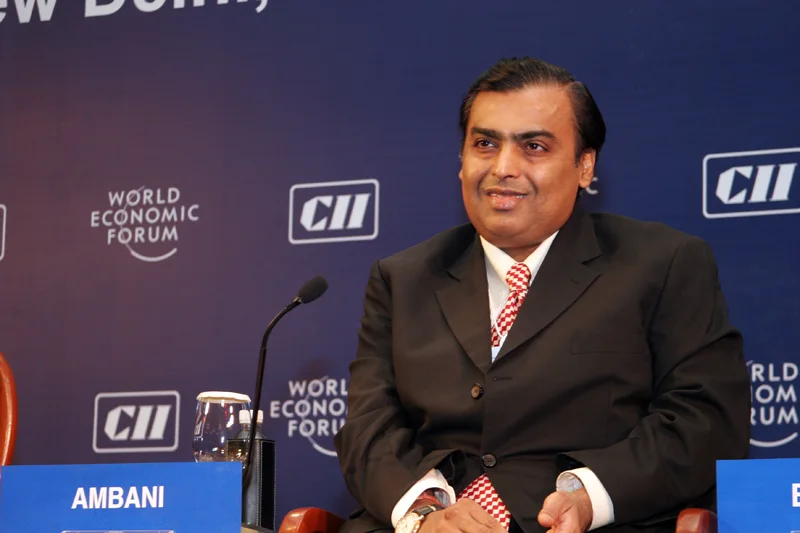
- 13. World Economic Forum / Wikimedia CommonsMukesh Ambani, complete India Economic Summit photograph, 2 December 2007
The exact WEF file preserves the complete 800 × 533 frame; a separate cropped and rotated Mukesh_Ambani.jpg derivative was rejected.
- 14. Creative CommonsAttribution-ShareAlike 2.0 Generic licence