
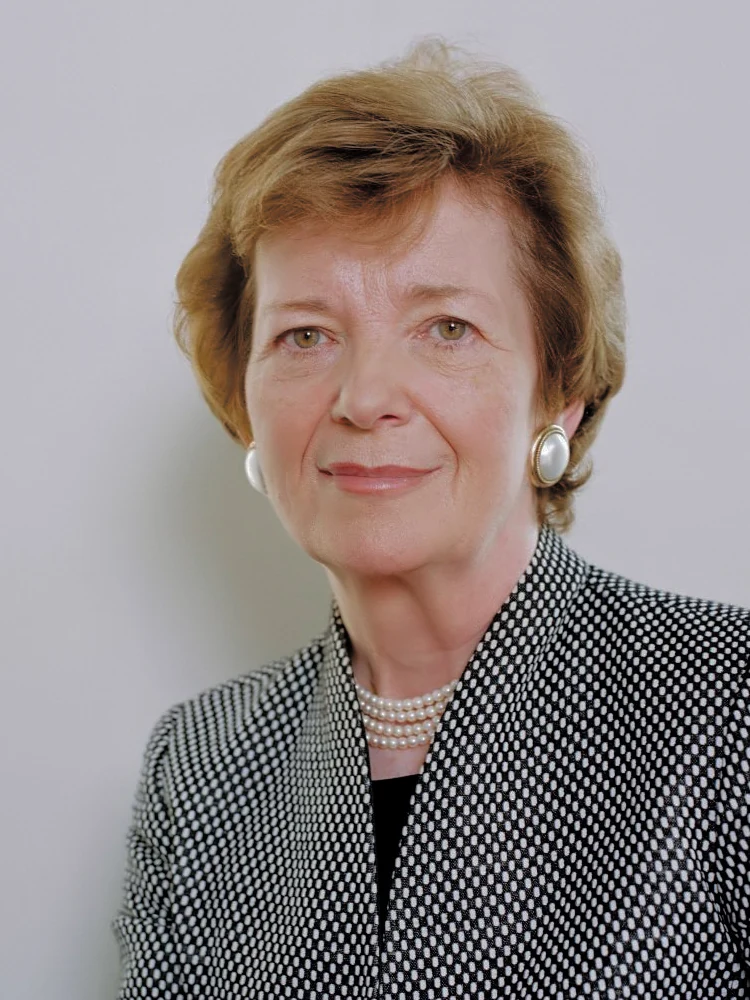
In this biography
Quick facts
- Born
- 21 May 1944
- Birthplace
- Ballina, County Mayo, Ireland
- Country
- Ireland
- Nationality
- Not independently established
- Known for
- Ireland’s first woman president, human rights advocacy and climate justice
- President of Ireland
- 3 December 1990–12 September 1997
- UN High Commissioner for Human Rights
- 1997–2002
- Seanad service
- University of Dublin constituency, 1969–1989
- The Elders
- Founding member in 2007; chair from 2018 to 2024
Why this life matters
Her career widened the public meaning of Ireland’s presidency and connected rights advocacy with questions of exclusion, international responsibility and climate inequality.
Timeline
Key moments
Born in Ballina
Born on 21 May in County Mayo.
Law and parliamentary service
Represents the University of Dublin in Seanad Éireann alongside a legal and academic career.
European law institution
Co-founds the Irish Centre for European Law with Nicholas Robinson.
President of Ireland
Inaugurated on 3 December 1990; resigns on 12 September 1997.
UN human rights office
Serves as High Commissioner for Human Rights.
The Elders and climate advocacy
Becomes a founding Elder, later chairing the group from 2018 until 2024.
Law, education and parliamentary work
Mary Robinson was born in Ballina, County Mayo, on 21 May 1944. She studied law at Trinity College Dublin and became a barrister and academic. Appointed Reid Professor of Criminal Law at twenty-five, she developed a public career that combined legal argument with elected office. From 1969 to 1989 she represented the University of Dublin constituency in Seanad Éireann, Ireland’s upper parliamentary house.
That combination matters to her later reputation. Her route to the presidency ran through universities, courts and the legislature, where arguments about individual rights could challenge established social practices. European law also became part of her teaching and professional work.
Changing the terms of Irish public debate
Robinson supported reforms concerning contraception, divorce and the decriminalisation of homosexuality. RTÉ’s archival account also identifies campaigning over women’s jury service and the civil service marriage bar. These subjects brought questions of private life, citizenship and equal treatment into public institutions. Her contribution belonged to wider campaigns and legislative processes; their eventual outcomes cannot be assigned to one advocate alone.
She also served on Dublin City Council from 1979 to 1983. In 1988 she and her husband, Nicholas Robinson, founded the Irish Centre for European Law, connecting her professional interest in European institutions with legal education in Ireland.
A presidency with a wider public audience
Elected in 1990, Robinson was inaugurated as Ireland’s seventh President on 3 December and became the first woman to hold the office. She used its representative platform to speak about inclusion and Ireland’s connections beyond its borders. The candle placed in a window of Áras an Uachtaráin acknowledged Irish emigrants and gave a visible form to that concern.
Humanitarian visits also extended the presidency’s audience. Her travels to Somalia during the 1992 crisis and to Rwanda after the 1994 genocide drew attention to suffering outside Ireland. This public advocacy was an important part of her presidency, alongside its formal constitutional responsibilities.
The United Nations and contested international advocacy
Robinson resigned the presidency on 12 September 1997 to take up the United Nations human rights appointment. Her service as High Commissioner ran from 1997 to 2002. The position placed her advocacy within an international institution, dealing with governments and civil society rather than representing Ireland as head of state.
The difficulties of that work were visible around the 2001 Durban conference against racism. At a December UN media forum, she acknowledged that the event had been flawed while defending the opportunities it gave excluded groups to be heard. The contemporary record captures both ambition and contention; it does not support an account of uncomplicated diplomatic success.
Climate justice and work after public office
Robinson became a founding member of The Elders in 2007. Subsequent UN envoy assignments included the Great Lakes region of Africa and climate change. Her climate advocacy connected environmental change with unequal exposure to harm and the position of poorer communities. The Mary Robinson Foundation – Climate Justice operated under her leadership from 2010 until its planned closure in 2019.
She chaired The Elders from 2018 until stepping down in 2024. These later activities continued a concern present in her earlier career: who participates in decisions, whose interests receive attention, and how institutions can answer people who otherwise struggle to be heard.
Sources for this section: [6]
Quick answers
Frequently asked questions about Mary Robinson
- Who is Mary Robinson?
- Mary Robinson is a lawyer, former President of Ireland and former UN High Commissioner for Human Rights. Her career widened the public meaning of Ireland’s presidency and connected rights advocacy with questions of exclusion, international responsibility and climate inequality.
- What is Mary Robinson best known for?
- Mary Robinson is best known for ireland’s first woman president, human rights advocacy and climate justice.
- When and where was Mary Robinson born?
- Mary Robinson was born on 21 May 1944 in Ballina, County Mayo, Ireland.
Keep exploring
Lives connected to this story
- Kate Sheppard
Compare gaining the parliamentary vote in New Zealand with a later Irish woman’s route to head-of-state office.
- Corazon Aquino
Compare a different presidency and route to national political leadership; the constitutional offices and historical settings differ.
- Kim Dae-jung
Compare human-rights advocacy and elected leadership through another country’s democratic transition.
- John Hume
Compare a different Irish political career focused on civil rights and negotiated peace.
- Éamon de Valera
Explore the leader of the 1937 constitutional project and a later holder of the presidency, keeping those historical roles distinct.
- Constance Markievicz
Provide earlier context on women’s elected and executive offices with an explicit distinction between constitutional systems.
- Mary McAleese
Compare the next president’s two terms, legal background and use of the office for reconciliation.
Sources and further reading
Explore the evidence
These references support the biography and offer further reading. Official records, first-person accounts and independent reporting provide different perspectives; image records document attribution and licensing.
- 1. President of IrelandMary Robinson: official former-president record
Official presidency record establishes birthday, birthplace, Seanad years, inauguration and resignation. It does not make later UN office an Irish presidency.
- 2. Court of Justice of the European UnionMary Robinson Space: legal and public career
- 3. RTÉ ArchivesMary Robinson: historical profile
Read indexed historical profile; direct live retrieval returned 403. Its present-tense chancellorship and foundation descriptions are outdated and are not adopted.
- 4. United Nations Library and Archives GenevaHuman Rights Timeline: High Commissioners
- 5. United NationsHuman Rights Commissioner at the UN media forum, 6 December 2001
Read indexed contemporary forum report; direct retrieval timed out. Robinson’s own evaluation is attributed. No complete Durban proceedings survey or single-person allocation of responsibility is claimed.
- 6. The EldersMary Robinson: career, climate advocacy and former chairmanship
Directly reviewed dated career entries and 2024 chair transition. This institutional biography supplies historical activity, not independent proof of every claimed impact. Older Robinson Centre copy still calls her current chair; it is not used.