
In this biography
Quick facts
- Born
- 2 June 1899
- Died
- 19 June 1981
- Birthplace
- Berlin-Charlottenburg, Germany
- Country
- United Kingdom
- Nationality
- Not independently established
- Known for
- The Adventures of Prince Achmed.
Why this life matters
Her craft joins performance and graphic design: a small change in a joint can become a readable gesture, while the ensemble of makers and apparatus gives that gesture screen time.
Timeline
Key moments
Animated feature
The Adventures of Prince Achmed.
Explaining the craft
Scissors make films.
A theatre artist finds a camera
Charlotte Reiniger grew up in Berlin with an interest in shadow theatre and cutting paper figures. Paul Wegener’s films encouraged her ambitions. Theatre training, actor silhouettes and decorative film titles led her toward the experimental circle at the Institut für Kulturforschung.
Her first silhouette short, Das Ornament des verliebten Herzens, appeared in 1919. She married filmmaker Carl Koch in 1921; their working partnership would shape the rest of her career.
A feature made by a small group
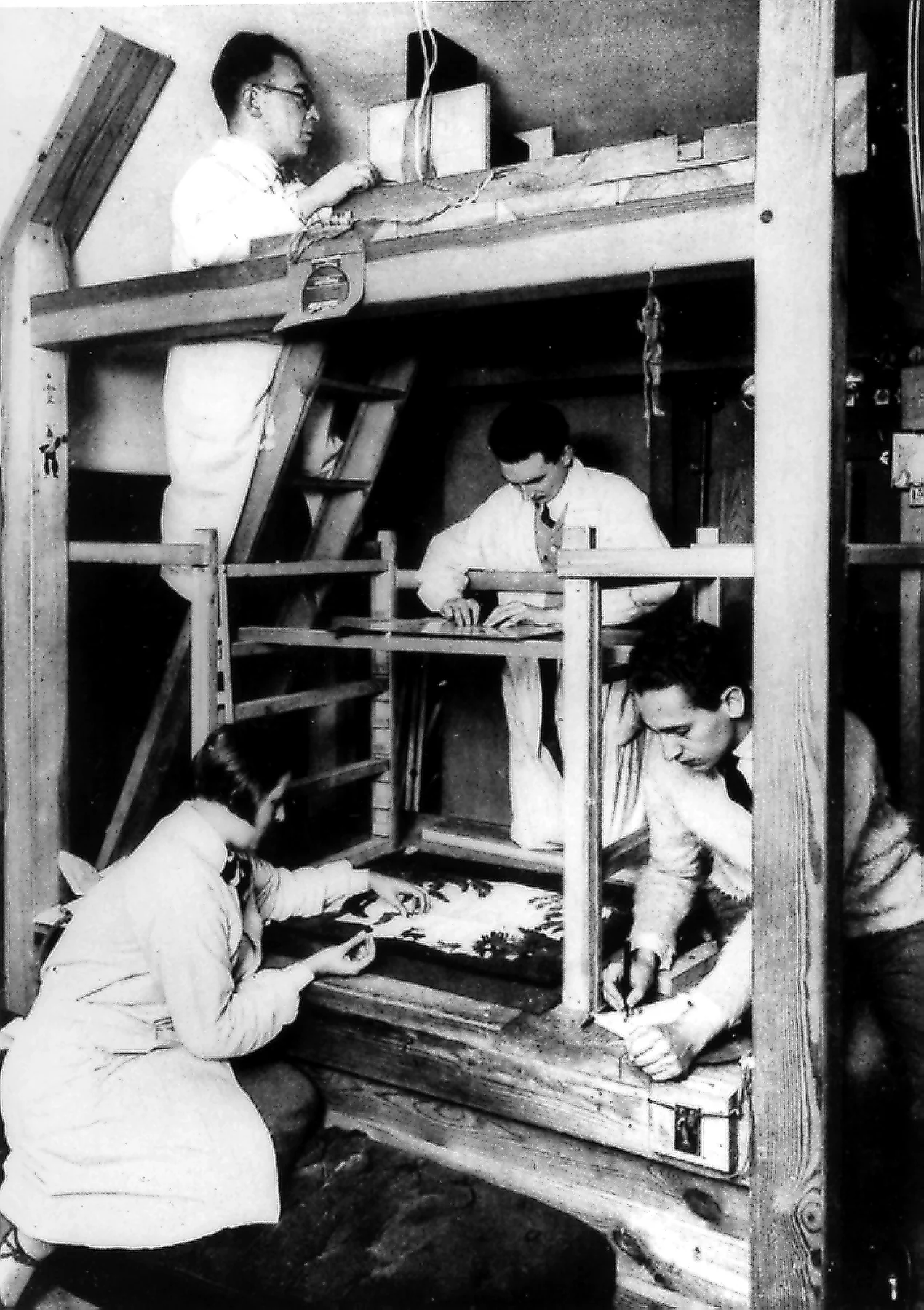
Louis Hagen financed a studio for The Adventures of Prince Achmed, made between 1923 and 1926. Reiniger’s collaborators included Koch, Walter Ruttmann, Berthold Bartosch, Alexander Kardan and Walter Türck. The result built a feature-length fantasy through cut-out animation rather than photographed actors.
A planned Doctor Dolittle series ran short of finance and yielded only three shorts. Papageno later joined her taste for Mozart to the possibilities of sound cinema.
The unfinished ambition matters alongside the famous success. A distinctive technique did not remove the need for money, assistants, distribution or a workable scale.
Migration and a British working base
Nazi-era restrictions and persecution of Jewish friends helped drive Reiniger and Koch abroad. Visa difficulties produced years moving between European cities, followed by wartime returns. They finally settled in London after the war.
British work included the Crown Film Unit, puppet-theatre design and Primrose fairy-tale shorts. Reiniger’s films adapted tales, myths and opera; commissions made the practice sustainable without requiring every production to become another feature.
Teaching and making in later life
Later films included The Lost Son and Aucassin and Nicolette.
After Koch’s death in 1963 she continued demonstrations, workshops and international travel. The Rose and the Ring belonged to her late Canadian work. She moved to Dettenhausen in 1980 and died there the following year.
Her own 1936 essay describes jointed silhouettes photographed one position at a time, with careful preparation for music.
That description makes her achievement tangible. The paper object is only one part of the invention; timing and the ability to suggest a character through a legible outline are equally important.
Quick answers
Frequently asked questions about Lotte Reiniger
- Who was Lotte Reiniger?
- Lotte Reiniger was a silhouette animator and director. Her craft joins performance and graphic design: a small change in a joint can become a readable gesture, while the ensemble of makers and apparatus gives that gesture screen time.
- What is Lotte Reiniger best known for?
- Lotte Reiniger is best known for the Adventures of Prince Achmed..
- When and where was Lotte Reiniger born?
- Lotte Reiniger was born on 2 June 1899 in Berlin-Charlottenburg, Germany.
- When did Lotte Reiniger die?
- Lotte Reiniger died on 19 June 1981.
Keep exploring
Lives connected to this story
- Norman McLaren
Explore another maker’s wider working life.
- Walt Disney
Explore another maker’s wider working life.
- Alison de Vere
Read Alison de Vere for a separate, documented example of animation production and artistic collaboration. This is a contextual comparison, not an assertion of personal collaboration.
Sources and further reading
Explore the evidence
These references support the biography and offer further reading. Official records, first-person accounts and independent reporting provide different perspectives; image records document attribution and licensing.
- 1. DFF / filmportal.deLotte Reiniger: biography
- 2. Philipp Bühler / Bundeszentrale für politische BildungLotte Reiniger
The consulted biographies vary between 1948 and 1949 for final settlement; the body uses postwar wording.
- 3. Christel Strobel / LotteReiniger.deLotte Reiniger: Porträt einer Filmpionierin
Production and collaborator history; first-ever-animated-feature shorthand is not adopted.
- 4. Lotte Reiniger / Sight and Sound, Spring 1936; BFI reprintScissors make films
A dated practitioner account, not an exact production log for the earlier silent feature.