
The short answer
A hand can reach, hesitate and withdraw without a single facial expression. Planning that action means deciding what changes between photographs and what the viewer needs time to recognise.
Compare production decisions
Separate the stages of the work
Use the distinctions to plan an action or explain an editorial choice.
| Stage | Decision to identify | A mistake to avoid |
|---|---|---|
| Joint | Which movement is physically possible? | Confusing articulation with timing. |
| Pose | Can the action be read in outline? | Counting every exposure as a different pose. |
| Exposure | How long is each state visible? | Forgetting that the added hold extends an existing pose. |
Chronology
A timeline of the turning points
Practitioner essay
An articulated cut-out workflow.
What the maker actually described
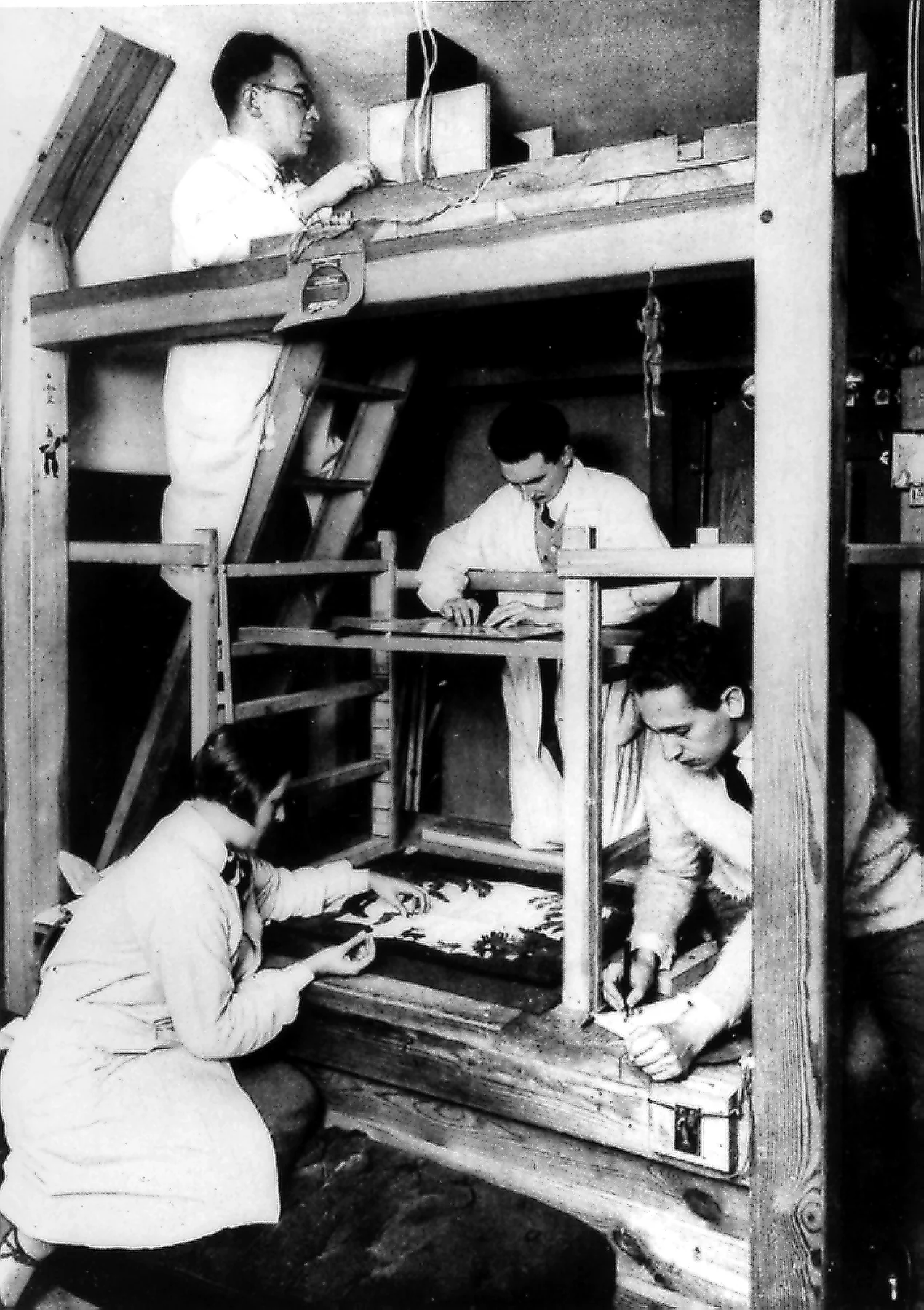
In her 1936 account, Reiniger describes separate limbs joined with wire, transparent-paper settings on a backlit glass table and a camera advancing one frame at a time. Hands move the figures between exposures.
This separates three things that are easily confused: the physical joint permits a change, the pose specifies an arrangement, and the exposure records it. A beautifully constructed puppet cannot decide its own timing.
Sources for this section: [1]
A later account beside a production history
The production history of Prince Achmed names a team around Reiniger, including Carl Koch and Berthold Bartosch. That collective work belongs beside the maker’s concise explanation of the apparatus.
Her essay also describes measuring a recorded soundtrack before photographing the picture. That is a 1936 workflow, not proof that the earlier silent feature was made to that same pre-recorded track.
The comparison gives a practical warning: a general explanation of a craft can clarify a mechanism without documenting every earlier production. Use it to plan your own action, while retaining the date and purpose of the account.
Original exercise: a hesitant hand
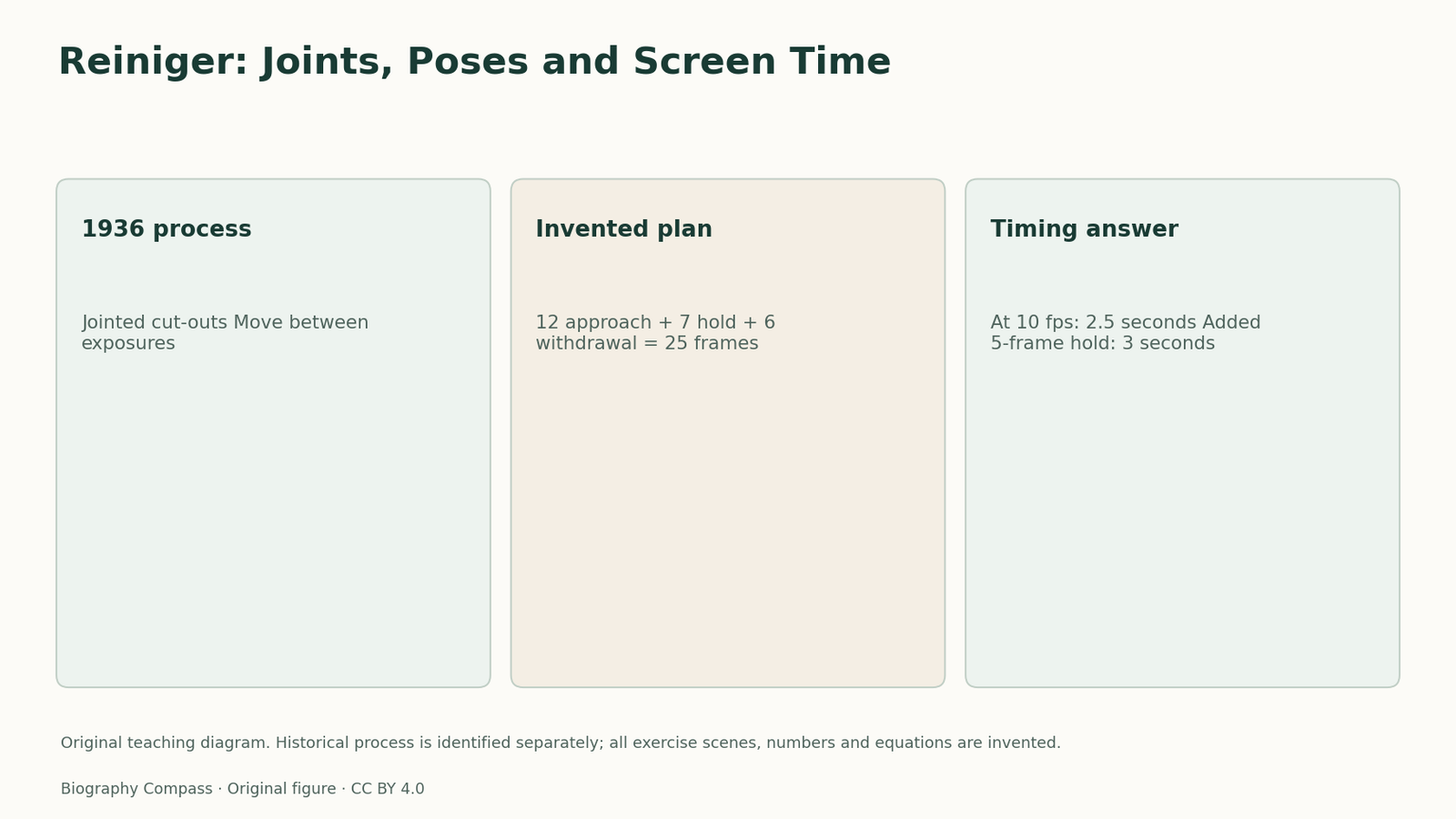
Invent a flat cut-out character reaching toward a door, pausing and withdrawing. At a stipulated playback rate of 10 frames per second, use 6 changing poses, each held for 2 exposures; repeat the final reaching pose for 7 additional exposures; then use 6 withdrawal poses at 1 exposure each. How long does the sequence last? Which single change would lengthen the hesitation while preserving the approach and withdrawal?
Before calculating, draw the outline at the point of maximum reach. Check that the hand does not disappear into the torso. This is an original design test, not a traced pose or measured passage from a Reiniger film.
Reference answer and a revision
The approach uses 12 frames, the added hold 7 and the withdrawal 6, giving 25 frames, or 2.5 seconds at the stipulated rate. The held reaching pose occupies 9 frames in total because its original 2 exposures remain. Adding another 5 hold frames gives 30 frames, or 3 seconds, without changing the moving parts of the plan.
That numerical answer does not guarantee a convincing hesitation. A hand touching the door may communicate arrival rather than doubt; a slight gap or change in body angle could communicate a suspended intention. State what the audience should recognise, then revise the silhouette and timing together. A hold repeats an exposure state; it need not require a newly cut puppet or a new pose.
Continue the chronology
Related history guides
Biography context
Explore United Kingdom through connected lives
Connected biographies
The maker’s wider career
1899–1981
Lotte Reiniger
Silhouette animator and directorSilhouettes made fairy tales move.Read biographyQuick answers
Common questions
- Are the 10 fps and 25 frames historical measurements?
- No. They are stipulated inputs for an original planning exercise.
Primary and institutional sources
How this history was checked
A dated practitioner account is compared with a collaborator-focused production history. No film passage is reproduced or claimed to have been watched. This article was reviewed on 31 October 2026.