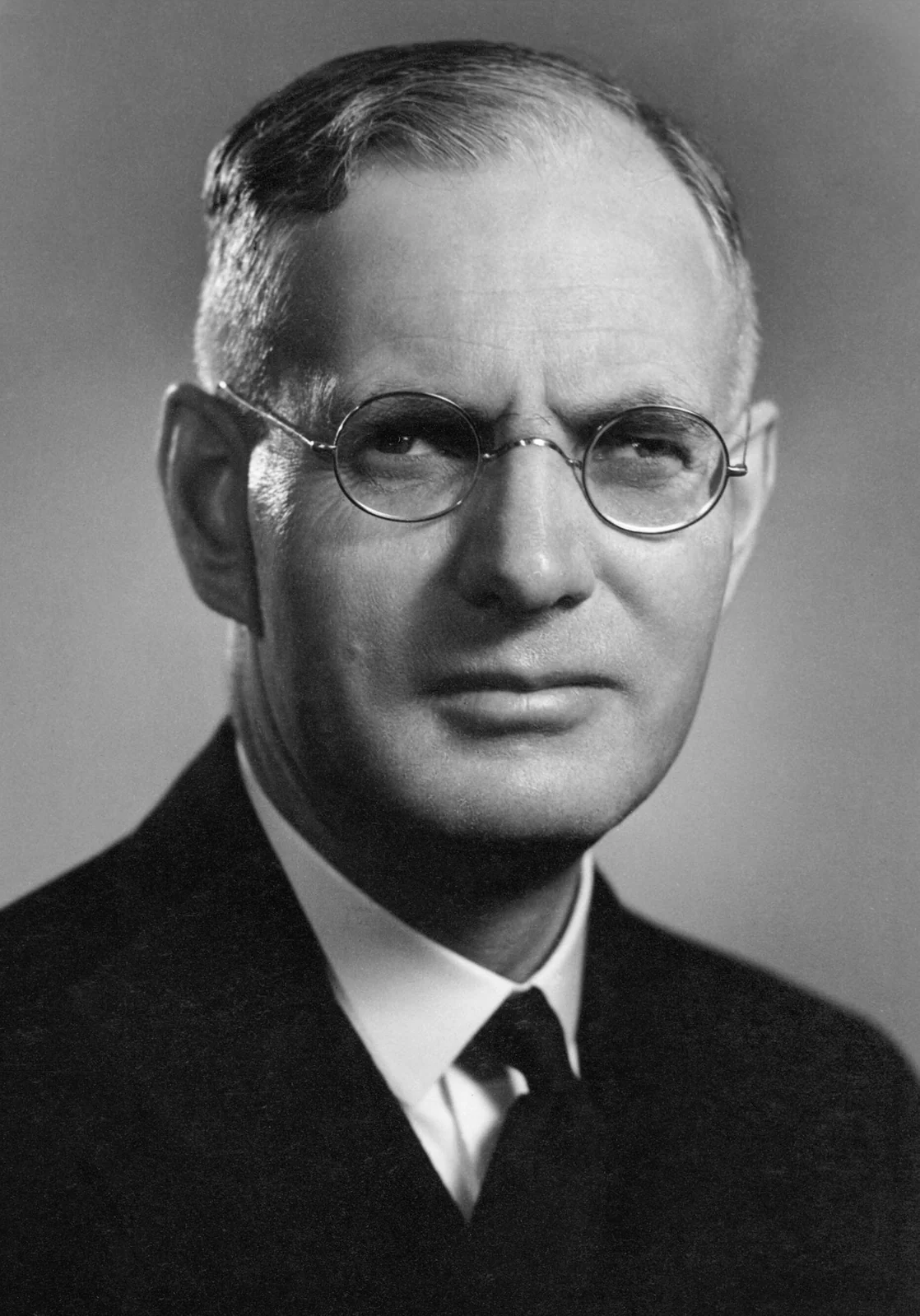
In this biography
Quick facts
- Born
- 1900
- Died
- 1980
- Birthplace
- Chiltern, Victoria
- Country
- Australia
- Nationality
- Not independently established
- Known for
- Negotiating trade arrangements while defending Australian industry and leading the Country Party within coalition governments
Why this life matters
Negotiating trade arrangements while defending Australian industry and leading the Country Party within coalition governments.
Timeline
Key moments
Birth
John McEwen was born in Chiltern, Victoria.
Parliament
Entered federal Parliament.
Trade agreement
Signed the commerce agreement with Japan.
Caretaker office
Served briefly as prime minister.
Death
John McEwen died in 1980.
Early loss led to work and a farming career
John McEwen was born in Chiltern, Victoria, in 1900. After the deaths of his parents, his grandmother raised him and his sister. He left school young but continued studying at night and entered Commonwealth clerical employment. His 1918 military enlistment ended without overseas combat after the Armistice. It nevertheless made him eligible for soldier-settlement assistance. Farming in Victoria, with financial and practical difficulties, became a formative part of his life. His later political identity grew from that rural experience rather than from a career wholly inside government.
Sources for this section: [1]
Country Party politics connected producers with Canberra
McEwen entered federal Parliament in 1934 and held several portfolios, including Interior, External Affairs, Air and Civil Aviation. His longest influence developed through commerce, trade and industry. He advocated protection for Australian manufacturing while also seeking markets for primary producers. These were not automatically harmonious objectives. A government supporting exports could face resistance from domestic industries concerned about imports. His political significance lies partly in managing that tension within the Country Party and coalition governments.
The Japan agreement combined access with protection
The 1957 commerce agreement with Japan was a major part of McEwen’s trade record. The text established non-discriminatory treatment while retaining defined exceptions and safeguards. Its signatures include McEwen, Australian official A.S.Watt and Japan’s Kishi. The document therefore records a negotiated governmental arrangement, not a promise of completely unrestricted trade. Its practical importance can be understood through its mechanisms: treatment of like products, rules affecting restrictions and consultation when domestic producers faced injury. Those provisions connect his trade diplomacy with his continuing concern for local industry.
A brief premiership followed a long ministerial career
McEwen became Country Party leader and deputy prime minister in 1958. After Harold Holt’s disappearance, he served as caretaker prime minister from December 1967 to January 1968. That short period should not overshadow decades of ministerial work. He retired from politics in 1971 and died in 1980. His legacy includes both rural representation and the industrial policy often associated with his name. Studying the actual trade agreement makes that combination clearer: international commercial relationships were expanded through negotiated rules while governments retained instruments intended to protect domestic interests.
Quick answers
Frequently asked questions about John McEwen
- Was the 1957 agreement a promise of tariff-free trade?
- No. It established treatment rules and retained exceptions and safeguards rather than eliminating every tariff.
- Why is McEwen associated with both trade and protection?
- His policy sought export markets and international agreements while preserving support for Australian producers.
Keep exploring
Lives connected to this story
- Robert Menzies
Explore Robert Menzies’s separate career as constitutional lawyer, liberal party organiser and two-time prime minister; compare the work and institutions in context.
- Nobusuke Kishi
Explore Nobusuke Kishi’s separate career as economic bureaucrat and postwar prime minister; compare the work and institutions in context.
- John Curtin
Read John Curtin’s documented work and the related study: Australia’s 1942 Adoption Act: Why 1939 Also Matters.
- Joseph Lyons
Read Joseph Lyons’s documented work and the related study: The United Australia Party in 1931: Formation before Office.
Sources and further reading
Explore the evidence
These references support the biography and offer further reading. Official records, first-person accounts and independent reporting provide different perspectives; image records document attribution and licensing.
- 1. C.J.Lloyd / Australian Dictionary of BiographyMcEwen, Sir John
- 2. National Museum of AustraliaJohn McEwen
- 3. National Portrait Gallery, AustraliaJohn McEwen
- 4. Original 1957 treaty / Department of Foreign Affairs and TradeAgreement on Commerce between Australia and Japan, document 221
- 5. General Agreement on Tariffs and TradeGATT L/1545: treatment of Japanese products