In this biography
Quick facts
- Born
- 1961
- Birthplace
- Seaforth, Ontario, Canada
- Country
- Canada
- Nationality
- Not independently established
- Known for
- Commercial leadership of Research In Motion and BlackBerry, CIGI and advocacy on innovation and digital governance
- Joined RIM
- 1992, eight years after the company’s incorporation
- Education
- University of Toronto BCom, 1984; Harvard MBA, 1989
- Co-CEO departure
- January 2012; board resignation announced in March 2012
- Public-policy institution
- CIGI, founded in Waterloo in 2001 with private endowment funding and later public support
Why this life matters
His career explains the commercial and institutional work behind a Canadian technology company, including corporate-governance failures and the distinction between building a business and shaping public policy.
Timeline
Key moments
Ontario and business education
Born in Seaforth in 1961, grows up in Peterborough, earns a Toronto commerce degree in 1984 and Harvard MBA in 1989.
Joins an existing technology company
Invests in Research In Motion and becomes co-CEO alongside Mike Lazaridis.
BlackBerry commercialization
RIM launches its integrated mobile-email offering, supported by sales, carrier and corporate-software relationships.
CIGI takes shape
The institute begins in 2001 with an endowment from Balsillie and Lazaridis; matching federal support follows in 2003.
Options settlement
The OSC approves a settlement concerning stock-option practices, including financial sanctions and a restriction on Balsillie’s directorships.
Beyond RIM management
Leaves executive leadership and then the board in 2012; later institutional profiles record research, investment and digital-policy roles.
Commerce, accounting and an operating-business education
Jim Balsillie was born in Seaforth, Ontario, in 1961 and grew up in Peterborough. The publisher’s excerpt from Jacquie McNish and Sean Silcoff’s Losing the Signal describes childhood jobs, sporting interests and his determination to enter the business world. The evidence consulted supports the year of birth; a complete birthday is not supplied here merely because it circulates online.
He completed a University of Toronto commerce degree in 1984 and a Harvard MBA in 1989. In a Canada School of Public Service interview, he describes working in Clarkson Gordon’s entrepreneurial-services group and then taking an operating role at Sutherland-Schultz. His account emphasizes learning how a business runs, rather than moving directly into a large financial institution after business school.
He joined RIM in 1992, not at its 1984 founding
Balsillie invested in Research In Motion and joined as co-CEO in 1992. Mike Lazaridis and Doug Fregin had founded the business in 1984. Calling Balsillie a co-founder is common in later honorary biographies, but it obscures this eight-year distinction. His importance lies in helping expand an existing engineering enterprise, not in being present at its incorporation.
CIGI’s historical biography identifies his responsibilities as corporate strategy, business development, marketing, sales and finance. Lazaridis remained particularly associated with technology. Balsillie later recalled mortgaging a house to join the small company. Published accounts differ on the exact amount he initially invested, so this biography does not present one contested figure as settled fact.
BlackBerry grew through a service and distribution system
BlackBerry’s January 1999 introduction linked a keyboard-equipped handheld to email software and wireless data service. RIM’s annual reports make clear that selling the device was only part of the business. Corporate adoption also depended on support, billing, carriers and resellers that already worked with organizations using Microsoft Exchange.
This setting explains Balsillie’s commercial role without crediting him with inventing the hardware or software alone. The company developed a global brand under the two executives, but its growth also required engineering, manufacturing and partner organizations. Revenue and subscriber totals belong to dated company financial periods, not to a permanent description of either man’s personal achievement.
The stock-option case brought real governance consequences
An Ontario Securities Commission settlement approved in February 2009 concerned improper stock-option practices at RIM. The published reasons describe substantial financial sanctions against Balsillie, Lazaridis and former finance executive Dennis Kavelman, together with payments towards investigation costs. The matter cannot be omitted from a biography simply because the company was commercially successful.
Balsillie undertook not to act as a director of a reporting issuer until at least twelve months after the order and until specified governance conditions were met. The company also underwent an independent governance review. These were securities-regulatory consequences; describing them as a criminal conviction, or asserting that all participants faced identical sanctions, would misstate the record.
Executive and board departures were separate events
RIM announced on 22 January 2012 that Thorsten Heins would replace Lazaridis and Balsillie as CEO. Its release presented the change as a succession plan, while Reuters reported investor pressure, competitive losses to Apple and Android, product problems and the previous year’s service outage. Both the official explanation and that wider business context matter.
Balsillie initially remained a director. His board resignation was announced with quarterly results in March 2012, whereas Lazaridis continued on the board until 2013. The two men therefore did not leave every office at the same moment. Later accounts of disagreements over BlackBerry strategy should be attributed to their speakers rather than treated as proof of a single cause for the company’s decline.
Public-policy work and dated current responsibilities
Balsillie founded the Centre for International Governance Innovation in Waterloo in 2001. CIGI’s history records an initial C$30 million endowment: C$20 million from him and C$10 million from Lazaridis. Matching federal funding followed in 2003. Its later development, and the Balsillie School of International Affairs, involved universities, governments and other partners rather than one donor acting alone.
As consulted on 23 October 2026, CIGI’s biography identifies him as its chair and a co-founder of the Council of Canadian Innovators and Institute for New Economic Thinking. It also lists investment and digital-rights activities. His arguments about data, intellectual property and commercialization are policy positions to examine, not neutral findings established by his former corporate title. He is not described here as BlackBerry’s current CEO.
Quick answers
Frequently asked questions about Jim Balsillie
- When did Jim Balsillie join BlackBerry?
- He joined Research In Motion, the company later renamed BlackBerry, in 1992. The company had been incorporated in 1984, and the BlackBerry mobile-email offering arrived in 1999.
- What did Balsillie do at RIM?
- He shared executive leadership with Mike Lazaridis and had responsibilities including corporate strategy, business development, marketing, sales and finance.
- Did he leave the board when he stepped down as co-CEO?
- Not immediately. He remained a director after the January 2012 executive change; his board resignation was announced in March.
- Did Jim Balsillie fund CIGI alone?
- No. Its institutional history records founding endowment contributions from both Balsillie and Lazaridis, followed by matching federal funding and other support.
Keep exploring
Lives connected to this story
- Mike Lazaridis
Follow RIM’s original engineering co-founder, the partner whose executive and board departures occurred on a different timetable.
- N. R. Narayana Murthy
Compare another technology business where founder reputation, professional management and governance disputes require separate scrutiny.
Sources and further reading
Explore the evidence
These references support the biography and offer further reading. Official records, first-person accounts and independent reporting provide different perspectives; image records document attribution and licensing.
- 1. Jacquie McNish and Sean Silcoff / Flatiron BooksLosing the Signal: publisher’s excerpt on Seaforth, Peterborough and education
Read the public publisher excerpt for Seaforth, 1961 and Peterborough. Sensitive family anecdotes are not repeated unnecessarily. This is a selected excerpt rather than a claim to have read the whole book.
- 2. University of Toronto / Rotman School6 June 2023: BCom 1984 alumni record
- 3. Harvard Business SchoolSending a Message, June 2006: MBA 1989 and the NTP settlement
- 4. Canada School of Public ServiceReflections by Jim Balsillie: transcript on accounting, Sutherland-Schultz, RIM and data policy
Read the transcript’s accounting, Harvard, Sutherland-Schultz, early RIM and strategy passages. These are Balsillie’s retrospective recollections, not independent adjudications of the causes of BlackBerry’s decline.
- 5. Centre for International Governance InnovationHistorical founder biography: joined RIM as co-CEO in 1992 and commercial responsibilities
Dated archival biography explicitly places the co-CEO appointment in 1992. It is historical evidence for that date and job division, not a current-office directory.
- 6. Research In Motion / AnnualReports archiveAnnual Report 1999: incorporation, radio modems, pagers, January launch and optional Enterprise Server
- 7. Research In Motion / AnnualReports archiveAnnual Report 2000: US-dollar reporting, enterprise adoption, partners and manufacturing
- 8. Research In Motion / US SECAnnual Information Form 2012: incorporation date, business and competition
- 9. Research In Motion / US SEC22 January 2012: Heins succession and separate board appointments
- 10. Reuters / BusinessTech23 January 2012: resignations, investor pressure and competitive setbacks
- 11. Ontario Securities CommissionMay 2009 bulletin, pages 4438–4440: approved options settlement and undertakings
Read published indexed reasons, including paragraphs 49–58, and cross-check the commissioned June governance review. Distinguish approved regulatory sanctions and undertakings from criminal proceedings.
- 12. Protiviti / Ontario Securities Commission30 June 2009: governance review required by the approved settlement
- 13. CityNews30 March 2012: Balsillie’s board resignation announced with quarterly results
- 14. BlackBerryAnnual Information Form 2014: the separate 2013 Lazaridis board retirement
- 15. Centre for International Governance InnovationInstitutional history: 2001 endowment, both donors and federal support
- 16. Centre for International Governance InnovationCurrent biography: former RIM roles, organizations and board responsibilities
Current roles checked as of 23 October 2026. Institutional self-description is used for offices, not as independent proof of claimed economic impact.
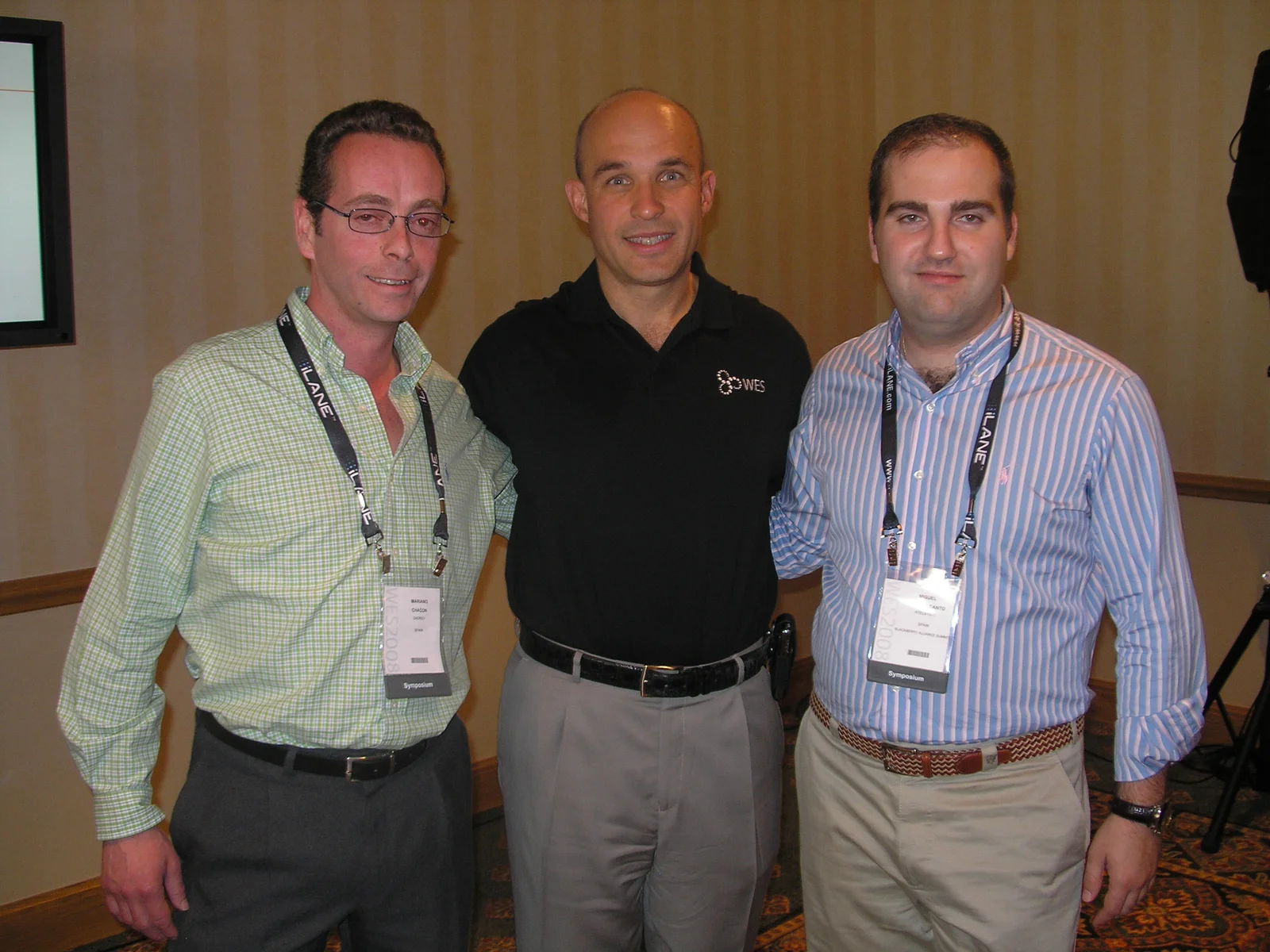
- 17. AtelMedia Technologies / Wikimedia CommonsWES2008 group photograph, original upload and reviewed Flickr CC BY 2.0 permission
Read the group caption, 14 May 2008 date, AtelMedia creator, Flickr licence review and two-version history. Downloaded the actual 17:58 pre-crop 2592 × 1944 archive file; Balsillie is the centre person. The full group frame was inspected before conversion.
- 18. Creative CommonsAttribution 2.0 Generic licence