
The short answer
What exactly launched when BlackBerry arrived in 1999? It was more than a handheld and less than the later smartphone readers may remember. RIM combined messaging hardware, software, corporate email integration and a service relationship. Understanding those parts explains the appeal to mobile professionals without claiming that the company invented either email or every form of mobile computing.
Chronology
A timeline of the turning points
Inter@ctive Pager 950
An earlier RIM handheld demonstrates the messaging lineage before BlackBerry branding.
BlackBerry introduced
The museum’s email timeline dates the mobile-email introduction to this day.
More than a handheld
RIM markets email integration, software support and flat-rate airtime as one offering.
Enterprise adoption
RIM reports 2,900 companies using BlackBerry and more than 900 with Enterprise Server installed.
Phone capability
The 5810 combines RIM’s email approach with smartphone functions; it is not the original 1999 pager.
A 1999 launch, not a 1984 company founding
The Computer History Museum’s email chronology dates the introduction to 19 January 1999. RIM’s contemporary annual report confirms January 1999 for the integrated BlackBerry device-and-service offering. These are different records from its Ontario incorporation in 1984. They also distinguish the brand’s introduction from earlier Inter@ctive pagers.
The early handheld was a two-way messaging and email device with a small screen and physical keyboard. Calling it a modern voice smartphone projects a later product backwards. RIM’s BlackBerry 5810, introduced in 2002, is the museum’s example of the company’s email machine becoming a full-function smartphone. The change took place over a product sequence, not at one universal birth of mobile communication.
The practical problem was access to an existing work mailbox
Mobile professionals already had email accounts, often on company systems. The problem was reaching those accounts away from the office without repeatedly finding a connection and dialing in with a laptop. BlackBerry’s selling proposition was continuity: receive and send work messages while mobile instead of maintaining an unrelated new mailbox.
The 850 user guide describes a system using a Windows desktop and Microsoft Exchange account. It explains that the Desktop Redirector must keep running on a computer connected to the company’s Exchange server, unless the organization uses BlackBerry Enterprise Server. The important distinction is the route that moved the mail. A handheld did not independently contain the whole corporate email system.
Enterprise Server was optional, not mandatory for every first customer
RIM’s 1999 annual report explicitly calls BlackBerry Enterprise Server optional add-on software. It offered centralized administration, scalability and other organizational benefits. The contemporary desktop-based alternative matters: describing every 1999 customer as requiring a centrally installed Enterprise Server would make the original system less accurate, not more sophisticated.
In either arrangement, the service linked several layers: the organization’s mailbox, redirection software, RIM’s delivery infrastructure, a wireless data network and the handheld. This is a functional summary of the documented components, not a claim that every implementation was configured identically. Corporate IT departments remained involved in installation, accounts and support even when a user experienced the product as a small personal device.
Networks, pricing and support made it a commercial system
RIM’s reports identify carrier and distribution relationships as central to expansion. BellSouth, Cantel and other partners supplied network access or routes to customers; resellers working with corporate software helped introduce the product. That commercial infrastructure helps explain why engineering and sales leadership both mattered. Neither a modem nor a memorable brand could provide nationwide network coverage by itself.
The offer also bundled support and flat-rate airtime rather than leaving customers to assemble every part separately. Its reports describe a growing customer-service function alongside the sales force. This did not eliminate all installation costs or guarantee that service worked in every location. It did make support and billing part of the product being sold, rather than incidental details outside its business model.
Adoption figures require fiscal-year and currency care
RIM reported that by the end of February 2000, 2,900 companies were using BlackBerry and more than 900 had Enterprise Server installed. Those figures are organizations, not a count of individual subscribers or phones sold. They also show why it is incorrect to assume that every adopting company used the optional server software.
The company’s annual reporting changed currency: its 1999 report presented Canadian dollars, while the 2000 report adopted US dollars and restated comparisons. A familiar claim that revenue reached about $85 million therefore needs the label US dollars and the financial year ended in February 2000. It should not be presented as a simple January-to-December 1999 total, or attributed exclusively to the new BlackBerry service when RIM also sold other products.
Why the launch mattered without making it a universal first
The achievement was a usable combination for a particular market: mobile workers and the organizations managing their email. Earlier wireless handheld experiments already existed, and other companies pursued different approaches to mobile computing. BlackBerry’s importance does not require claiming that RIM invented email, the radio network or all smartphones.
The story also shows the limits of reading later history backwards. The 2002 phone, subsequent consumer popularity and the much later competition with iPhone and Android were further developments. In 1999 the immediate business question was whether a complete email service could win adoption. Separating that question from the later rise and decline of BlackBerry allows the original product and its collaborators to be understood on their own terms.
Continue the chronology
Related history guides
Biography context
Explore Canada through connected lives
Connected biographies
The commercial and engineering co-leaders
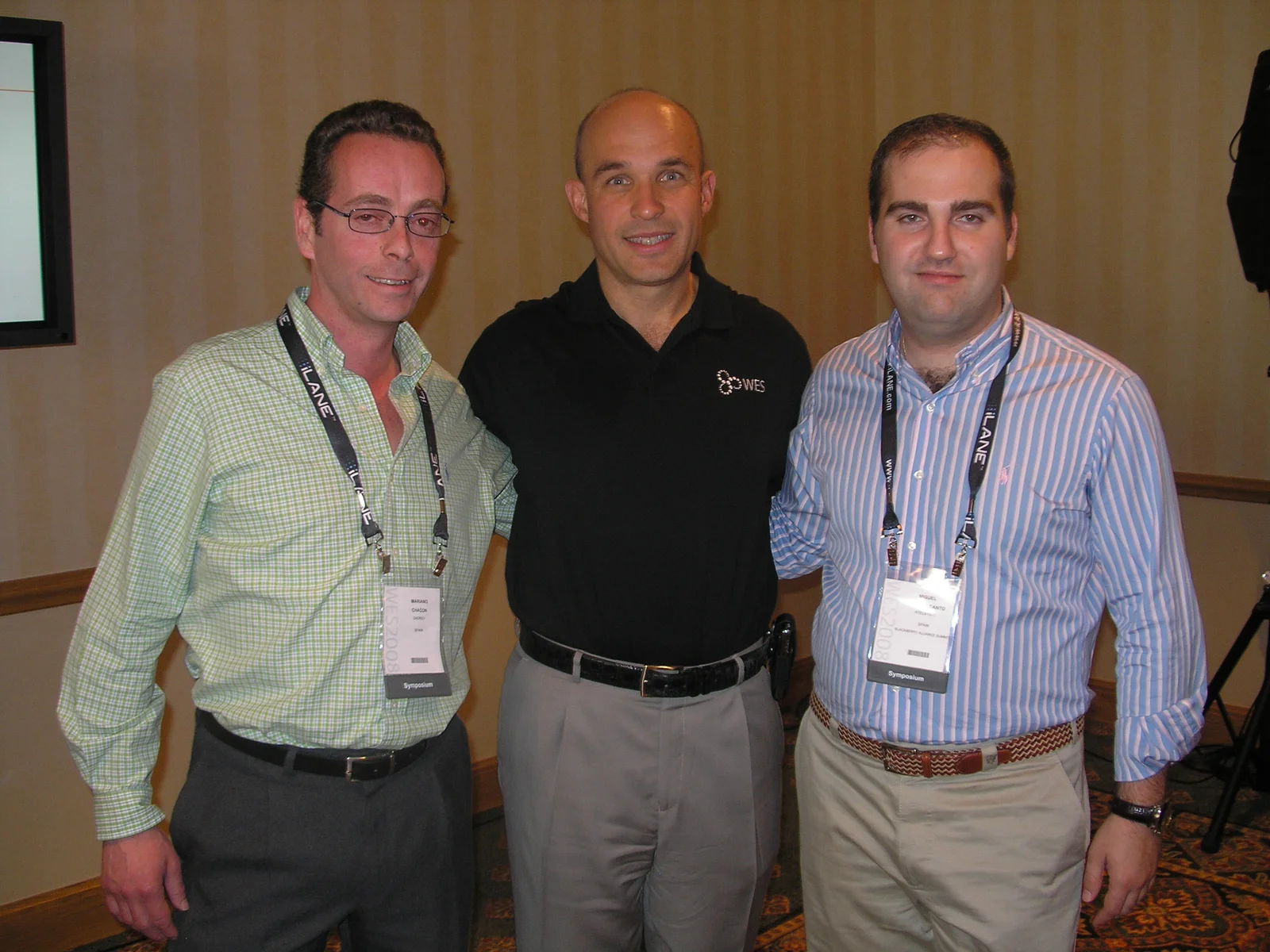
1961–present
Jim Balsillie
Former RIM co-CEO, investor and public-policy institution founderJim Balsillie is a business executive and institution founder who joined Research In Motion in 1992 and shared its leadership with Mike Lazaridis until 2012. His later activities include investment, support for international-affairs research and advocacy on intellectual property and the digital economy.Read biography
1961–present
Mike Lazaridis
RIM co-founder, former co-CEO and quantum-research benefactorMike Lazaridis is a Canadian technology entrepreneur who co-founded Research In Motion in 1984 and helped develop the BlackBerry mobile-email business. After leaving its executive leadership, he continued financing fundamental physics and the commercialization of quantum technologies in Waterloo.Read biographyQuick answers
Common questions
- Was the first BlackBerry a phone?
- The 1999 offering used an email pager. RIM’s BlackBerry 5810 added phone functionality in 2002.
- Did every 1999 user need BlackBerry Enterprise Server?
- No. The 1999 annual report describes it as optional. Desktop Redirector software provided another route from the work mailbox to the handheld.
- Was BlackBerry just the physical device?
- No. The offering combined handheld hardware, software, corporate email integration, airtime, billing and support.
- Why do early BlackBerry revenue figures differ?
- RIM changed its reporting currency from Canadian to US dollars in fiscal 2000 and restated comparative figures. Fiscal years and the company’s other products also need to be distinguished.
Primary and institutional sources
How this history was checked
Contemporary company reports and the original user guide establish how the system worked; museum records distinguish earlier pagers and the later phone. Promotional claims of worldwide firsts are not adopted. This article was reviewed on 23 October 2026.
- Research In MotionAnnual Report 1999: BlackBerry system, optional server and Canadian-dollar statements
- Research In MotionAnnual Report 2000: adoption, service business, partners and US-dollar restatement
- Research In Motion / ManualsLibRIM 850 Installation and User’s Guide, 1999–2000: Desktop Redirector and server alternatives
- Computer History MuseumEmail Innovation Timeline: 19 January 1999 introduction
- Computer History MuseumInter@ctive Pager 950, 1998 object record
- Computer History MuseumBlackBerry 5810 GSM wireless device, 2002 object record
- Computer History MuseumNetworked Handhelds: earlier wireless-data approaches
- AtelMedia Technologies / Wikimedia CommonsComplete WES2008 group photograph and reviewed Flickr licence
- Creative CommonsAttribution 2.0 Generic licence