In this biography
Quick facts
- Born
- 29 April 1899
- Died
- 24 May 1974
- Birthplace
- Washington, D.C., United States
- Country
- United States
- Nationality
- American
- Known for
- An individual approach to orchestral jazz, compositions shaped around his musicians, and a long creative partnership with Billy Strayhorn
- Full name
- Edward Kennedy Ellington
- Birth
- 29 April 1899 in Washington, D.C.
- Musical roles
- Composer, pianist, arranger and leader of the Duke Ellington Orchestra
- Creative partner
- Billy Strayhorn, associated with the orchestra from 1939 until his death in 1967
- Signature tune credit
- Take the ‘A’ Train was composed by Billy Strayhorn and became the orchestra’s theme in 1941
- Presidential honor
- Presidential Medal of Freedom, presented on 29 April 1969
- Death
- 24 May 1974 in New York City
Why this life matters
Ellington expanded the expressive range of jazz composition while bringing African American history and artistry to nightclubs, concert halls, recordings and international audiences.
Timeline
Key moments
Born in Washington
Edward Kennedy Ellington was born in Washington, D.C., to a family in which both parents played piano.
Cotton Club engagement
His band began a regular Harlem engagement whose radio broadcasts reached a national audience.
Strayhorn joins
Billy Strayhorn entered the Ellington organization as an arranger and lyricist, becoming a major composer and collaborator.
A new signature tune
The orchestra recorded Strayhorn’s Take the ‘A’ Train, which became its theme.
Black, Brown and Beige
Presented his extended account of African American history at Carnegie Hall.
Newport breakthrough
A Newport Jazz Festival performance featuring Paul Gonsalves’s extended solo revived public attention to the orchestra.
Medal of Freedom
Received the Presidential Medal of Freedom at the White House on his seventieth birthday.
Death in New York
Died in New York City after a career spanning performance, composition, recording and international touring.
Washington beginnings and a Harlem audience
Edward Kennedy Ellington was born in Washington, D.C., on 29 April 1899. Both parents played piano, and lessons supplied an early foundation for his musical life. Blues and ragtime pianists helped shape his interests as he began performing professionally in his teens. His career developed from local engagements into the leadership of an ensemble with ambitions beyond a succession of dance bookings.
In 1927 his Washingtonians secured a regular engagement at Harlem’s Cotton Club. Frequent radio broadcasts carried the music to wider audiences. The opportunity operated within segregation: the club presented Black performers to white patrons. National recognition grew from a workplace whose racial restrictions remained part of the musicians’ daily experience.
Composing for particular musicians
Ellington’s orchestra was an instrument he could continually reshape. He wrote with particular players in mind, valuing the individuality of a trumpet tone, a clarinet register or a saxophonist’s phrasing. Unusual instrumental combinations, muted brass and carefully chosen harmonies made the ensemble recognizable without requiring every piece to follow the same formula.
Composition, arrangement, piano playing and leadership belonged to this shared working process. His scores could identify musicians by name rather than simply designate numbered instrumental parts. The music developed through what those players could contribute. That approach made an enduring orchestra especially valuable: the continuity of its people helped him pursue ideas that a less personal ensemble might not have realized.
Strayhorn and the orchestra’s repertoire
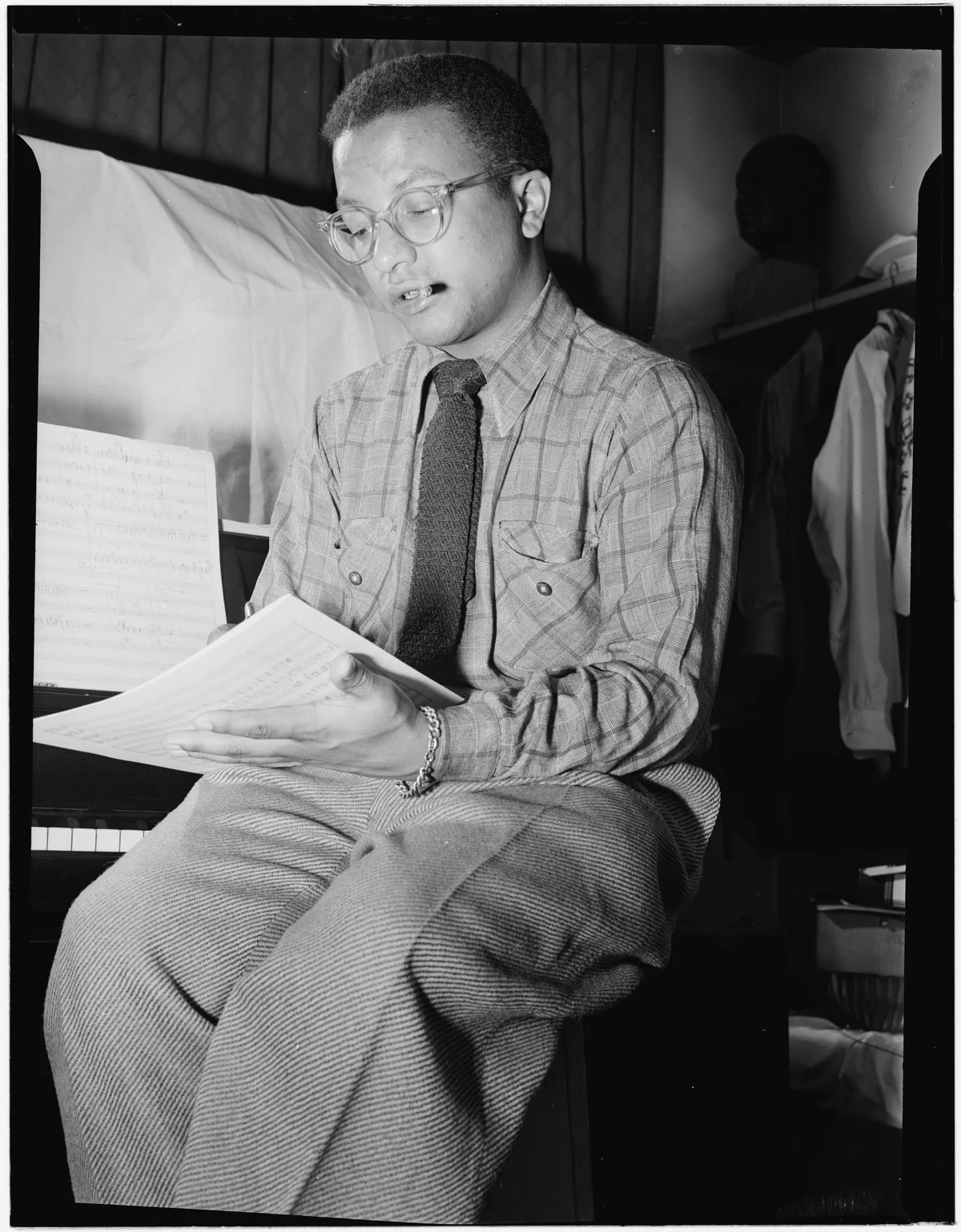
Billy Strayhorn joined the organization in 1939 and became an essential creative partner. He composed, arranged and sometimes played piano, contributing both independent works and collaborations. Their musical understanding widened the orchestra’s resources, but its public identity can obscure the authorship of individual pieces. Take the ‘A’ Train, adopted as the band’s signature in 1941, was Strayhorn’s composition.
Other repertoire also emerged through collaboration. Caravan was written by Ellington and trombonist Juan Tizol before Strayhorn joined; Strayhorn later made an arrangement of it. A composition’s origin and a later arrangement are different contributions. Ellington’s achievement includes sustaining an ensemble in which those contributions could meet, develop and reach listeners through distinctive performances.
History in the concert hall
Ellington used music to address the experience of African Americans as well as to entertain. Black, Brown and Beige, presented at Carnegie Hall on 23 January 1943, placed a sweeping historical narrative within an extended orchestral work. Its ambition challenged narrow expectations of what a jazz orchestra should play and what Black American experience could contribute to the concert stage.
The concert-hall achievement did not remove barriers on the road. His musicians faced segregated travel and restaurants that refused them service. Ellington also supported the campaign for the Scottsboro Boys through benefit concerts. His public position and compositions offered different means of advancing racial justice, linking the orchestra’s cultural prestige with causes affecting people beyond the concert audience.
Newport, honors and continuing work
The orchestra regained conspicuous public attention at the Newport Jazz Festival on 7 July 1956. Saxophonist Paul Gonsalves’s extended solo during Diminuendo and Crescendo in Blue helped turn the appearance into a celebrated event. The history of its recording continued afterward: a fuller reconstruction drawing on separate tapes appeared in 1999, long after the original performance.
Ellington continued composing and recording through his later years. The Recording Academy recognized work ranging from sacred music to large jazz ensembles. On 29 April 1969 he received the Presidential Medal of Freedom at the White House. He died in New York on 24 May 1974, leaving a body of work whose changing arrangements and recorded interpretations reward attention alongside its familiar titles.
Quick answers
Frequently asked questions about Duke Ellington
- Was Duke Ellington primarily a pianist or a composer?
- He was both, as well as an arranger and orchestra leader. His compositions were often designed around the individual sounds of his musicians, making the orchestra central to his creative method.
- Did Duke Ellington write Take the ‘A’ Train?
- Billy Strayhorn composed it. The Duke Ellington Orchestra made the piece its signature tune in 1941; the band’s association with a recording should not be confused with the composition credit.
- What was Black, Brown and Beige?
- It was Ellington’s extended orchestral account of African American history, presented at Carnegie Hall on 23 January 1943. Its concert presentation was an important expression of his ambitions beyond short dance numbers.
- Why is Ellington’s 1956 Newport appearance important?
- It brought renewed attention to the orchestra, particularly through Paul Gonsalves’s long saxophone solo. The performance date is 7 July 1956; the fuller reconstructed CD edition appeared in 1999.
Keep exploring
Lives connected to this story
- James Baldwin
Compare another artistic response to racial injustice, expressed through novels, essays and public interventions rather than an orchestra.
- Anna May Wong
Explore a different American performance career shaped by international audiences, racial restrictions and struggles over representation.
Sources and further reading
Explore the evidence
These references support the biography and offer further reading. Official records, first-person accounts and independent reporting provide different perspectives; image records document attribution and licensing.
- 1. Smithsonian National Museum of American HistoryJazz Appreciation Month 2024 — Duke Ellington
- 2. Smithsonian National Museum of African American History and CultureJazz Appreciation Month: Duke Ellington
- 3. Smithsonian National Museum of American HistoryDuke Ellington — Jazz Composers exhibition
- 4. Smithsonian National Museum of American HistoryCaravan — composition and arrangements
Exhibition differentiates Caravan’s Ellington–Tizol composition from a later Strayhorn arrangement, and identifies scores written for named players.
- 5. Library of CongressLibrary Acquires Archive of Jazz Great Billy Strayhorn
Used for Strayhorn’s musical roles and archive. Its statement that he was 25 when meeting Ellington in 1938 is inconsistent with his 1915 birth and is not repeated.
- 6. Smithsonian National Museum of American HistoryTake the ‘A’ Train — manuscript and edition history
- 7. Smithsonian National Museum of American HistoryDuke Ellington and Billy Strayhorn: Jazz Composers
- 8. Carnegie Hall ArchivesBlack, Brown, and Beige — work and performance record
Carnegie Hall’s own linked performance record confirms 23 January 1943; a Smithsonian collection finding aid’s November 1943 debut wording is not followed.
- 9. Library of Congress, National Recording Preservation BoardEllington at Newport — Registry titles with descriptions and essays
Registry account distinguishes the 7 July 1956 Newport performance from the fuller 1999 reconstruction of its recording.
- 10. Recording AcademyDuke Ellington — awards and biography
Institutional biography supplies full name, exact life dates and death place; award records establish the breadth of later recording work.
- 11. U.S. National ArchivesFacial Hair Friday: Duke Ellington
- 12. Library of CongressPortrait of Duke Ellington, Zanzibar, New York, ca. July 1946
Item’s Rights & Access statement says Gottlieb collection photographs entered the public domain on 16 February 2010 at his wish and notes possible privacy/publicity rights. This specific dedication supplies reuse basis; government custody alone does not. Direct page retrieval was intermittent, but the indexed institutional rights text and Commons provenance agree.
- 13. Wikimedia CommonsGottlieb’s Ellington portrait at Zanzibar — original file
Original Commons JPEG downloaded and visually checked at 1024×1325, with full supplied negative edges. Single sitter is Ellington. File traces to LOC’s Flickr original and persistent digital ID gottlieb.02481; institutional item 2023867664 names photographer William P. Gottlieb. No separate restoration is credited.