In this biography
Quick facts
- Born
- 29 November 1915
- Died
- 31 May 1967
- Birthplace
- Dayton, Ohio, United States
- Country
- United States
- Nationality
- American
- Known for
- Take the ‘A’ Train, Lush Life and a long creative partnership with Duke Ellington
- Full name
- William Thomas Strayhorn
- Birth
- 29 November 1915 in Dayton, Ohio
- Musical roles
- Composer, arranger and pianist; not solely Ellington’s assistant
- Early work
- Lush Life and the school revue Fantastic Rhythm predated his move to Ellington’s orchestra
- Collaboration
- Joined Ellington in 1939 after meeting him in December 1938
- Death
- 31 May 1967, aged 51
Why this life matters
His manuscripts and recordings reveal the difference between an orchestra’s public identity and the individual creative work of its composers, arrangers and performers.
Timeline
Key moments
Born in Dayton
William Thomas Strayhorn was born in Ohio and later grew up in Pittsburgh.
Fantastic Rhythm
His own revue was performed at Westinghouse High School, before his association with Ellington.
Meeting Ellington
Met the orchestra leader at Pittsburgh’s Stanley Theater.
Accepting the invitation
Accepted Ellington’s invitation to collaborate, beginning a long musical partnership.
The orchestra’s signature tune
Take the ‘A’ Train, a Strayhorn composition, became associated with the Ellington orchestra.
Extended collaborations
Projects included Such Sweet Thunder and the later Far East Suite.
Death
Died aged 51; his music remained in performance and in the archive maintained by his family.
Pittsburgh and a musical education
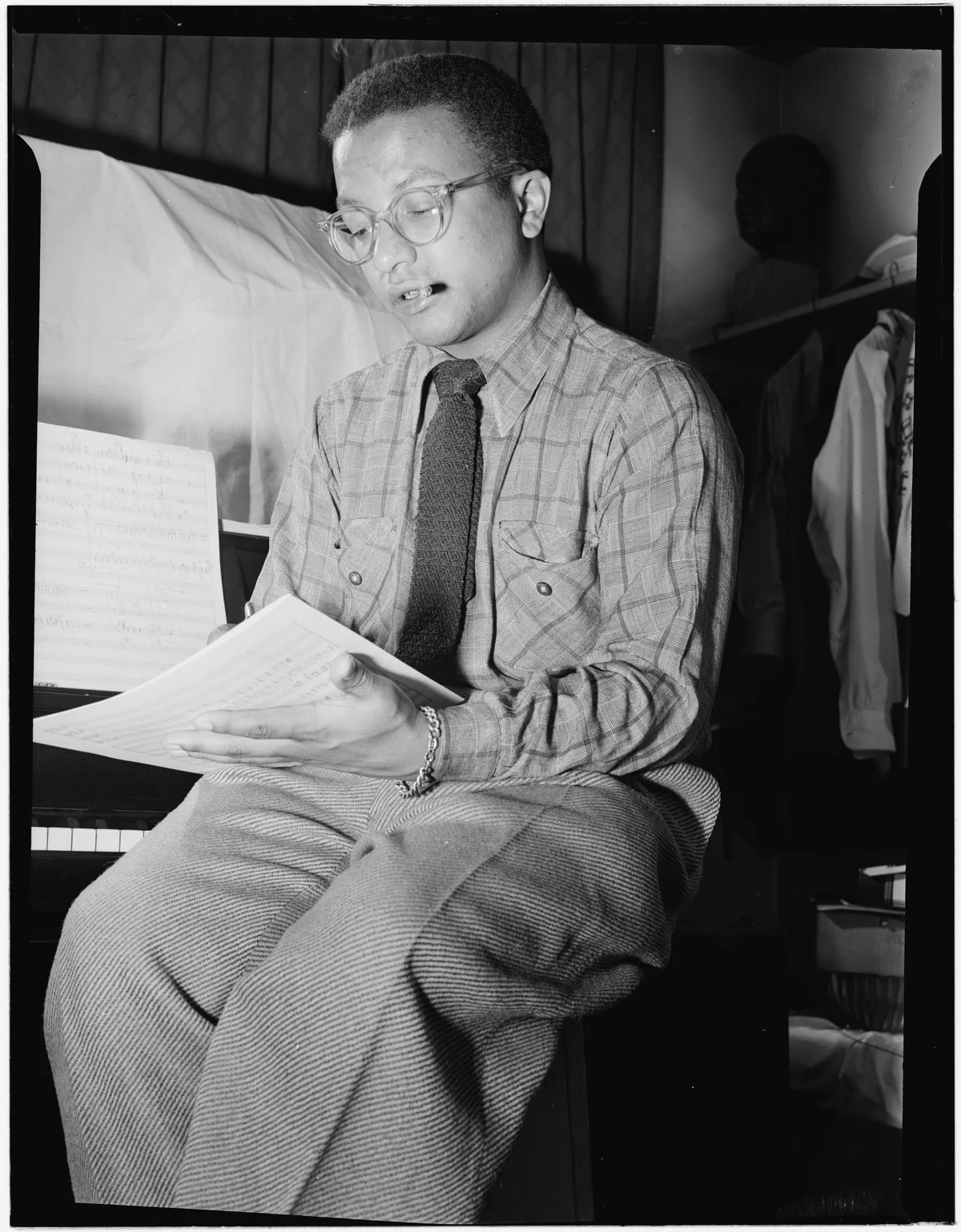
William Thomas Strayhorn was born in Dayton, Ohio, on 29 November 1915 and grew up in Pittsburgh. Piano study, school activities and the city’s musical life gave him experience before he entered a celebrated orchestra. Classical training and an interest in jazz developed alongside one another, rather than representing mutually exclusive stages of his imagination.
His own early projects included Fantastic Rhythm, a revue written for Westinghouse High School. Lush Life also originated before he left Pittsburgh. These beginnings matter because his career did not start as an extension of Duke Ellington’s: he brought existing compositions and a developing musical identity into the partnership.
Entering Ellington’s musical workshop
Strayhorn met Ellington in Pittsburgh in December 1938 and accepted an invitation to collaborate the following January. The orchestra already possessed a distinctive sound. Studying its scores helped him understand its harmonies, instrumental combinations and the individual capacities of its musicians. He joined a working ensemble, not an abstract exercise in orchestration.
His responsibilities included composing, arranging and occasional piano playing. A close musical understanding with Ellington made their work unusually integrated, but describing him simply as an assistant understates his contribution. Pieces under the orchestra’s name could be his own compositions, the work of another composer that he arranged, or part of a collaborative project.
A signature tune with its own composer
Take the ‘A’ Train became the orchestra’s signature tune in 1941. Strayhorn composed it, drawing its title from subway directions to Harlem. Its association with Ellington’s ensemble made it widely familiar without changing that authorship. Manuscript and recording evidence help separate the creation of a piece from the performances through which audiences came to know it.
The famous February 1941 RCA recording also featured trumpeter Ray Nance. His solo became so familiar that later performers often repeated it. A composer, an orchestra and a memorable soloist thus made different contributions to one recording’s identity. That distinction is useful throughout Strayhorn’s career: recognizable ensemble style does not make every creative decision the work of one person.
Songs and larger musical forms
Strayhorn’s work ranged beyond a theme tune. The Smithsonian identifies Lush Life, Day Dream and Lotus Blossom among his best-known pieces. His classical grounding and sophisticated harmonic sense offered the orchestra another compositional voice. Songs written outside its immediate needs remained part of his own repertoire and later reputation.
Larger projects with Ellington included the Shakespeare-inspired Such Sweet Thunder, which debuted in 1957, and their adaptation of The Nutcracker Suite in 1960. Far East Suite was recorded in December 1966. These projects required music to develop across related movements, extending the partnership beyond the demands of a single song or dance arrangement.
An archive that restores individual decisions
Strayhorn died on 31 May 1967, aged 51. His nephew and estate executor, Gregory Morris, preserved the papers that eventually entered the Library of Congress. In the Library’s acquisition interview, Morris emphasized Strayhorn’s desire to receive credit for his work. That concern makes the manuscripts more than a collection of famous titles.
The surviving materials include scores, sketches, parts and business records, encompassing original compositions and arrangements of music by other writers. They allow researchers to examine handwriting, revisions and music prepared for particular performers. The archive makes visible the patient work between an initial idea and an orchestra’s sound, giving Strayhorn an individual history within a celebrated collaboration.
Quick answers
Frequently asked questions about Billy Strayhorn
- Who wrote Take the ‘A’ Train?
- Billy Strayhorn composed it. The Duke Ellington Orchestra made it its signature tune in 1941; association with the ensemble does not replace the composition credit.
- Did Billy Strayhorn only arrange Duke Ellington’s music?
- No. He composed independent songs and extended works, arranged other writers’ music and collaborated with Ellington. He also sometimes played piano.
- Was Lush Life written before he joined Ellington?
- Yes. It developed during his Pittsburgh years, before the collaboration began in 1939. It is not simply another name for an Ellington composition.
- What can researchers find in his archive?
- Scores, sketches, instrumental parts and business papers preserve original compositions and arrangements. They help identify musical decisions and authorship that an orchestra’s name alone cannot explain.
Keep exploring
Lives connected to this story
- Duke Ellington
Follow the orchestra leader’s wider career, then compare the distinct composing and arranging contributions within their collaboration.
Sources and further reading
Explore the evidence
These references support the biography and offer further reading. Official records, first-person accounts and independent reporting provide different perspectives; image records document attribution and licensing.
- 1. Smithsonian National Museum of African American History and CultureBilly Strayhorn
- 2. Smithsonian National Museum of American HistoryBilly Strayhorn — Jazz Composers exhibition
- 3. Billy Strayhorn Songs, Inc.Biography and chronology
The dated chronology supports the December 1938 meeting and January 1939 acceptance. Conflicting narrative ages of 24 or 25 are not repeated: his November 1915 birth makes him 23.
- 4. Smithsonian National Museum of American HistoryTake the ‘A’ Train — manuscripts and editions
- 5. Smithsonian National Museum of American HistoryTake the ‘A’ Train — recording descriptions
- 6. Library of Congress, Music DivisionAnnouncing New Acquisition: The Billy Strayhorn Collection
Executor Gregory Morris identifies Fantastic Rhythm as Strayhorn’s own school production and confirms Lush Life predates the Ellington years; no Cole Porter commission is inferred.
- 7. Billy Strayhorn Songs, Inc.Billy Strayhorn Archive — scope and content