
The short answer
Read the historical record, work through the invented example, then identify which conclusions depend on the example’s assumptions.
Read the distinctions
Different objects of change
Compare the kind of statement being made before treating two claims as equivalent.
| Question | Stipulated edit | What follows |
|---|---|---|
| Position | Insert Methods at 2. | The old position 2 now identifies Methods. |
| Name | Keep EVID attached to Evidence. | EVID follows Evidence to 3. |
| View | Hide child statements. | The stored children remain. |
Chronology
A timeline of the turning points
Published design
The paper separates statement structure from views.
Read the paper beside the event history
Engelbart and English’s 1968 paper describes hierarchical statements, cross-references and selectable views. Its authors used their own research group as the experimental subject. The institute’s event history separately identifies Bill English’s production leadership for the 9 December demonstration.
A location can change while an identity remains
On printed page 398, statement numbers describe positions in a hierarchy; names stay with statements when the surrounding structure changes. Page 399 separates the display’s starting point from its form of view. Neither distinction makes a displayed subset identical to the stored file.
The comparison is technically specific. A useful link needs a referent that can still be found after the permitted edit. A useful view needs a rule for selecting what is shown. These are related design problems, but solving one does not automatically solve the other.
Sources for this section: [1]
Invented outline and editing task
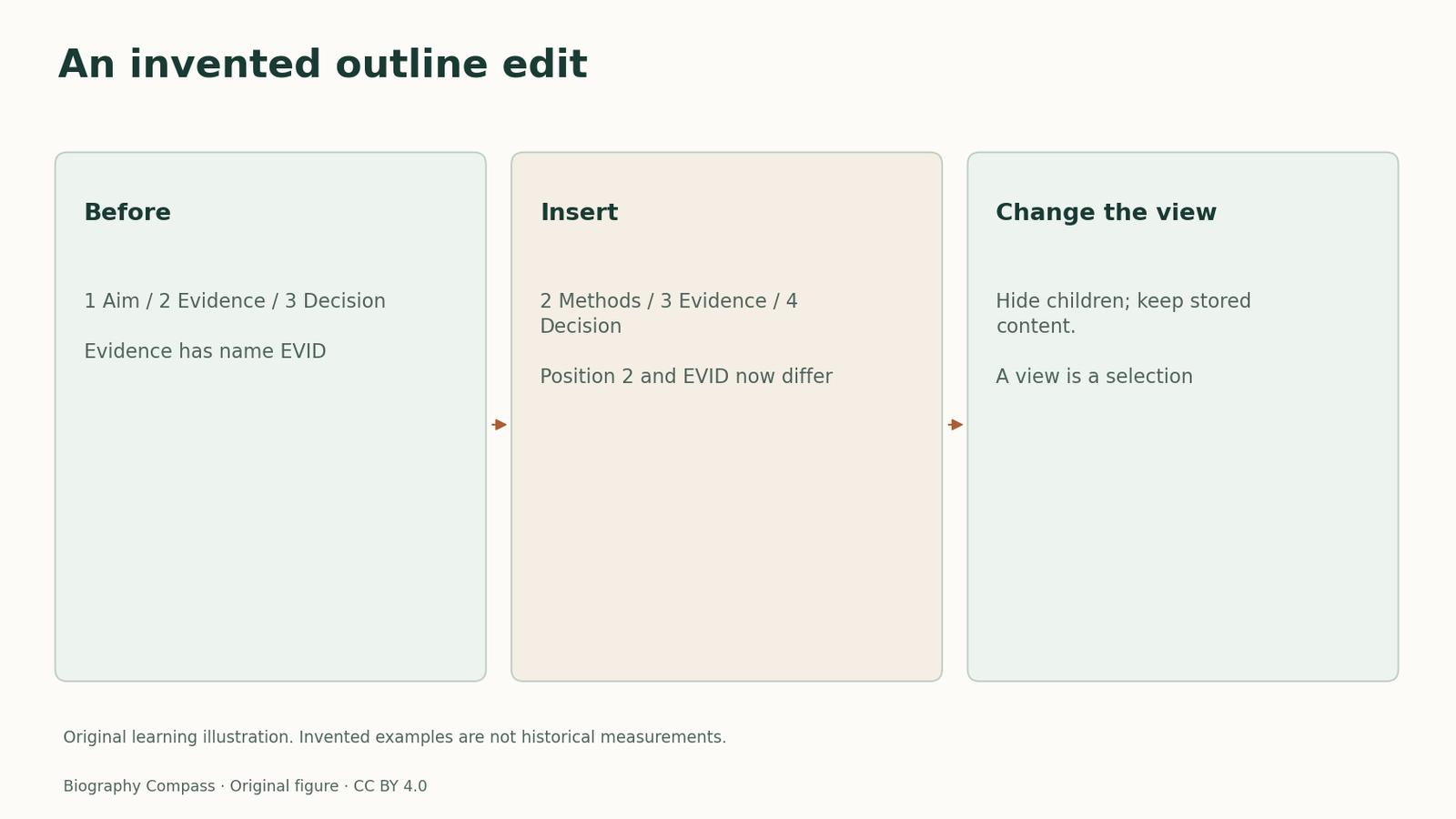
Create a teaching outline with three top-level statements: 1 Aim, 2 Evidence, 3 Decision. Evidence has the unique name EVID and two children, 2a Observation and 2b Caveat. Decision refers both to position 2 and to name EVID. Define references to names as following that named statement, while positional references retain the stated number. These rules are explicit inputs to the fixture.
Insert a new top-level statement, Methods, at position 2 and renumber later positions. Keep all names and content. Where does each reference now lead? Then display only the top-level statements, hiding their children. Has Caveat been deleted? Finally, explain why making a second copied Evidence paragraph would be a different operation from making another reference to EVID.
Sources for this section: [1]
Reference answer
Methods is now 2, Evidence is 3 and Decision is 4. The literal position 2 leads to Methods, while EVID still identifies Evidence. The collapsed view hides Observation and Caveat without removing either from the stipulated stored outline. A second reference still targets one object; a second copy creates another object whose later edits need not follow the first.
The result follows the fixture’s edit and reference rules. It is not a claim that every naming system survives every operation: deletion, name reuse and cross-file moves would need additional rules. Nor does it prove that the historical team’s experience generalised to all workplaces. No recording of the demonstration is treated as watched here.
Sources for this section: [1]
Continue the chronology
Related history guides
Biography context
Explore United States through connected lives
Connected biographies
People behind the records
Quick answers
Common questions
- Do names make information indestructible?
- No. The fixture preserves names during one particular insertion. Other operations need their own specified rules.
Primary and institutional sources
How this history was checked
The cited records have different dates and purposes. All worked examples are newly invented and are not historical measurements. This article was reviewed on 31 October 2026.