
The short answer
Country of My Skull is Antjie Krog’s literary account of reporting on South Africa’s Truth and Reconciliation Commission. It is neither the commission’s official report nor a neutral transcript of every hearing. Its position between journalism, personal narrative and literary reconstruction is central to understanding it.
Chronology
A timeline of the turning points
Reporting the commission
Krog’s radio journalism precedes and accompanies the book.
Original publication
The bibliographic record identifies Random House, Johannesburg.
Different overseas editions
London and US publication dates belong to later editions.
Public critical debate
Literary criticism and disputed attribution allegations require distinct treatment.
A reporter’s book and a commission’s record serve different purposes
Krog reported on the TRC for radio during the 1990s. Country of My Skull turns that encounter into a book in which the reporter’s own response is visible. The publisher describes an account involving testimony and the author’s experience, rather than an institutional report produced by the commission.
That distinction changes how a reader checks a passage. A scene can convey fear, uncertainty or moral conflict without establishing that every sentence is a verbatim official transcript. Historical or legal conclusions should be checked against the relevant record, not inferred solely from the literary narrator’s emotional response.
The original year should not be replaced by a later paperback date
The British bibliographic record identifies the original publication as Johannesburg: Random House, 1998, while describing a 1999 Jonathan Cape edition in London. Crown’s US listing dates its paperback to August 2000. These are publication histories of different issues, not competing proof that the book first appeared in three different years.
Page totals also vary by edition. The selected 2009 Zebra Press excerpt lists 320 pages; the cited US paperback lists 432. A reference to a page number needs its edition attached. Differences in format should not automatically be treated as evidence that a passage was added, removed or rewritten.
One selected scene exposes the work of listening and mediation
The available book excerpt narrates a parliamentary committee hearing on draft TRC legislation. It places testimony, journalists’ note-taking and the disruptive arrival of right-wing participants within one scene. This is not the same event as a later commission hearing merely because the subject is the TRC.
The passage also raises practical questions about language and translation equipment. What reaches a listener depends partly on who can speak, who translates and what the reporter records. This reading is confined to the supplied passage: it is not a claim to have read the complete book or verified every scene against a parliamentary transcript.
Sources for this section: [4]
Literary criticism asks whose pain and whose language organise the story
Phil van Schalkwyk’s 2006 Literator article examines the relationship between multilingual testimony and English retelling. His discussion questions how a white Afrikaner narrator’s personal crisis relates to the suffering being reported. That is an attributed critical argument, not a finding that the testimony itself was false.
The distinction between truth and reconciliation is also important in that analysis. Giving suffering a narrative form does not demonstrate that reconciliation followed for every participant. Readers can value a literary response while asking what its perspective foregrounds, what it cannot contain and which other voices they need to consult.
Sources for this section: [5]
A disputed allegation is not a proven judgement
In February 2006, IOL reported Stephen Watson’s allegations about attribution in Krog’s work, including a claimed relationship to a Ted Hughes essay. Krog denied knowing that essay when writing Country of My Skull, and her publishers rejected the allegations. The report also described possible legal action, not a completed judgement resolving the dispute.
Those responses belong alongside the allegation; neither should be removed to manufacture certainty. This controversy is separate from the broader debate about narrative voice. For historical context, read the TRC institution’s history and Desmond Tutu’s biography; the contextual photograph shows its chair in 2007, not the book’s author or a scene from it.
Biography context
Explore South Africa through connected lives
Desmond Tutu
Follow the life of the TRC chair pictured here.
Explore the biographiesHistorical frameworkThe TRC’s legislative foundation
Distinguish the institution and its legal framework from a reporter’s book.
Explore the biographiesLiterary comparisonNadine Gordimer
Explore a different writer’s engagement with apartheid; she did not author this book.
Explore the biographiesConnected biographies
The commission’s chair, not the book’s author
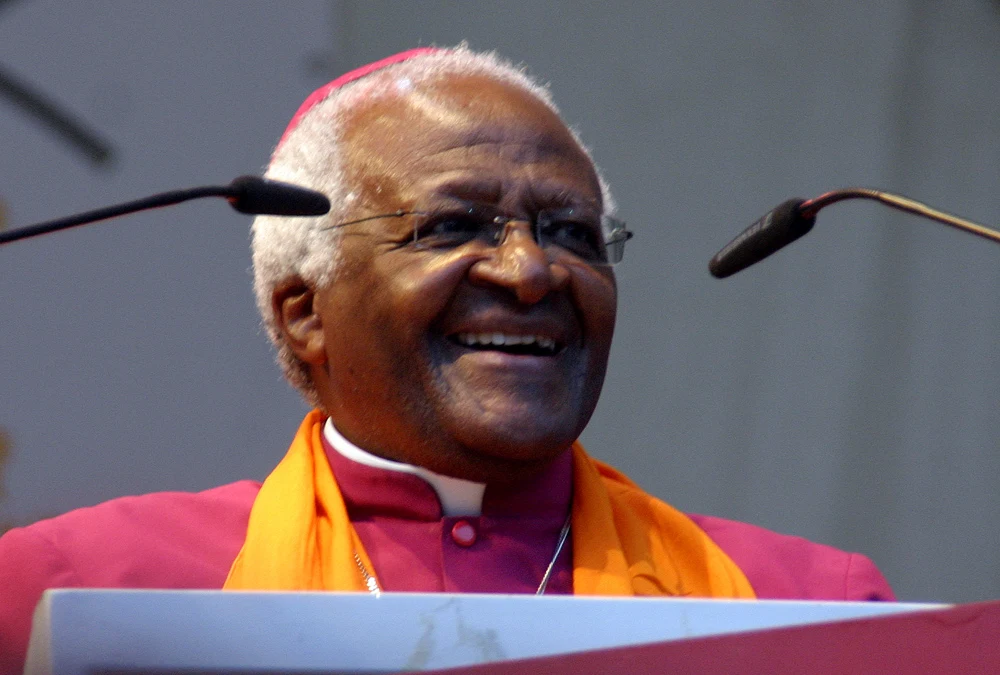
1931–2021
Desmond Tutu
Anglican archbishop, anti-apartheid campaigner and TRC chairDesmond Tutu moved from teaching into Anglican ministry and became an internationally prominent opponent of apartheid. His moral authority supported non-violent pressure, public truth-telling and later criticism of democratic governments, while the compromises of the TRC remained open to challenge.Read biographyQuick answers
Common questions
- Who wrote Country of My Skull?
- Antjie Krog, drawing on her reporting of the Truth and Reconciliation Commission.
- Was it first published in 2000?
- No. The bibliographic record identifies a 1998 South African original; the cited US paperback appeared in 2000.
- Is it the official TRC report?
- No. It is a literary and personal account, not the commission’s institutional report.
- Does this guide claim the 2006 allegation was proven?
- No. It records the allegation and responses; the cited report does not establish a completed judicial finding.
Primary and institutional sources
How this history was checked
Bibliographic and publisher records, one selected book passage, selected pages of literary criticism and a report containing allegations and responses. No complete-book reading, complete hearing transcript, legal adjudication or reproduced cover is claimed. Krog’s biography is not counted or linked as an existing page. This article was reviewed on 24 October 2026.
- Poetry International30 May 2019 — selected biographical passage on Krog’s radio reporting of the TRC
- Crown / Penguin Random HouseCountry of My Skull — 2000 US paperback record and publisher description
- Open British National BibliographyCountry of My Skull — original 1998 publication and 1999 London edition
- Antjie Krog / NamibianaCountry of My Skull — selected book excerpt in the 2009 Zebra Press edition, not the complete book
- Phil van Schalkwyk / Literator 27(3), 2006Selected printed pages 115–117 on translation, narrative and reconciliation
- Karen Breytenbach / IOL20 February 2006 — allegations, Krog’s denial and her publishers’ response
- Elke Wetzig / Wikimedia CommonsDesmond Tutu, 7 June 2007 — previously verified contextual photograph, not the book’s author