
The short answer
A Christmas Carol is a short prose story, not a song, an original stage script or an episode first written for a modern film. This guide follows the 1843 book’s structure and publishing form, then examines what Scrooge’s change requires. Plot details, including the ending, are discussed.
Chronology
A timeline of the turning points
Composition
Dickens wrote the story in the autumn for publication during the Christmas season.
Separate illustrated book
Chapman and Hall published A Christmas Carol with illustrations by John Leech.
Early readers
The initial 6,000-copy printing sold quickly, although sales and author profit are different measures.
A continuing Christmas-book project
Later Christmas books include The Chimes and The Cricket on the Hearth; they are distinct works, not additional staves of the 1843 story.
What readers encountered in 1843
Chapman and Hall issued A Christmas Carol on 19 December 1843 as a separate illustrated book. John Leech supplied the original illustrations. Its decorated binding and coloured pictures made it a carefully produced object; its five-shilling price was not equivalent to giving the story away. The museum’s first-edition record stresses the tension between elaborate production and keeping the price down.
The first printing of 6,000 copies sold within days, but a successful sale does not tell us the author’s net profit: production costs and contractual arrangements also matter. Nor does the book’s fame establish that Dickens invented Christmas or created every custom associated with it. A more useful question is how this particular story made celebration, memory and responsibility part of a compelling short narrative.
Marley sets the terms of a five-stave story
The book calls its divisions staves, sustaining the musical metaphor of a carol while remaining prose fiction. In the opening stave, Ebenezer Scrooge rejects invitations, charity and the warmth enjoyed by other people. The narrative insists that his former partner, Jacob Marley, is dead before allowing that partner to return. The explanation is playful but functional: this is a ghost story in which the supernatural must interrupt a firmly established ordinary world.
Marley’s ghost warns Scrooge of the consequences of a life narrowed to money and announces three visitors. Marley is consequently a fourth supernatural visitor if the three later spirits are counted; he is not the Ghost of Christmas Past under another name. The distinction is useful when comparing adaptations that shorten introductions or combine scenes. The book’s sequence is a framing warning, three guided encounters and a final test in waking life.
Sources for this section: [1]
Past and present change the way Scrooge sees people
The Ghost of Christmas Past returns Scrooge to scenes from his own life: loneliness, attachment, apprenticeship and choices about wealth. Fezziwig’s celebration shows an employer shaping the emotional conditions of work through modest generosity. These scenes do not excuse all of Scrooge’s later behaviour. They make him confront the difference between the pleasures he remembers receiving and the limited obligations he now recognises towards others.
The Ghost of Christmas Present takes him beyond his private memories. At the Cratchits’ home, inadequate resources coexist with effort and affection; the family’s warmth is not evidence that poverty is harmless. Tiny Tim makes the consequences personal, while Mrs Cratchit’s anger prevents the household from becoming merely a grateful audience for its employer. Scrooge hears his own dismissive reasoning returned to him as the spirit asks him to consider a real child rather than an abstract population.
Sources for this section: [1]
Ignorance, Want and an avoidable future
The children named Ignorance and Want widen the argument beyond one deserving family. They are allegorical figures attached to social neglect, not additional members of the Cratchit household. Their appearance interrupts abundance with the results of exclusion. The spirit’s repetition of Scrooge’s remarks about prisons and workhouses exposes how easily an available institution becomes an excuse not to consider another person’s need.
The Ghost of Christmas Yet to Come is largely silent. It presents reactions to an unloved man’s death and a household changed by the loss of a child, eventually drawing Scrooge towards his own grave. The crucial question is whether these are inevitable events or consequences that can be altered. That makes the frightening section a pressure towards action, rather than simply a prediction that renders all action pointless. No medical diagnosis for Tiny Tim is needed to understand that narrative purpose.
The ending requires material and continuing change
On waking, Scrooge sends food, contributes to charity and visits his nephew. But the ending does not stop with one conspicuous Christmas gift. He raises Bob Cratchit’s salary, promises assistance to the family and improves the working environment. The narrator then reports continued change. The final assurance that Tiny Tim lives belongs to a revised future, answering the earlier scenes of possible loss.
Reading the conclusion only as a message to feel cheerful misses these practical consequences. Reading it as a complete legislative programme goes too far in the other direction: it is a fictional conversion worked through employment, kinship and giving. The book asks what a changed relationship with other people looks like in conduct. That question is sharper than a simple equation between an expensive meal and moral redemption.
Sources for this section: [1]
Read the book before assigning an adaptation’s choices to Dickens
Start with the five staves and keep track of who speaks, what Scrooge sees and what the narrator confirms later. Distinguish a vision from an event already settled in the story’s present. If a film supplies an extra childhood scene, song, character or explanatory diagnosis, check whether it occurs in the prose before using it as evidence about the 1843 work. This guide does not attempt a census of screen or stage adaptations.
The Gutenberg transcription consulted here includes the original title, preface, stave divisions and Leech illustrations, while the British Library and Dickens Museum records identify first-edition features. A transcription is convenient for searching; an original-edition image is better evidence of page layout and the book’s physical presentation. Neither is the handwritten manuscript. The book can then be placed beside Dickens’s biography without assuming that Scrooge, Bob or the narrator is a transparent substitute for the author.
Biography context
Explore United Kingdom through connected lives
Charles Dickens
Place the 1843 book alongside journalism, serial novels, public readings and the surviving personal papers.
Explore the biographiesCompare original editionsShakespeare’s First Folio
See why publication form, contents and later editorial choices matter in another major English book.
Explore the biographiesConnected biographies
The writer behind the book
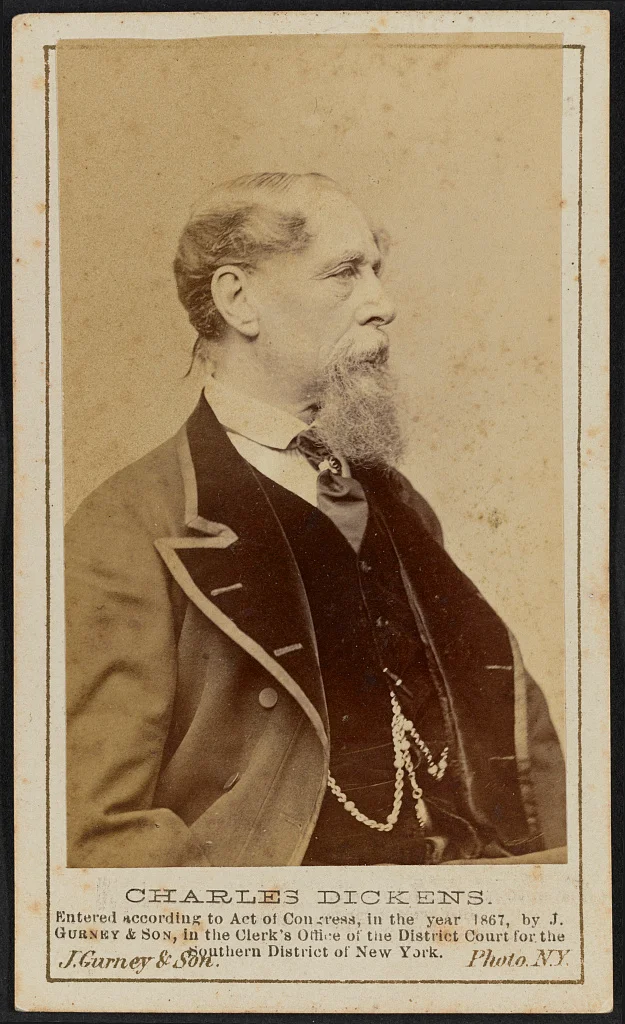
1812–1870
Charles Dickens
Novelist, journalist, editor and public readerCharles Dickens was an English novelist, journalist and performer whose serial fiction and public readings brought memorable characters to a wide audience.Read biographyQuick answers
Common questions
- When was A Christmas Carol first published?
- Chapman and Hall published the separate illustrated book in London on 19 December 1843. John Leech was its original illustrator.
- How many ghosts visit Scrooge?
- Marley’s ghost appears first, followed by the Ghosts of Christmas Past, Christmas Present and Christmas Yet to Come: four supernatural visitors in that count.
- Is A Christmas Carol divided into chapters?
- Its five divisions are called staves, extending the musical idea of a carol. The work itself is prose fiction, not a songbook.
- Does Tiny Tim die at the end?
- No. The visions show the danger of an unchanged future. The ending states that Tiny Tim lives after Scrooge changes his conduct.
- Was A Christmas Carol originally a monthly serial?
- No. It appeared as a separate 1843 book. Do not confuse its publishing form with the instalment publication of many longer Dickens novels.
Primary and institutional sources
How this history was checked
The public-domain prose was read selectively across the opening, the three spirit encounters and the ending, with particular attention to employment, Ignorance and Want, and the changed future. Institutional records establish the 1843 edition and publication context. No full manuscript comparison, adaptation survey or original accounts audit is claimed. This article was reviewed on 23 October 2026.
- Charles Dickens; Project Gutenberg transcriptionA Christmas Carol: title matter, five staves and original Leech illustrations
- Charles Dickens MuseumFirst edition of A Christmas Carol
- British LibraryCharles Dickens’s A Christmas Carol: original publication and context
- Library of CongressHighlighting the Holidays: A Tale of Two Publishings
- Library of CongressCharles Dickens: Gurney’s later author portrait, official Flickr posting
- Wikimedia Commons / Library of CongressExact Gurney photograph and no-known-restrictions record