In this biography
Quick facts
- Born
- 13 May 1842
- Died
- 22 November 1900
- Birthplace
- Lambeth, London, England
- Country
- United Kingdom
- Nationality
- British
- Known for
- Comic operas with W. S. Gilbert, including H.M.S. Pinafore, The Pirates of Penzance and The Mikado
- Training award
- First Mendelssohn Scholar, 1856
- Composer, not librettist
- W. S. Gilbert wrote the words of their collaborations
- Knighthood
- 1883
- Grand opera
- Ivanhoe, 1891
Why this life matters
His work with Gilbert and D’Oyly Carte established a durable theatrical repertoire, while his orchestral, choral and sacred compositions reveal a broader professional ambition.
Timeline
Key moments
Born in Lambeth
Born on 13 May into a musical family.
Training and first recognition
Won the Mendelssohn Scholarship; The Tempest music gained attention at Crystal Palace in 1862.
Gilbert collaboration develops
Thespis preceded the reunion for Trial by Jury in 1875.
Major comic operas
H.M.S. Pinafore, The Pirates of Penzance, Iolanthe and The Mikado reached the stage.
Honours and larger forms
Knighted in 1883; The Golden Legend followed in 1886 and Ivanhoe in 1891.
Death in London
Died on 22 November, with another Basil Hood collaboration unfinished.
A musical childhood and rigorous training
Arthur Seymour Sullivan was born in Lambeth, London, on 13 May 1842. His father Thomas was an Irish military musician, and the family setting brought instruments and professional music into his childhood. As a Chapel Royal chorister he gained practical experience of singing and church music before the stage successes for which he later became famous.
In 1856 he won the first Mendelssohn Scholarship. Study at the Royal Academy of Music and Leipzig Conservatory placed him within British and continental musical traditions. The Royal Society of Musicians names teachers including William Sterndale Bennett, John Goss, Ignaz Moscheles and Julius Rietz. The later apparent ease of his melodies followed systematic training.
The professional musician before the Savoy operas
A Crystal Palace performance of his incidental music for Shakespeare’s The Tempest brought national attention in 1862. The score was an early demonstration of orchestral colour and dramatic response. It belonged to a wider professional life involving teaching, organ playing, editing and conducting, rather than to an immediate decision to specialise in comic opera.
During the 1860s Sullivan produced orchestral and chamber music, songs, hymns and choral works. These activities provided different audiences and forms of employment. His public career depended on performers, concert organisers, publishers and theatre management as well as composition. A successful work required institutions able to put it before paying listeners.
Gilbert, D’Oyly Carte and collaborative theatre
Sullivan first worked with W. S. Gilbert on Thespis in 1871. Richard D’Oyly Carte brought them together again for Trial by Jury in 1875, after which a sequence of longer works developed. Gilbert supplied the words and dramatic situations; Sullivan composed the music. Their different responsibilities matter when discussing the wit of a song or the dramatic effect of its setting.
Carte’s producing organisation and the Savoy Theatre helped turn individual successes into a continuing repertoire. H.M.S. Pinafore appeared in 1878 and The Pirates of Penzance in 1879, followed by Iolanthe in 1882 and The Mikado in 1885. The works depended on coordinated writing, music, performance and business, even when tensions complicated the partnership.
How the music makes a comic argument audible
Sullivan’s setting of Gilbert’s rapid verbal patterns lets a character display status, expertise or self-importance through a memorable musical form. The Modern Major-General’s song in Pirates is an especially clear example. The humour depends on the relation between claims of knowledge, precisely articulated text and a musical pattern the audience can follow.
His scores also contain lyrical passages, ensemble writing and detailed orchestration. ENO traces a mixture of church music, ballad traditions and European opera in the style. The comedy therefore involves more than fast words. A change of musical register can make a ridiculous situation feel momentarily sincere, giving the theatrical world emotional weight as well as satirical precision.
Choral ambition and the case of Ivanhoe
Sullivan was knighted in 1883. His large choral works included The Golden Legend in 1886, while other commissions maintained his presence in concert and ceremonial music. The popularity of the comic operas should not erase this output. Equally, an artist’s ambition to work in a prestigious form does not by itself establish a composition’s lasting place in performance.
Ivanhoe, his grand opera after Walter Scott, appeared in 1891. It enjoyed an extensive initial run but did not establish itself as a regular repertory work. That distinction is more informative than calling it simply a triumph or a failure. The case reveals the gap between the success of one production and the longer institutional life needed for a work to keep returning to the stage.
Later collaborations and a varied legacy
The Yeomen of the Guard and The Gondoliers, from 1888 and 1889, belong to the later Gilbert partnership. Sullivan also worked with other librettists. The Rose of Persia, with words by Basil Hood, was a late success; another Hood collaboration remained unfinished when Sullivan died in London on 22 November 1900.
His legacy can be heard in the continuing capacity of these scores to serve performers and reach audiences, but performance traditions also change. The Mikado’s imagined Japan, for example, invites scrutiny of theatrical representation as well as admiration of musical craft. Sullivan’s biography provides the work’s historical setting without dictating how every later production must interpret it.
Quick answers
Frequently asked questions about Arthur Sullivan
- Did Sullivan write Gilbert and Sullivan’s lyrics?
- Gilbert wrote the libretti and lyrics; Sullivan composed their musical settings. Richard D’Oyly Carte played an essential producing role.
- What did Sullivan compose besides comic operas?
- His output includes orchestral and chamber music, incidental theatre music, choral works, hymns, songs and the grand opera Ivanhoe.
- Why is his setting of patter songs important?
- He made rapid, intricate words singable and memorable, using rhythm and melodic shape to support both the character’s self-presentation and the joke.
- Was Ivanhoe an immediate failure?
- It had a substantial initial run in 1891, but did not secure a lasting place in the standard repertory. Those are different measures of success.
Keep exploring
Lives connected to this story
- Edward Elgar
Compare the institutions, choral traditions and professional ambitions of another British composer.
- Benjamin Britten
Compare a later composer’s work across opera, vocal music and collaborative performance.
Sources and further reading
Explore the evidence
These references support the biography and offer further reading. Official records, first-person accounts and independent reporting provide different perspectives; image records document attribution and licensing.
- 1. English National OperaArthur Sullivan: musical style, Gilbert, Carte and Ivanhoe
Read musical-style and career sections. The comments on musical character paraphrase the institution’s account; linked performance videos were not played.
- 2. Birmingham Royal BalletArthur Sullivan: training, musical employment, stage works and later career
- 3. Royal Society of Musicians / Colin ColemanFrom the Archives: Arthur Sullivan, scholarship, teachers and concert programmes
Read the biographical and concert-programme discussion; the displayed programmes were not independently transcribed as a complete performance history.
- 4. Library of Congress / NLS Music NotesPirates, Sorcerers, and Gondoliers: Sullivan’s life and comic opera
- 5. Polska Biblioteka MuzycznaSullivan, Arthur: biographical and selected choral-work entries
Selected indexed biography and choral-work entries support The Golden Legend date and the broader catalogue. No complete score analysis is claimed.
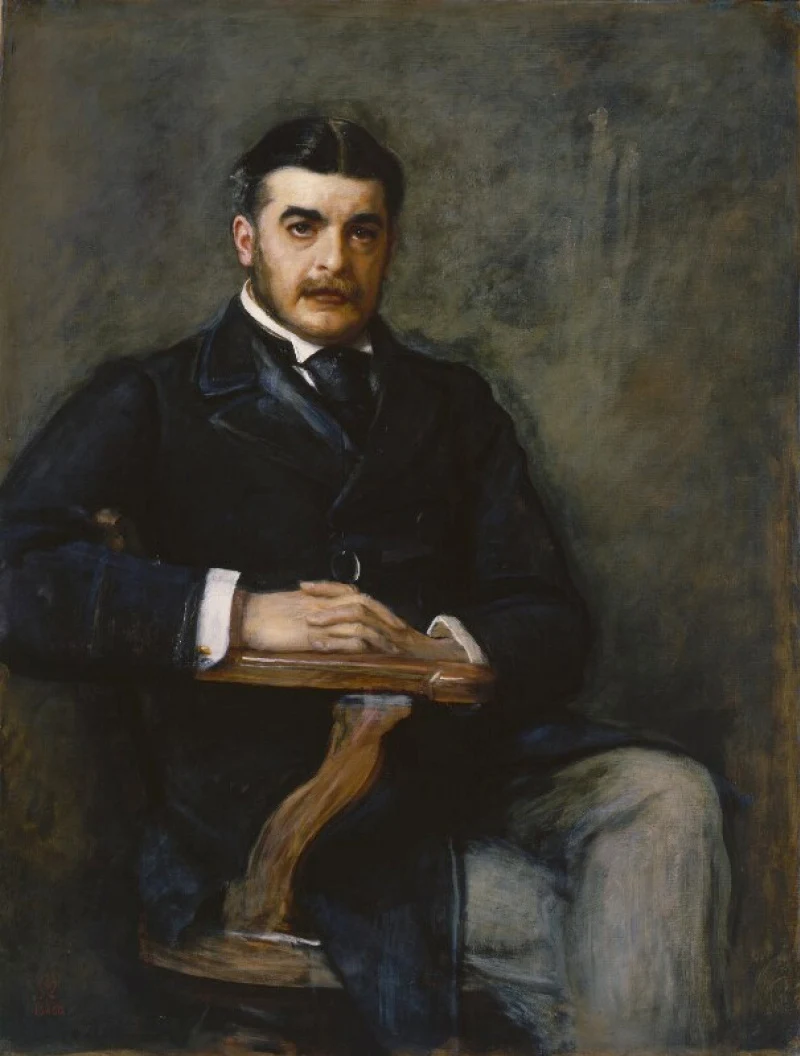
- 6. John Everett Millais / Wikimedia CommonsExact 1888 Sullivan portrait, rights and current 2020 revision
The current 2020 file is a complete NPG-sourced 800 × 1056 image. The record’s older general ArtDaily source field is distinguished from its later revision history.
- 7. Wikimedia CommonsComplete current Sullivan JPEG