In this biography
Quick facts
- Born
- 25 November 1835
- Died
- 11 August 1919
- Birthplace
- Dunfermline, Scotland
- Country
- United States
- Nationality
- American
- Known for
- Building Carnegie’s steel enterprises and funding libraries, education and peace institutions
- Birth
- 25 November 1835 in Dunfermline, Scotland
- Migration
- Settled with his family in Allegheny, Pennsylvania, in 1848
- Industry
- Railroad investment, bridges and steel production
- Major essay
- The Gospel of Wealth, 1889
- Business exit
- Sold his steel interests in 1901; they became part of U.S. Steel
- Death
- 11 August 1919 in Lenox, Massachusetts
Why this life matters
His career connects industrial expansion and conflict over workers’ power with a lasting debate about private wealth, public libraries and the obligations of philanthropy.
Timeline
Key moments
Born in Dunfermline
Grew up in a Scottish weaving family affected by industrial change.
Migration to Pennsylvania
His family settled in Allegheny, near Pittsburgh; he began factory work.
Keystone Bridge Company
Organized a bridge enterprise as his investments expanded beyond railroad employment.
The Gospel of Wealth
Published his argument that surplus wealth should support public benefit.
Homestead conflict
Backed Henry Clay Frick’s management strategy while abroad during the lockout and strike.
Steel sale
Withdrew from steel after the sale that helped form U.S. Steel.
Carnegie Corporation
Established a foundation to continue distributing his wealth.
Death in Massachusetts
Died on 11 August; institutions he endowed continued their work.
From Dunfermline to industrial Pennsylvania
Andrew Carnegie was born in Dunfermline, Scotland, on 25 November 1835. Mechanized production weakened the handloom trade on which his family depended. In 1848 they crossed the Atlantic and settled in Allegheny, Pennsylvania, near Pittsburgh. Carnegie entered a cotton mill as a bobbin boy, then worked as a telegraph messenger and operator. These jobs placed him inside the communications networks of a rapidly expanding industrial economy.
Formal schooling was limited, but reading remained central to his education. Colonel James Anderson’s lending library for working boys gave him access to books he could not buy. Railroad employment subsequently offered experience in management and connections that helped him enter business.
Building a steel enterprise
While working for the Pennsylvania Railroad, Carnegie invested in sleeping cars and other ventures connected with transportation. He organized the Keystone Bridge Company in 1865 and moved into steel in the following decade. Bridges, rails and locomotives linked his businesses to growing demand for durable industrial infrastructure. His enterprises relied on partnerships and skilled managers as well as his own investment decisions.
Carnegie’s contribution was the expansion and organization of production, rather than the invention of steel. His companies became a major industrial group before their sale to J. P. Morgan in 1901. The properties entered the newly formed United States Steel Corporation, and Carnegie’s attention shifted toward distributing the proceeds.
Sources for this section: [3]
Responsibility for the Homestead conflict
The 1892 conflict at the Homestead steelworks exposed the distance between Carnegie’s public sympathy for labor and his conduct as an owner. Henry Clay Frick directed the local management campaign to reduce wages and defeat the Amalgamated Association of Iron and Steel Workers. Carnegie was abroad, but his correspondence supported Frick’s strategy, including shutting the plant if workers rejected the terms.
The confrontation became deadly when Pinkerton guards attempted to reach the works. State militia later occupied the town, and the union suffered defeat. Frick managed the confrontation on the ground; Carnegie’s absence did not remove his responsibility for backing the campaign. Homestead remains central to assessing his exercise of industrial power alongside his later gifts.
The Gospel of Wealth and public libraries
In the essays published in 1889 and known as The Gospel of Wealth, Carnegie argued that wealthy people should administer their surplus resources for public benefit during their lifetimes. His preferred gifts created opportunities for education and self-improvement. That approach placed considerable power in donors’ judgments about what other people needed.
Libraries became its most visible expression. Carnegie and his foundation funded 2,509 public-library buildings worldwide, including 1,681 in the United States. These figures describe a geographically broad building program, not libraries all owned or operated by him. Communities generally undertook continuing support while his grants supplied construction capital, making local commitments essential to the institutions’ survival.
Institutions beyond a donor’s lifetime
Carnegie’s giving also supported museums, scientific inquiry, teaching and international peace. Pittsburgh’s Carnegie Institute opened in 1895 with a library and music hall as well as museum facilities. Its collections and public programs show how his philanthropy extended beyond providing books into art, science and civic culture.
In 1911 he established Carnegie Corporation of New York to carry forward the distribution of his wealth. Its early decision makers included his secretary James Bertram and financial agent Robert A. Franks. Carnegie died in Lenox, Massachusetts, on 11 August 1919. The institutions outlived him, leaving a legacy that requires attention both to their public benefits and to the labor relations that helped generate his resources.
Quick answers
Frequently asked questions about Andrew Carnegie
- Was Andrew Carnegie born in the United States?
- No. He was born in Dunfermline, Scotland, in 1835 and moved to Pennsylvania with his family in 1848. The Carnegie foundation documents his later U.S. citizenship certificate.
- What was Carnegie’s role in the Homestead strike?
- Henry Clay Frick directed operations locally, while Carnegie, abroad, supported the management strategy against the union. Carnegie’s responsibility rests on that support and ownership, rather than a claim that he personally commanded the fighting.
- How many Carnegie libraries were built?
- The foundation identifies 2,509 public-library buildings worldwide, including 1,681 in the United States. These are historical construction totals, not a count of branches still operating today.
- What does The Gospel of Wealth argue?
- Carnegie’s 1889 essays argue that wealthy people should use surplus resources during their lifetimes for public benefit. Libraries and educational institutions were prominent examples of his approach.
Keep exploring
Lives connected to this story
- Henry Ford
Compare another industrialist whose production systems, labor policies and public influence require examination together.
- Madam C. J. Walker
Explore a different American business built around products, training, distribution and philanthropy.
- S. R. Ranganathan
Compare library-building grants with a distinct programme of reader service, classification and professional education.
Sources and further reading
Explore the evidence
These references support the biography and offer further reading. Official records, first-person accounts and independent reporting provide different perspectives; image records document attribution and licensing.
- 1. Carnegie Corporation of New YorkAndrew Carnegie’s Story
- 2. Carnegie Council on Ethics in International AffairsAndrew Carnegie
- 3. Carnegie Corporation of New YorkAndrew Carnegie’s Philanthropic Institutions, 2007
- 4. PBS American ExperienceThe Strike at Homestead Mill
The documentary’s institutional historical essay quotes Carnegie’s correspondence supporting Frick. This supports responsibility for the antiunion strategy while identifying Frick as local manager; it does not establish that Carnegie personally directed the Pinkertons’ individual actions.
- 5. National Park Service200 Years of Labor History
- 6. Carnegie Corporation of New YorkThe Gospel of Wealth, 1889 essays
- 7. Carnegie Corporation of New YorkLibraries
- 8. Carnegie Corporation of New YorkCan Libraries Save America?
- 9. Carnegie Museums of PittsburghOur History
- 10. Columbia University LibrariesCarnegie Corporation of New York: Historical Note
- 11. Carnegie Corporation of New YorkCertificate of Andrew Carnegie’s U.S. Naturalization
The 2015 institutional account describes the certificate granted in New York after presentation of his father’s declaration. It supports American nationality and supersedes the same foundation’s 1997 essay footnote claiming he never attained full citizenship. No precise legal naturalization date is inferred here.
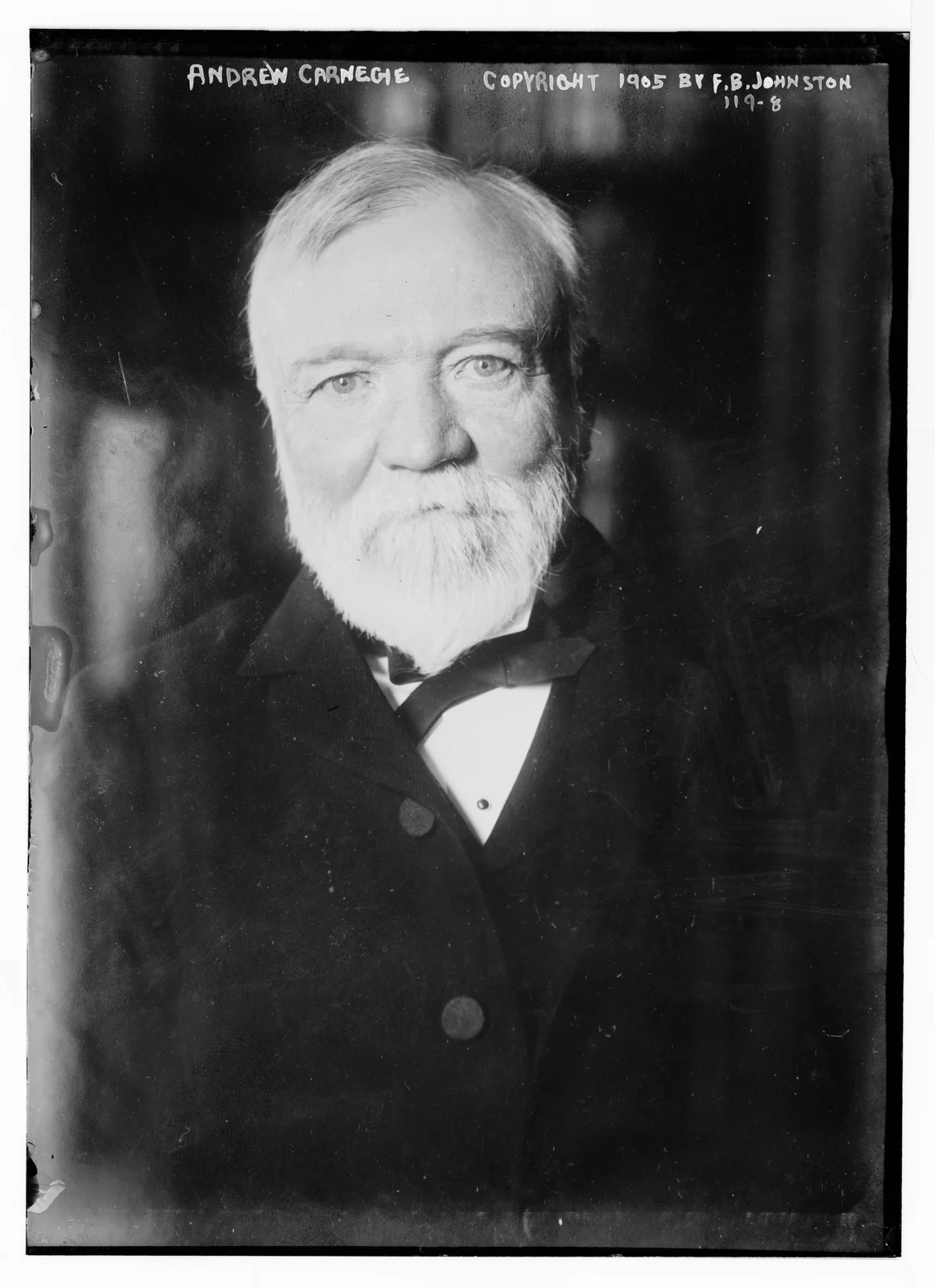
- 12. Library of Congress / Wikimedia CommonsAndrew Carnegie, portrait, copyright by F.B. Johnston — original scan
The source TIFF measures 4216×5810 and preserves the complete glass-negative scan. LOC identifies the portrait as copyrighted by F.B. Johnston, published later by Bain, dated 1905; Commons applies PD-Bain and PD-old-70-expired. Photographer attribution follows the LOC title; Bain is the publisher of the copy negative. Johnston died in 1952. No restoration, crop or AI alteration was performed.