
The short answer
A Carnegie library grant joined a private construction gift to a continuing public commitment. Understanding the division of costs explains both the program’s rapid growth and the work communities had to do after opening day.
Follow the obligation
Construction gift and continuing support
The grant and the local pledge answered different needs.
| Responsibility | Donor | Community |
|---|---|---|
| Starting the project | Construction capital | Site and formal acceptance |
| Running the library | No general promise of perpetual operation | Collections and recurring support |
Chronology
A timeline of the turning points
Dunfermline gift
Carnegie’s library giving begins in Scotland.
Braddock opens
The first Carnegie library to open in the United States.
New York branches
A major gift supports a neighborhood library network.
Design guidance
Bertram circulates Notes on Library Bildings.
What did the program build, and where?
The foundation’s historical total is 2,509 public-library buildings worldwide, of which 1,681 were in the United States. Keep those geographical categories together: the larger number is not an American total. These figures also describe funded buildings, rather than an inventory of operating libraries today. A building might later close, move to another use or be replaced without changing the historical count.
Carnegie libraries therefore form a building program rather than a single library chain. A shared donor did not make their collections, staffing and local services identical. To investigate one town, start with its own grant and opening records instead of assuming that a national total explains its particular history.
Sources for this section: [1]
What did an applicant need to show?
The application schedule reproduced by the National Park Service asked about population, an existing library, its book stock, circulation, accommodation, income and expenses. Those questions tested more than enthusiasm for a handsome building. They established what service already existed and whether the community could support a larger institution. A useful historical application can reveal local library work that began before Carnegie offered money.
Applicants also needed a suitable site and a commitment to annual support. The familiar standard was a yearly local pledge equal to ten percent of the construction gift. Thus a hypothetical $10,000 grant implied a $1,000 annual commitment; the recurring pledge was not a repayment of the donation.
Sources for this section: [2]
Who paid after the building opened?
The central distinction was capital versus operation. Carnegie generally paid for the physical building, while the community established collections and met continuing running costs. Land and annual support made the gift a local undertaking with obligations extending beyond construction. Describing the program simply as free libraries can obscure the taxes, organization and public decisions that made them function.
For a town considering the offer, the relevant question was therefore whether it could sustain a service, not merely obtain a structure. A construction grant removed a major initial expense without supplying an unlimited operating endowment. The opening ceremony marked the beginning of continuing responsibility for staff, books and the practical work of keeping the library useful.
Sources for this section: [3]
Did Carnegie prescribe one architectural style?
James Bertram, Carnegie’s secretary, increasingly examined plans for practical accommodation. His 1911 Notes on the Erection of Library Bildings offered six layouts for different sites. The guidance concerned light, shelf space, efficient rooms and economical use of the grant. It was not an instruction to reproduce one decorative facade in every town.
The California Carnegie Libraries research project records that exterior style was not prescribed and communities were not required to put Carnegie’s name on the building. Later procedures released funds in stages against certified work. An ornate entrance or a familiar classical appearance is therefore insufficient evidence by itself: correspondence, resolutions and payment records give a firmer basis for identifying a Carnegie-funded project.
Why separate the grant date from the opening date?
Library gifts and completed buildings followed different calendars. The foundation’s timeline distinguishes Allegheny’s earlier gift from Braddock’s distinction as the first Carnegie library to open in the United States, in 1889. A town could receive an offer before acquiring land, approving support, completing plans or finishing construction. One date cannot safely stand for all those milestones.
The same timeline places the large New York branch-library gift in 1901. That example shows why branches matter: the donor supported access through neighborhood buildings rather than assuming that one impressive central library could serve every resident. When comparing projects, record the offer, acceptance, construction and opening separately, and distinguish the number of communities from the number of buildings.
Sources for this section: [5]
Why does the foundation matter to the records?
Carnegie Corporation of New York was established in 1911 to continue distributing Carnegie’s resources. Columbia University’s historical note identifies Carnegie, Bertram and financial agent Robert A. Franks as the early executive committee. Library correspondence can therefore involve a donor’s office, a foundation and local public officials at different stages. Those participants should not be collapsed into an assumption that Carnegie personally handled every building decision.
For research, follow the obligation through the documents: the donor’s offer explains the gift, the municipal resolution explains local acceptance, and later accounts show how service continued. This approach makes the library’s civic history visible alongside its benefactor. It also explains why a surviving Carnegie building and a successful, adequately supported library are related achievements requiring separate evidence.
Sources for this section: [6]
Continue the chronology
Related history guides
Biography context
Explore United States through connected lives
Connected biographies
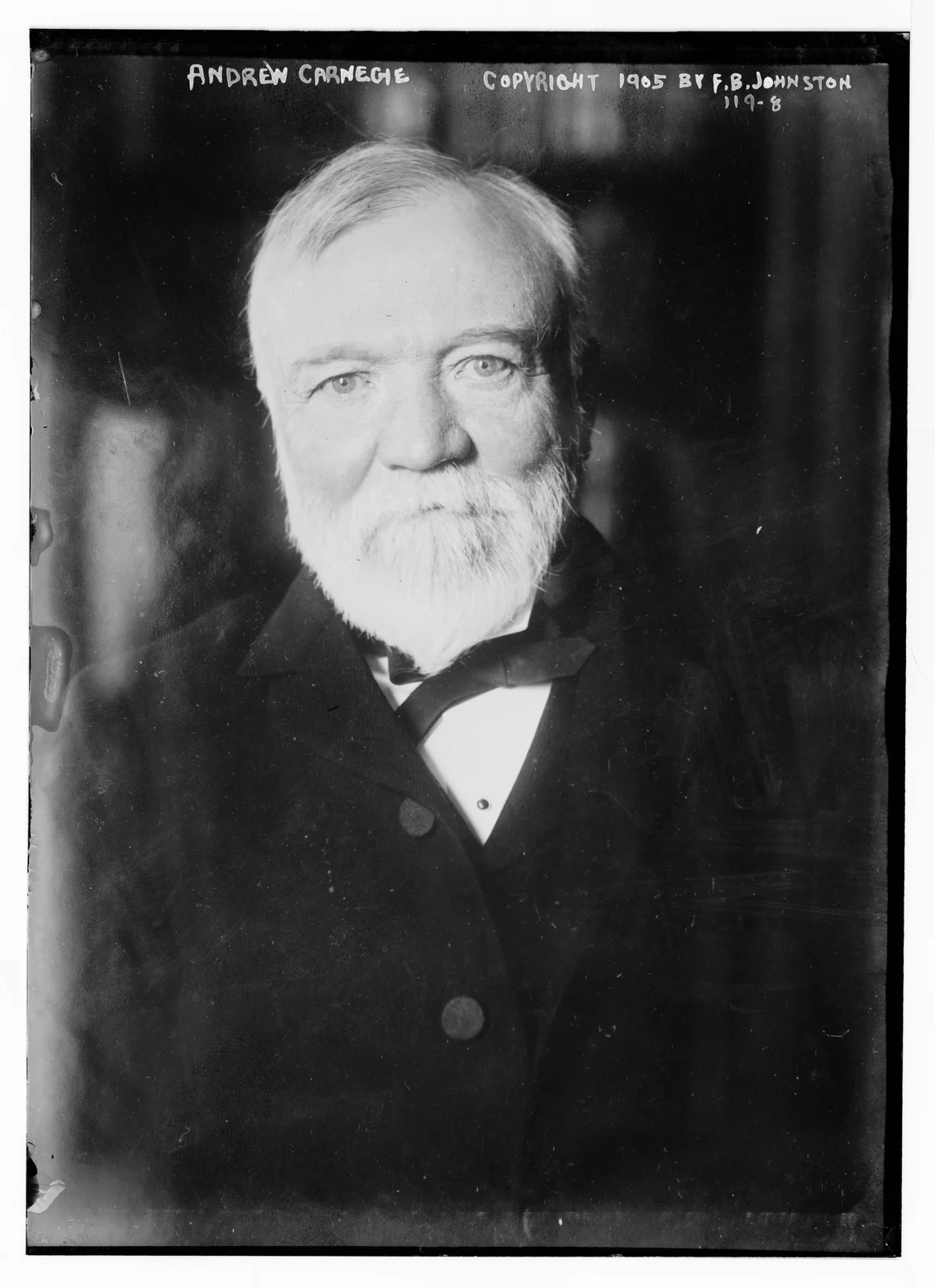
The industrialist behind the grants
1835–1919
Andrew Carnegie
Steel industrialist and philanthropistA Scotland-born American industrialist who expanded steel production, supported the management campaign against the Homestead union and devoted his later life to philanthropy.Read biographyQuick answers
Common questions
- Were all 2,509 Carnegie public libraries in America?
- No. That is the worldwide building total; 1,681 were in the United States.
- Was the ten-percent annual pledge a repayment?
- No. It committed local support for the library rather than returning the grant to Carnegie.
- Did the grant normally cover continuing operating costs?
- The general model funded the building and required local support for collections and operation.
- Did every library have to use the same exterior design?
- No. Bertram emphasized practical layouts and efficient use of funds, without prescribing one exterior style.
Primary and institutional sources
How this history was checked
Institutional histories, an application schedule reproduced by the National Park Service and research into grant correspondence establish the program’s general rules. Individual agreements may differ. This article was reviewed on 21 October 2026.
- Carnegie Corporation of New YorkLibraries — worldwide and U.S. building totals
- National Park ServiceCarnegie Libraries: The Future Made Bright — application and local obligations
- Carnegie Corporation of New YorkCan Libraries Save America? — building gifts and local operating support
- Carnegie Libraries of CaliforniaCarnegie Grants: process and design requirements
- Carnegie Corporation of New YorkAndrew Carnegie’s Library Legacy: A Timeline
- Columbia University LibrariesCarnegie Corporation of New York: Historical Note