
The short answer
Why does exchange in two spatial dimensions allow a different statistical description?
Read the evidence
Different records within the same investigation
The following comparison distinguishes the specific questions answered by the inspected records.
| Record or test | What it establishes | What remains different |
|---|---|---|
| Specified model | Defines particles, flux and the relevant setting. | Does not describe every spatial dimension or material. |
| Exchange calculation | Derives consequences of the chosen rule. | Is not a laboratory detection event. |
| Later experimental test | Would compare discriminating observables with a model. | Requires its own actual experimental record. |
Exchange was the question, not merely a label
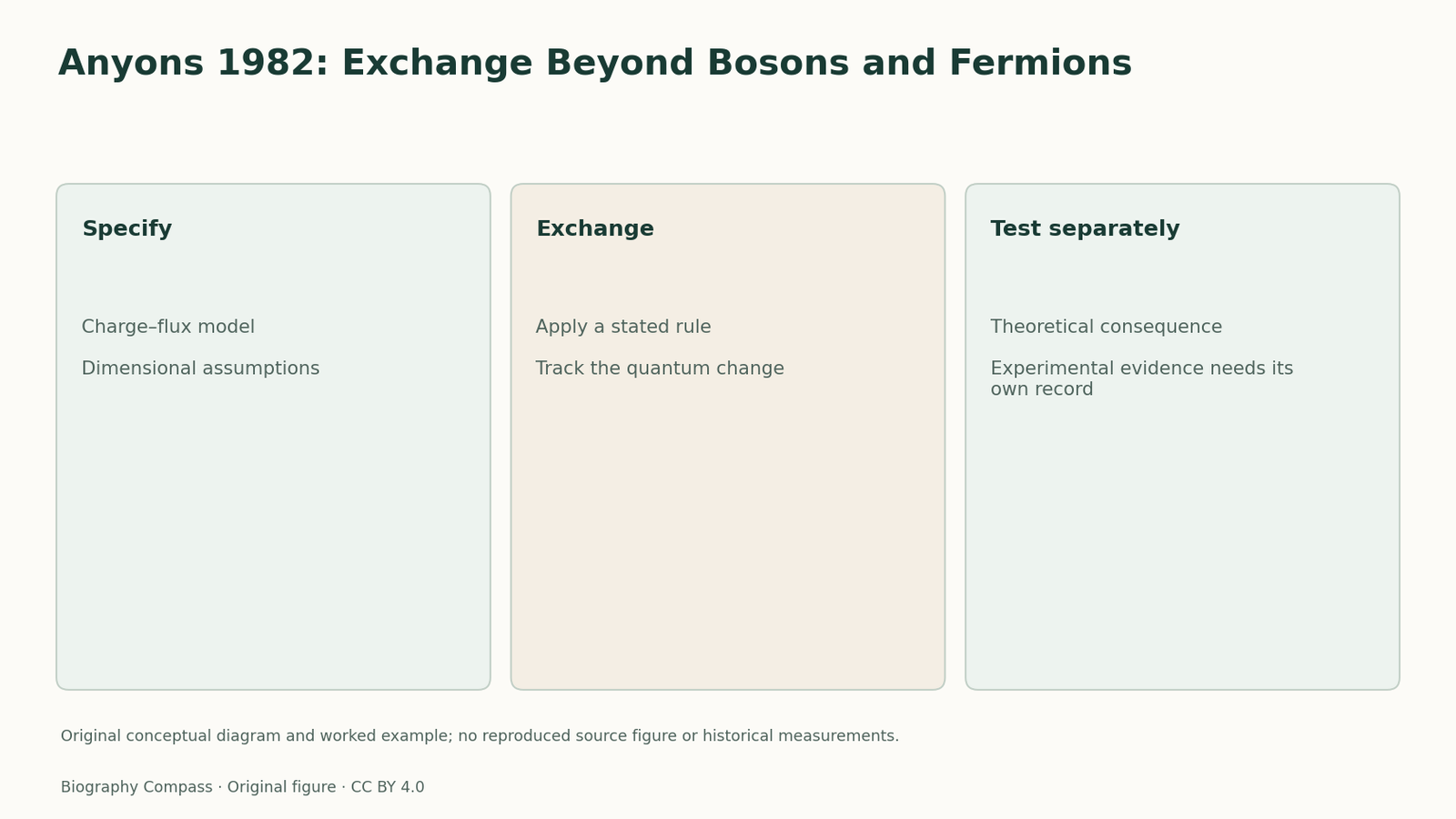
Wilczek’s 1982 fractional-spin paper analysed models involving charged particles and magnetic flux. In the relevant two-dimensional setting, exchange behaviour could interpolate beyond the familiar bosonic and fermionic cases. The paper made that possibility a concrete quantum-mechanical question. It was not a claim that ordinary particles in every three-dimensional setting could be assigned any exchange rule at will. Dimensionality and the assumptions of the constructed system were part of the result.
Sources for this section: [1]
A companion paper connected flux with angular momentum
The earlier 1982 paper on magnetic flux and angular momentum considered a charged particle associated with a flux tube and discussed unusual statistics of the composite. It supplied a physical route into the problem rather than simply declaring a new category. Read together, the papers connect a model’s ingredients with its quantum behaviour. They should still be identified as theoretical work: a calculation can demonstrate the consequences of a specified model without constituting a detector record from a material system.
A model prediction and an experimental claim need different records
The historical distinction matters because later discussions often place theoretical proposals and experimental searches in a single paragraph. The 1982 papers establish what Wilczek analysed then. To claim that a particular sample later realised the predicted statistics, an account would need the relevant experiment and its interpretation. No such later measurement is silently inserted here. The reader can instead ask exactly which exchange property the model specifies and what observable consequences would be needed to discriminate it from more familiar alternatives.
An original exchange-phase exercise
Consider three invented Abelian exchange rules that multiply a state by one, by minus one, or by the imaginary unit i after one exchange. Under the third rule, what factor results from two successive exchanges? Multiplying i by i gives minus one. That differs from assuming that two exchanges must return the phase factor to plus one. The exercise illustrates why an exchange rule contains information beyond a label attached to an individual object. It is not a measurement of an anyon, a derivation of all braid statistics or a description of non-Abelian state transformations. The supported answer is conditional on the stated Abelian phase rule. Changing that mathematical rule or the physical assumptions changes the question, so the toy calculation should not be treated as evidence that every possible material realises it.
Continue the chronology
Related history guides
Asymptotic Freedom: Scale and Interaction Strength
Read Gross and Wilczek’s 1973 result as a statement about scale-dependent coupling, with an original exercise separating high-energy behaviour from all-scale claims.
Read the timeline1983Laughlin 1983: A Wavefunction for Fractional States
Explore Laughlin’s variational quantum-fluid proposal and Haldane’s later extension, with an original exercise distinguishing a good trial state from an exact solution.
Read the timeline1982The Fractional Hall Effect 1982: A New Plateau
Read the Tsui–Störmer–Gossard transport result in its original scope, separating plateau measurements from the later quantum-fluid explanation.
Read the timelineBiography context
Explore United States through connected lives
Connected biographies
Researchers and related approaches
1951–
Frank Wilczek
Theoretical physicistFrank Wilczek helped establish asymptotic freedom and explored fractional statistics, connecting particle theory with questions about quantum matter.Read biography1902–1984
Paul Dirac
Theoretical physicistPaul Dirac developed mathematical foundations of quantum mechanics, linking a Bristol engineering education with Cambridge research and a prediction tested by particle experiments.Read biographyQuick answers
Common questions
- Were the 1982 papers reports of detecting anyons?
- No. They analysed theoretical models of fractional spin and statistics.
- Does the phase exercise cover non-Abelian anyons?
- No. It uses a stated Abelian phase rule solely to illustrate repeated exchange.
Primary and institutional sources
How this history was checked
The references below distinguish the original study from later explanations. The worked exercise and comparison are newly written for this article. This article was reviewed on 8 November 2026.