
The short answer
What distinguished the 1982 fractional Hall observation from an ordinary integer plateau?
Read the evidence
Different records within the same investigation
The following comparison distinguishes the specific questions answered by the inspected records.
| Record or test | What it establishes | What remains different |
|---|---|---|
| Hall plateau | Shows a transverse-response interval with the reported fractional behaviour. | Is more than one isolated data point. |
| Longitudinal minimum | Adds a second transport characteristic. | Does not alone specify the complete microscopic state. |
| Later collective explanation | Relates behaviour to correlated many-electron motion. | Must not be backdated as the original paper’s completed theory. |
The system and the measurements were specific
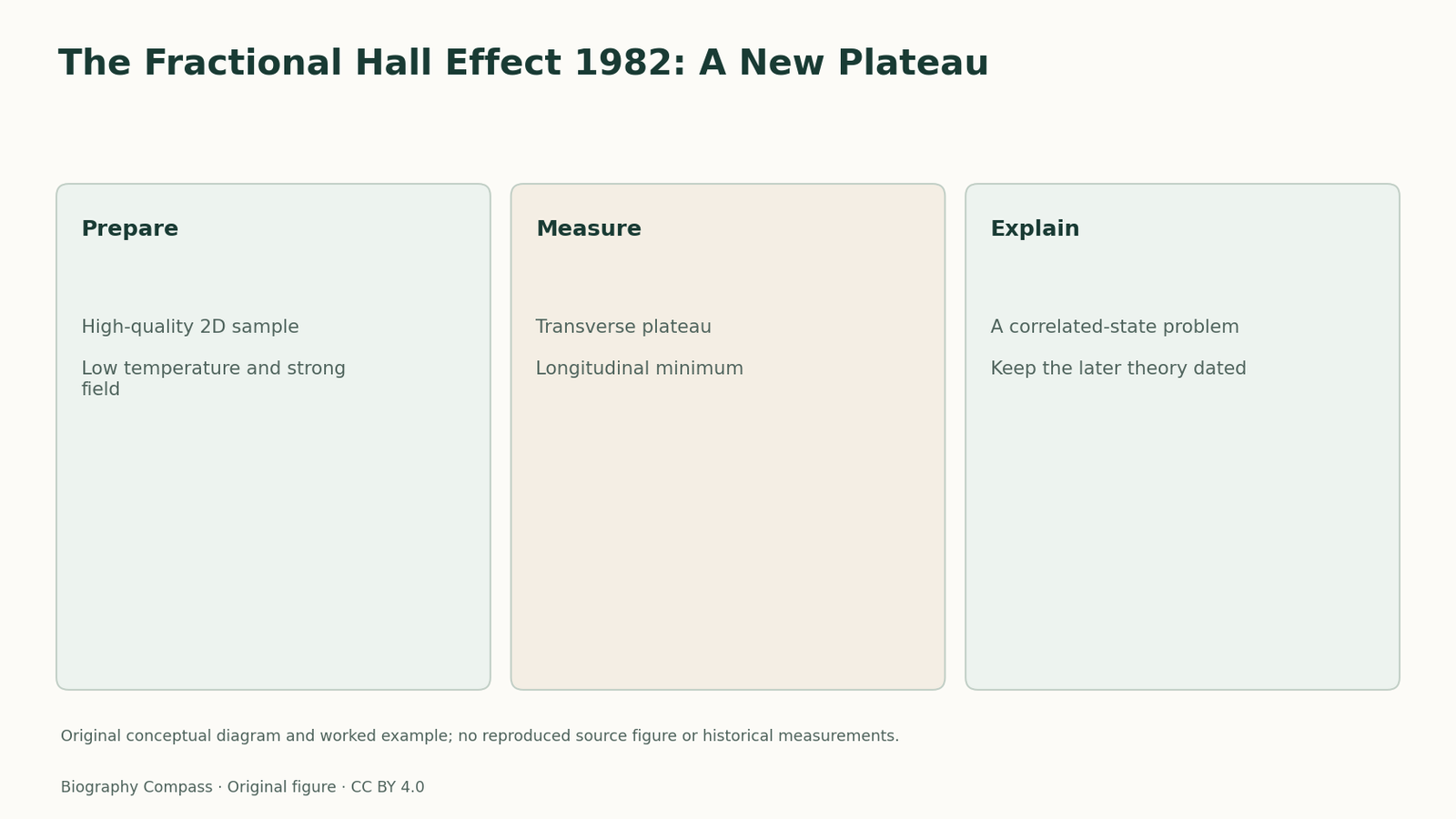
The 1982 experiment studied a high-mobility two-dimensional electron system in a gallium-arsenide-based semiconductor structure at low temperature and strong magnetic field. Tsui, Störmer and Gossard measured transport, including the transverse Hall response and longitudinal resistance. The reported fractional feature combined a Hall plateau with a longitudinal minimum. It was a pattern across controlled conditions, not merely an unexpected voltage at one unexamined setting. Sample quality and the measurement regime were essential parts of the observation.
Sources for this section: [1]
A fractional plateau created an explanatory problem
The paper identified behaviour associated with one-third filling rather than the integer fillings already familiar from earlier quantum Hall work. Its interpretation was not yet the full quantum-fluid account later associated with Laughlin. The original discussion considered possibilities appropriate to the evidence then available. Reading it in historical order makes the surprise visible: the transport record arrived before the mature explanation. A later successful theory should not be inserted into the earlier article as though the experimenters had already written it there.
The later overview explains the collective character
The 1999 overview by Störmer, Tsui and Gossard describes fractional quantum Hall behaviour as emerging from highly correlated motion of many electrons. That statement explains why an independent-electron picture was insufficient for the observed phenomenon. It is a later synthesis by the experimental collaborators, not a separate 1982 measurement of every predicted fractional excitation. The two records can be read productively together when the contemporary observation and the retrospective explanation remain clearly labelled.
Sources for this section: [2]
An original two-response exercise
Imagine a fictional experiment in which the transverse resistance remains nearly constant across a small field interval while the longitudinal resistance falls strongly in the same interval. Why record both responses? Together they describe more of the transport state than either quantity alone. Now imagine a second sample showing only a noisy isolated point at the same nominal field. That point is not equivalent to demonstrating the first sample’s plateau-and-minimum pattern. These are invented qualitative examples, not reconstructed Hall data. The supported answer distinguishes an interval of behaviour, a second transport observable and the reproducibility of the conditions. It also keeps observation separate from microscopic explanation: identifying a distinctive resistance pattern motivates a theory, but a cartoon of the pattern does not derive the underlying many-electron state.
Continue the chronology
Related history guides
Laughlin 1983: A Wavefunction for Fractional States
Explore Laughlin’s variational quantum-fluid proposal and Haldane’s later extension, with an original exercise distinguishing a good trial state from an exact solution.
Read the timeline1982Anyons 1982: Exchange Beyond Bosons and Fermions
Explore Wilczek’s 1982 fractional-statistics papers, distinguishing a theoretical exchange rule from a laboratory observation through an original phase exercise.
Read the timelineBiography context
Explore United States through connected lives
Connected biographies
Researchers and related approaches
1939–
Daniel Tsui
Experimental condensed-matter physicistDaniel Tsui studied two-dimensional electron transport and co-discovered the fractional quantum Hall effect using exceptionally clean semiconductor samples.Read biography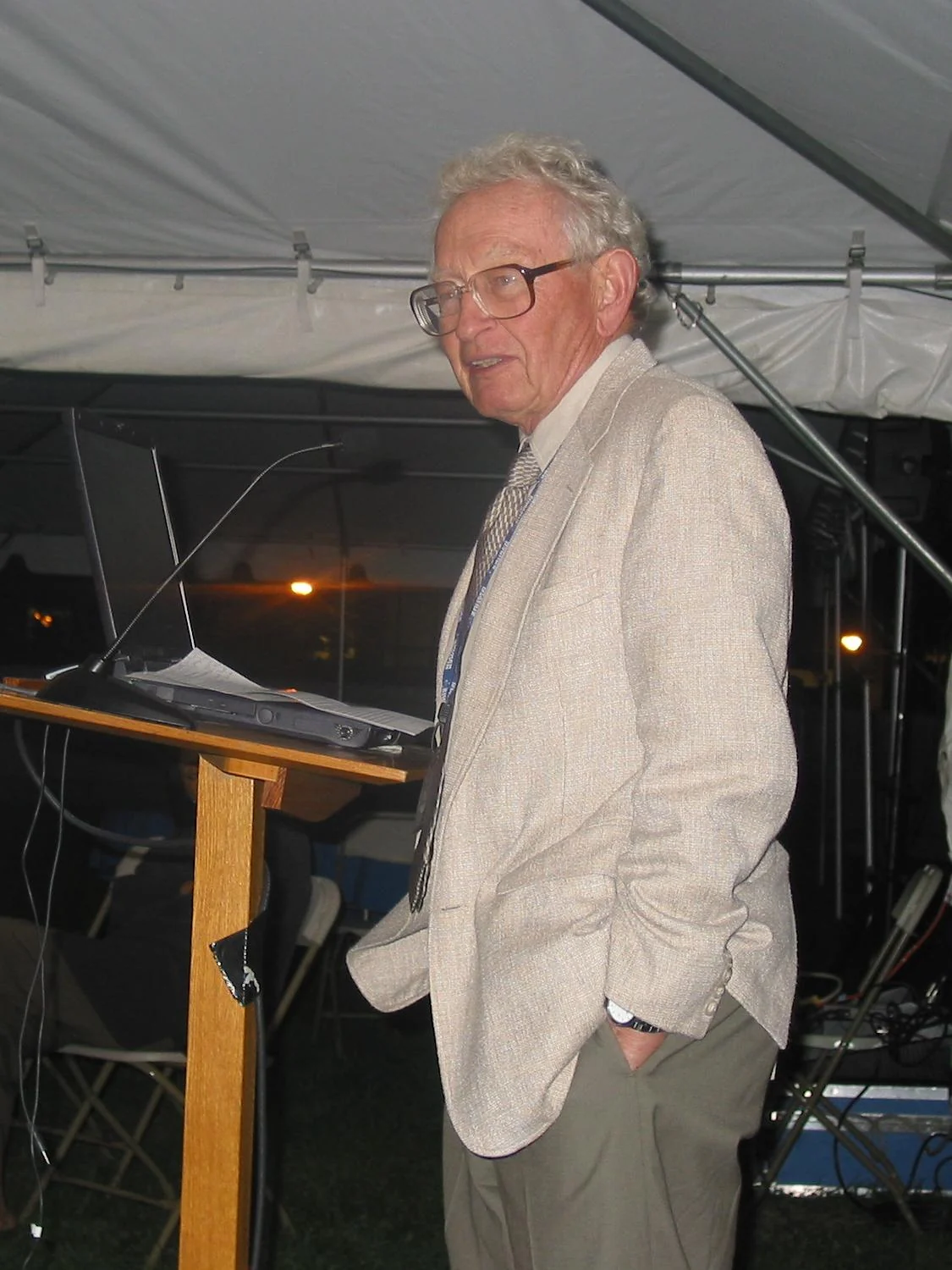
1923–2020
Philip Anderson
Condensed-matter theoretical physicistPhilip Anderson developed condensed-matter theory through Bell Laboratories, Cambridge and Princeton, connecting microscopic models with collective material behaviour.Read biographyQuick answers
Common questions
- Was Laughlin’s explanation already in the 1982 paper?
- No. The experimental result preceded the 1983 quantum-fluid proposal.
- Why compare two transport responses?
- They characterise different aspects of the same experimental regime.
Primary and institutional sources
How this history was checked
The references below distinguish the original study from later explanations. The worked exercise and comparison are newly written for this article. This article was reviewed on 8 November 2026.
- Tsui, Störmer and Gossard, Physical Review Letters, 1982Two-Dimensional Magnetotransport in the Extreme Quantum Limit
- Störmer, Tsui and Gossard, Reviews of Modern Physics, 1999The fractional quantum Hall effect
- Robert Laughlin, Physical Review Letters, 1983Anomalous Quantum Hall Effect: An Incompressible Quantum Fluid with Fractionally Charged Excitations
- Nobel Prize OutreachDaniel Tsui — Facts
- Nobel Prize OutreachDaniel Tsui — Biographical