
The short answer
What did a correlated wavefunction explain beyond the observed fractional Hall plateau?
Read the evidence
Different records within the same investigation
The following comparison distinguishes the specific questions answered by the inspected records.
| Record or test | What it establishes | What remains different |
|---|---|---|
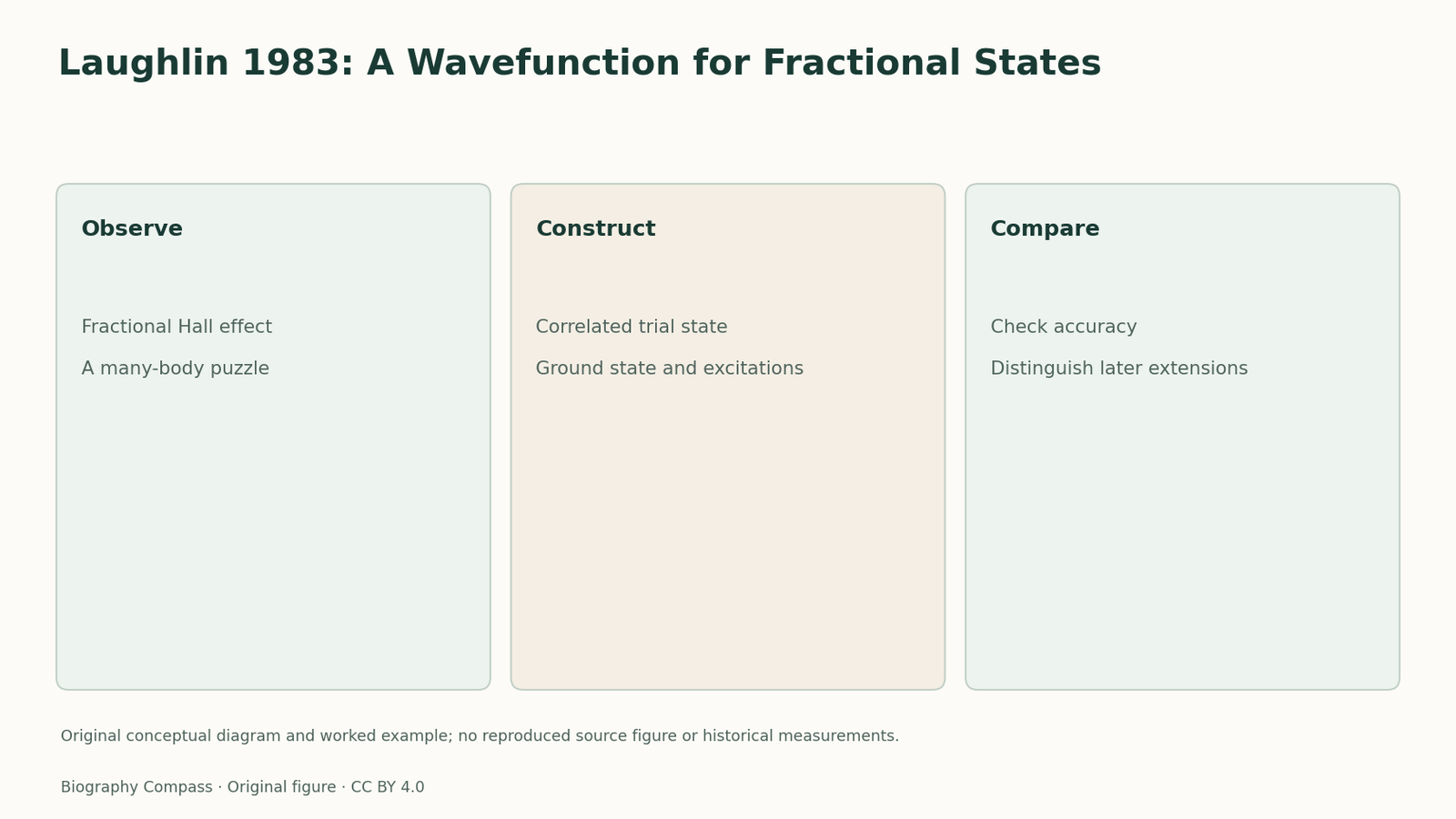
| 1983 trial wavefunctions | Provide a correlated account of ground and excited states. | A variational proposal is not automatically an exact solution. |
| Fractional excitations | Describe low-energy behaviour within the interacting system. | Do not imply an isolated electron was physically cut apart. |
| Haldane hierarchy | Extends the theoretical landscape to further fractional states. | Is a separate later contribution. |
The proposal described a many-electron state
Laughlin’s 1983 paper presented variational wavefunctions for the ground and excited states of a two-dimensional electron system. The explanatory unit was a collective state, rather than an isolated electron assigned a new elementary charge. The proposal addressed the fractional quantum Hall effect observed experimentally the preceding year. Its importance lay in connecting that transport behaviour with a specific form of correlated quantum matter that could be analysed, tested and extended.
Correlation changed the theoretical problem
The Nobel scientific background explains the proposed state using factors involving pairs of electron positions. Such a construction encodes relationships among electrons rather than treating each as an independent contribution. The account also distinguishes the ground state from its low-energy excitations, which carry fractional charge within the system. A statement about those excitations is not a claim that every electron has ceased to possess its usual charge. This is why the words “quantum fluid” and “fractional excitation” belong together in a careful explanation.
Sources for this section: [2]
A successful construction still had a defined range
Haldane’s 1983 paper reformulated the state in spherical geometry and extended it into a hierarchy of fractional fillings. That was a separate theoretical contribution, not a section silently contained in Laughlin’s original short paper. The comparison is useful because a compelling trial state can organise a field while leaving further states and questions for additional work. Laughlin’s own autobiography also describes numerical exploration and the use of variational methods, making the proposal’s approximate and constructive character part of its history.
An original trial-state exercise
Suppose two invented trial states give estimated energies of ten and eight in the same arbitrary units under the same model. Which is the better variational candidate? The state with eight has the lower estimate within that comparison. Does this establish that eight is the exact ground-state energy? No: a third permitted state might yield a lower value. These are not historical Hall-system energies or a calculation of fractional charge. The exercise illustrates why a successful variational construction must be distinguished from an exact solution. Its supported answer states the common assumptions, compares the candidates and identifies the remaining task of testing accuracy or improving the state. Agreement with independent observations and calculations can provide strong support without changing an approximation into a claimed mathematical identity.
Continue the chronology
Related history guides
The Fractional Hall Effect 1982: A New Plateau
Read the Tsui–Störmer–Gossard transport result in its original scope, separating plateau measurements from the later quantum-fluid explanation.
Read the timeline1982Anyons 1982: Exchange Beyond Bosons and Fermions
Explore Wilczek’s 1982 fractional-statistics papers, distinguishing a theoretical exchange rule from a laboratory observation through an original phase exercise.
Read the timelineBiography context
Explore United States through connected lives
Connected biographies
Researchers and related approaches
1950–
Robert Laughlin
Theoretical condensed-matter physicistRobert Laughlin proposed a correlated quantum-fluid description of the fractional quantum Hall effect, linking a many-electron state with fractional-charge excitations.Read biography
1923–2020
Philip Anderson
Condensed-matter theoretical physicistPhilip Anderson developed condensed-matter theory through Bell Laboratories, Cambridge and Princeton, connecting microscopic models with collective material behaviour.Read biographyQuick answers
Common questions
- Does a lower trial energy prove the exact answer?
- No. It identifies a better candidate within the comparison, subject to the model and remaining possibilities.
- Are fractional excitations isolated pieces of an electron?
- No. They are collective-system excitations with fractional effective charge.
Primary and institutional sources
How this history was checked
The references below distinguish the original study from later explanations. The worked exercise and comparison are newly written for this article. This article was reviewed on 8 November 2026.
- Physical Review Letters, 1983Anomalous Quantum Hall Effect: An Incompressible Quantum Fluid with Fractionally Charged Excitations
- Royal Swedish Academy of Sciences, 1998Additional background material on the Nobel Prize in Physics 1998
- F. D. M. Haldane, Physical Review Letters, 1983Fractional Quantization of the Hall Effect: A Hierarchy of Incompressible Quantum Fluid States
- Nobel Prize OutreachRobert Laughlin — Facts
- Nobel Prize OutreachRobert Laughlin — Biographical