
The short answer
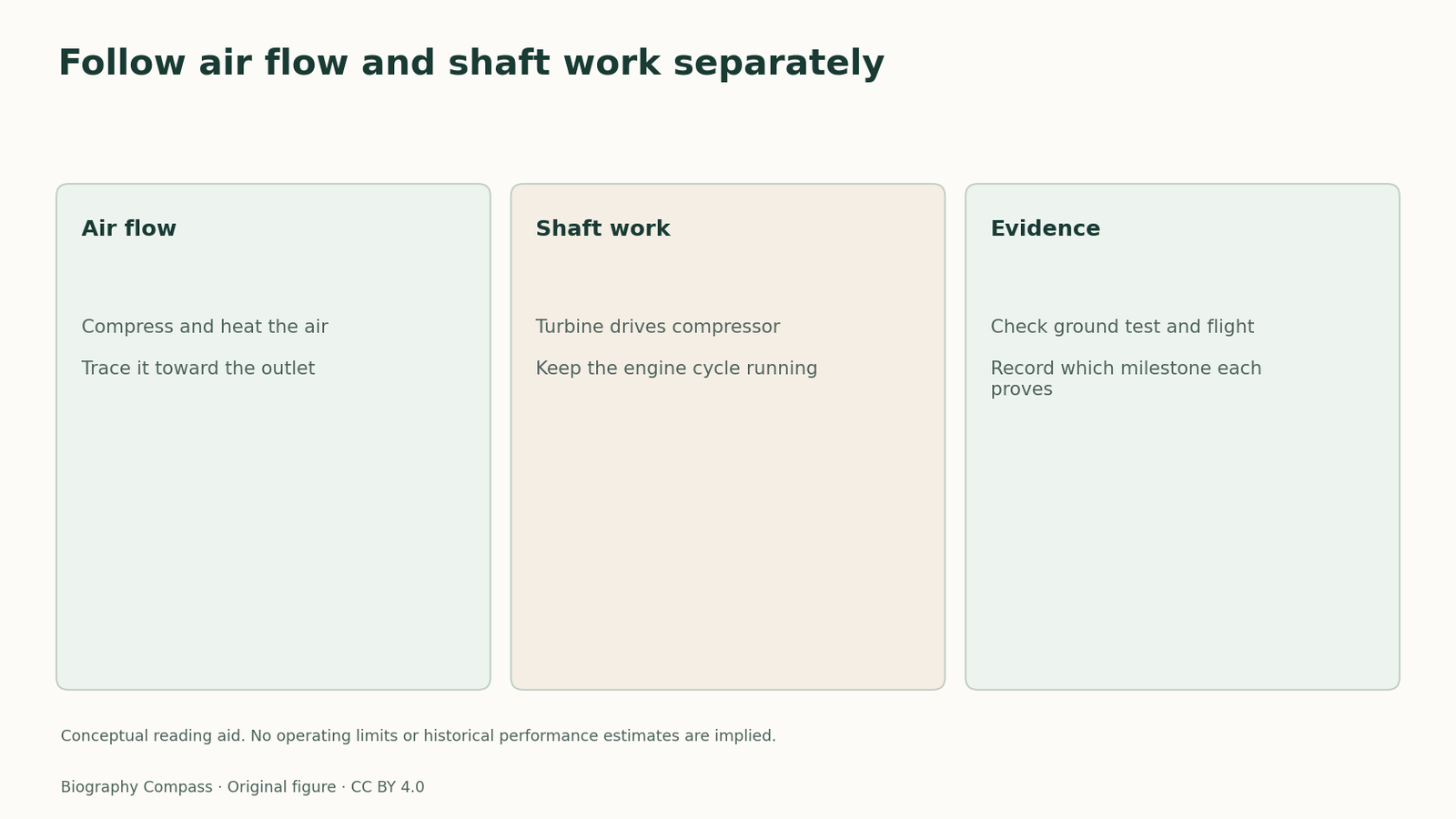
A turbojet uses some energy in its hot gas to keep the compressor turning. The rest of the flow can still be useful in producing thrust. A cutaway is easier to read once these jobs are separated.
Reading the evidence
Three milestones in an engine programme
Do not assign a later capability to an earlier document.
| Stage | Question answered | Separate claim |
|---|---|---|
| Patent | How the compressor and turbine are intended to work together. | Whether a built engine ran. |
| Ground test | Whether an engine operates under specified conditions. | Whether it can power an aircraft in flight. |
| Flight test | Whether this aircraft and engine flew together. | Whether the design was ready for routine service. |
Trace the flow and the shaft separately
The patent specifies that air is compressed, heated and expanded. The hot stream passes through a turbine linked to the compressor. That linkage transfers power mechanically. A separate path carries gas toward the outlet, where its motion contributes to thrust.
Draw a line through the compressor, combustion region, turbine and outlet. On a second line connect turbine and compressor by the shaft. A drawing with only the gas path could give the impression that each part acts independently. The second line explains why a failure to supply enough shaft power would undermine the whole cycle.
Sources for this section: [1]
Match a question to a test
The Gloster E.28/39 and RAF flight record are evidence of an engine operating in an aircraft. They establish a different milestone from the 1930 filing. Before flight, a ground run can answer a narrower question about sustained operation. After flight, questions about reliability, durability and ordinary service still require more evidence.
The distinction helps when comparing aircraft programmes. A filing can precede an engine run by years; a successful flight can precede mass manufacture by another interval. Sort documents by what was actually tested rather than by which one is oldest.
Read an invented energy budget
Assume a classroom model has ten units of available energy after heating and the compressor needs four units of shaft work. If the turbine supplies only three, that operating point cannot sustain the compressor on its own under the stated assumptions. Increasing the turbine share may affect what remains in the outlet flow. The example does not calculate a real engine’s thrust or efficiency. Its job is to identify two competing demands on one flow.
Continue the chronology
Related history guides
Biography context
Explore United Kingdom through connected lives
Connected biographies
People in the records
1907–1996
Frank Whittle
RAF officer and turbojet engineerWhittle developed a turbojet proposal into running engines and a British flight test programme.Read biographyQuick answers
Common questions
- Does all the turbine’s shaft work become thrust?
- No. Shaft work powers the compressor. The exhaust flow, after giving up some energy to the turbine, contributes to thrust.
Primary and institutional sources
How this history was checked
Dates, legal milestones and historical claims are checked against the official and institutional records below. This article was reviewed on 5 November 2026.