
The short answer
How did modified nucleosides change innate immune recognition without proving vaccine efficacy?
Read the evidence
Three endpoints in an RNA history
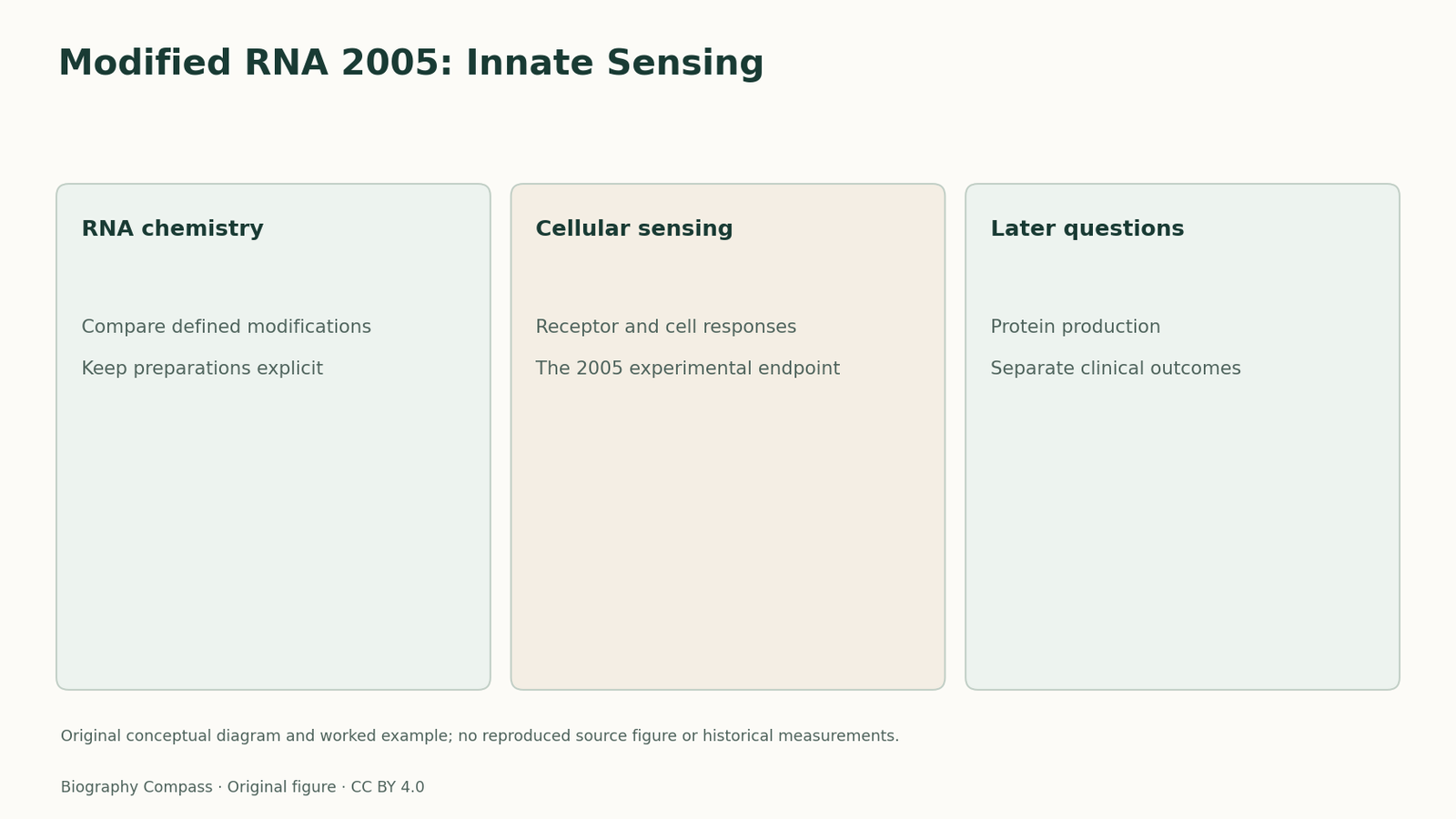
Changing a cellular signal, producing a protein and preventing disease require different evidence.
| Record or test | What it establishes | What remains different |
|---|---|---|
| Innate sensing | Measures responses to the RNA preparation. | Does not itself establish clinical protection. |
| Protein production | Measures translation of the encoded message. | Is different from an immune-sensor assay. |
| Clinical outcome | Tests a defined effect in participants. | Was not the endpoint of the 2005 laboratory paper. |
The experimental question was immune recognition
The 2005 paper examined how RNA interacted with innate immune sensors. The researchers compared responses to RNA with different chemical modifications and investigated Toll-like receptor activity. Their question concerned a cell’s recognition of RNA, not whether a future vaccine prevented disease. Naming that endpoint makes the result more informative: a change in cellular sensing can be an important enabling discovery while remaining distinct from an eventual clinical application.
Sources for this section: [3]
Modified RNA changed the tested response
The abstract reports that incorporating modified nucleosides reduced activation in the tested receptor and dendritic-cell systems. This connected molecular chemistry with measurable cellular behaviour. The Nobel account places the experiment within a comparison between laboratory-transcribed RNA and forms of RNA found in mammalian cells. These sources help explain why the chemical difference mattered. They do not support treating every possible RNA preparation as interchangeable or assuming that one assay predicts every immune response in a whole organism.
A research programme contains several endpoints
Weissman’s Penn research profile distinguishes studies of RNA immunogenicity and translation from the development of possible applications. That distinction is useful when reading the history. Innate activation concerns recognition and signalling; translation concerns production of the encoded protein; clinical efficacy concerns an outcome measured in people. A successful result at one level can motivate research at the next without automatically supplying its answer. The 2005 study belongs early in that sequence, while later work investigated additional obstacles and applications. A historical comparison becomes clearer when it states the preparation, experimental system and measured response for each step.
An original endpoint-sorting exercise
Imagine three fictional reports. Report A measures cytokine responses after cells receive an RNA preparation. Report B measures how much encoded protein the cells produce. Report C compares a disease outcome between groups of participants. Which report answers each question? A addresses an immune-response endpoint, B a translation endpoint and C a clinical outcome. Now suppose A shows reduced activation while B is unchanged. The supported interpretation is a narrower sensing result, not proof that every downstream objective improved. The cards contain no invented vaccine data or claim about a particular treatment. They help readers understand why foundational laboratory papers and later clinical studies can be connected historically while remaining different kinds of evidence, with different measurements and different populations.
Continue the chronology
Related history guides
Pseudouridine 2008: Translation and Sensing
Compare the 2008 pseudouridine study with the earlier RNA-sensing result, separating encoded protein, RNA persistence and later clinical applications.
Read the timeline2000–2001RNA Polymerase II: Structure and Transcription
Compare the 2001 ten-subunit polymerase structure with a separate elongation complex, and distinguish structural proposals from functional transcription evidence.
Read the timelineBiography context
Explore United States through connected lives
Connected biographies
Researchers and related approaches
1959–
Drew Weissman
Physician-scientist and immunologistDrew Weissman brought immunology to a Penn collaboration with Katalin Karikó that investigated how cells recognise experimentally produced RNA.Read biographyQuick answers
Common questions
- What was the 2005 study’s main endpoint?
- It investigated RNA recognition and innate activation, including receptor and dendritic-cell responses.
- Why distinguish sensing from translation?
- A preparation can change how cells recognise RNA without automatically establishing how much protein it produces.
Primary and institutional sources
How this history was checked
The primary abstract supports the specific sensing result. Penn and Nobel records explain its place within a larger research programme without making it a clinical trial. This article was reviewed on 7 November 2026.
- University of Pennsylvania Perelman School of MedicineDrew Weissman: education and research expertise
- National Inventors Hall of FameDrew Weissman: inventor biography
- Karikó, Buckstein, Ni and Weissman / ImmunitySuppression of RNA recognition by Toll-like receptors: the impact of nucleoside modification and the evolutionary origin of RNA
- Nobel Assembly at Karolinska InstitutetThe 2023 Nobel Prize in Physiology or Medicine: press release
- Nobel Prize OutreachDrew Weissman — Facts