
The short answer
What additional question did the 2008 translation experiments ask beyond the 2005 immune-recognition work?
Read the evidence
A message, its output and the response
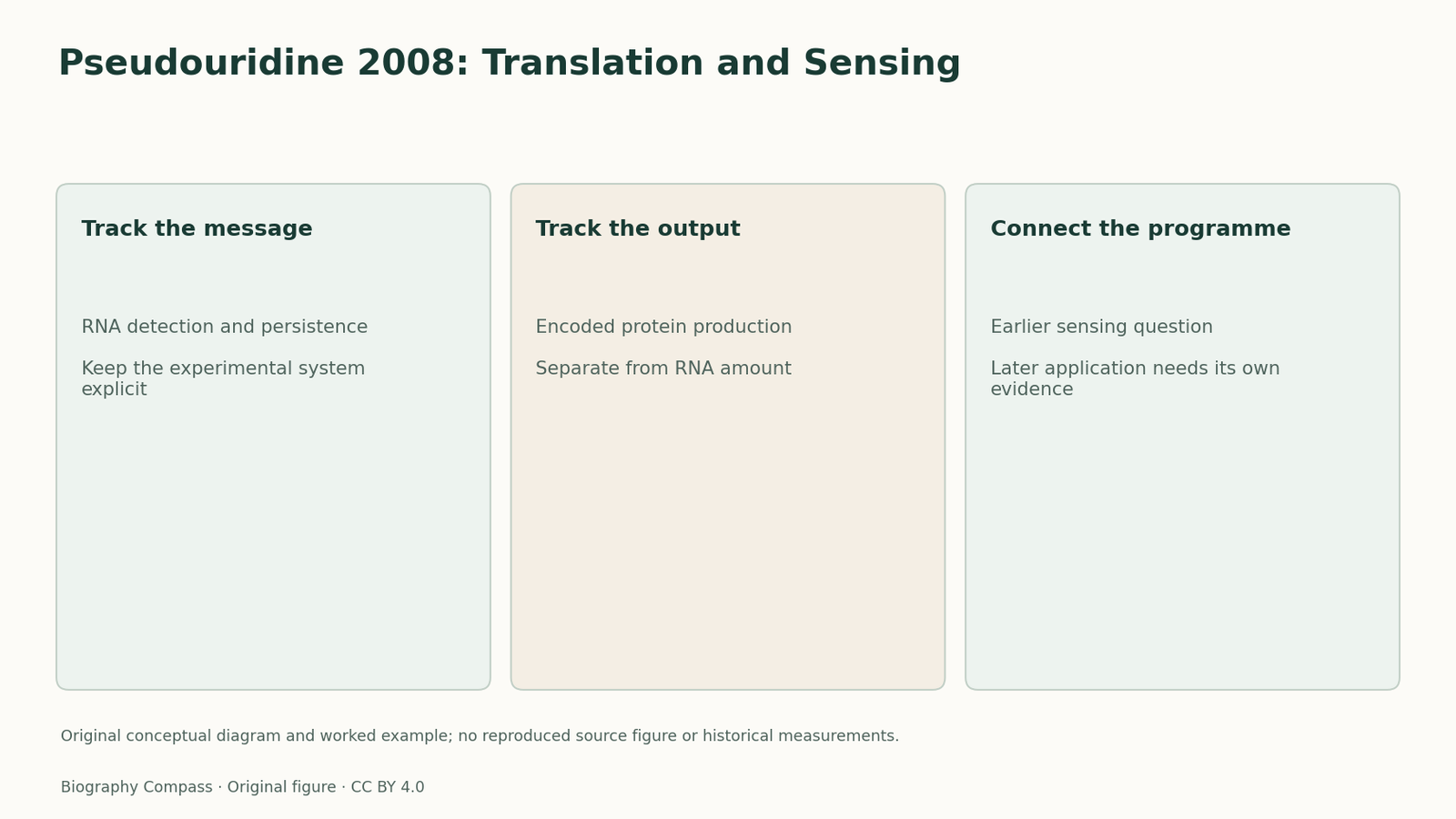
The 2008 question becomes clearer when three biological records are kept separate.
| Record or test | What it establishes | What remains different |
|---|---|---|
| Delivered RNA | Tracks the message under the tested conditions. | Does not by itself quantify encoded protein. |
| Encoded protein | Measures an output of translation. | Does not alone prove why that output increased. |
| Innate response | Measures recognition or activation. | Is distinct from a later clinical efficacy endpoint. |
A less inflammatory message must still work
The earlier modified-RNA studies addressed innate recognition. The 2008 paper asked an additional practical question: could a modified transcript support improved production of its encoded protein? A message that provokes less activation is not automatically an efficient template for translation. The study therefore examined pseudouridine-containing mRNA through endpoints that went beyond the original sensing question, linking the chemistry of a transcript with its performance as a biological message.
Measure protein and RNA as different records
The primary abstract describes higher translation in mammalian cells and lysates and after administration in mice. It also reports detection of both delivered RNA and encoded protein in the spleen. Those are related observations with different meanings. Measuring RNA indicates persistence of the message under the study conditions; measuring protein indicates output from translation. One quantity cannot simply replace the other. The distinction is especially useful when a general account compresses all improvements into the word stability.
Sources for this section: [4]
Keep the development sequence visible
The Nobel account places later protein-production findings after the 2005 innate-sensing discovery. Karikó’s Szeged institutional biography also describes a wider research programme involving RNA preparation and applications. The useful historical connection is cumulative: reducing a recognition problem, examining translation and investigating delivery or application are linked tasks. The 2008 result did not independently establish the clinical effectiveness of a later vaccine. Its value lies in answering defined laboratory questions that helped make subsequent development possible. Historical value comes from identifying which obstacle each experiment actually addressed.
An original message-and-output exercise
Imagine two fictional RNA preparations tested under the same conditions. Both leave detectable RNA, but one produces more encoded protein. A student concludes that the higher protein level proves longer RNA persistence. Is that conclusion supported? Not from those observations alone: the experiment must separately measure the message and its output over time. Now add a third record showing an innate immune response. This supplies another endpoint, not a substitute for either earlier measurement. The supported answer is to keep RNA persistence, protein production and immune activation in separate columns before explaining their relationships. This original exercise uses no historical doses, patient data or invented therapeutic outcome; it shows why the 2008 study asked a question that the 2005 sensing result could not answer by itself.
Continue the chronology
Related history guides
Modified RNA 2005: Innate Sensing
Examine the 2005 RNA-modification study’s receptor and dendritic-cell endpoints, separating reduced innate activation from translation and clinical efficacy.
Read the timeline2000–2001RNA Polymerase II: Structure and Transcription
Compare the 2001 ten-subunit polymerase structure with a separate elongation complex, and distinguish structural proposals from functional transcription evidence.
Read the timelineBiography context
Explore United States through connected lives
Connected biographies
Researchers and related approaches
1955–
Katalin Karikó
Biochemist and RNA researcherKatalin Karikó pursued RNA research from Hungary to the United States, investigating how modified messenger RNA could produce proteins with reduced innate activation.Read biography
1918–2013
Frederick Sanger
Biochemist and sequencing-method researcherFrederick Sanger developed ways to determine the order of components in proteins and nucleic acids. His two chemistry Nobel Prizes mark different stages of a research career whose continuity was the problem of sequence and whose methods depended on many collaborators.Read biographyQuick answers
Common questions
- Are RNA persistence and protein production identical?
- No. They are related measurements of a message and its output, which need to be assessed separately.
- Did the 2008 experiments establish a later vaccine’s clinical efficacy?
- No. They investigated defined RNA preparations in laboratory systems and mice, not that later clinical endpoint.
Primary and institutional sources
How this history was checked
The 2008 primary abstract supplies the translation and persistence endpoints. The earlier paper and institutional histories explain why these were additional questions. This article was reviewed on 7 November 2026.
- Penn MedicineKatalin Karikó: biography
- University of Szeged Library and Media ArchiveKatalin Karikó: scientific biography
- Karikó, Buckstein, Ni and Weissman / ImmunitySuppression of RNA recognition by Toll-like receptors
- Karikó and colleagues / Molecular TherapyIncorporation of pseudouridine into mRNA yields superior nonimmunogenic vector with increased translational capacity and biological stability
- Nobel Assembly at Karolinska InstitutetThe 2023 Nobel Prize in Physiology or Medicine: press release
- Nobel Prize OutreachKatalin Karikó — Facts