
The short answer
How did the 1967 lepton model combine gauge interactions and symmetry breaking in one framework?
Read the evidence
Different records within the same investigation
The following comparison distinguishes the specific questions answered by the inspected records.
| Record or test | What it establishes | What remains different |
|---|---|---|
| 1967 construction | Specifies fields, symmetry and a mass-generating structure. | Does not contain the later renormalisability proof. |
| Mathematical consistency result | Establishes a defined theoretical property. | Does not itself observe a predicted particle. |
| Experimental test | Compares a physical prediction with observations. | Does not replace the model’s assumptions or proof. |
The paper proposed a particular lepton model
Weinberg’s 1967 opening restricted the immediate construction to electron-type leptons and associated gauge fields. It combined weak and electromagnetic interactions through a spontaneously broken symmetry. The resulting description included massive weak carriers while identifying a massless photon. This was a deliberately specified model, not a claim that the short paper already contained every quark generation and every element of the later Standard Model. Its scope belongs in the historical explanation.
Sources for this section: [1]
The origin of mass terms mattered to the question
The paper distinguished masses arising through the symmetry-breaking construction from masses inserted into the theory by hand. That distinction was relevant to the outstanding question of renormalisability: whether the quantum theory could retain a controlled predictive structure when corrections were included. Weinberg did not simply announce that all mathematical difficulties had been settled. His closing discussion asked whether the apparent renormalisability survived the reorganisation of the theory and what happened when the construction was extended to hadrons.
The later framework required another theoretical step
Weinberg’s Nobel lecture places the 1967 work within the history of symmetry principles and renormalisation. The eventual success depended on developments establishing the consistency of spontaneously broken gauge theories, alongside experimental investigation. Reading the lecture as a retrospective account helps distinguish the original proposal from what became clear afterward. This does not diminish the model. It shows why identifying a promising structure, proving a mathematical property and testing physical predictions are different contributions to the development of a theory.
Sources for this section: [2]
An original three-record exercise
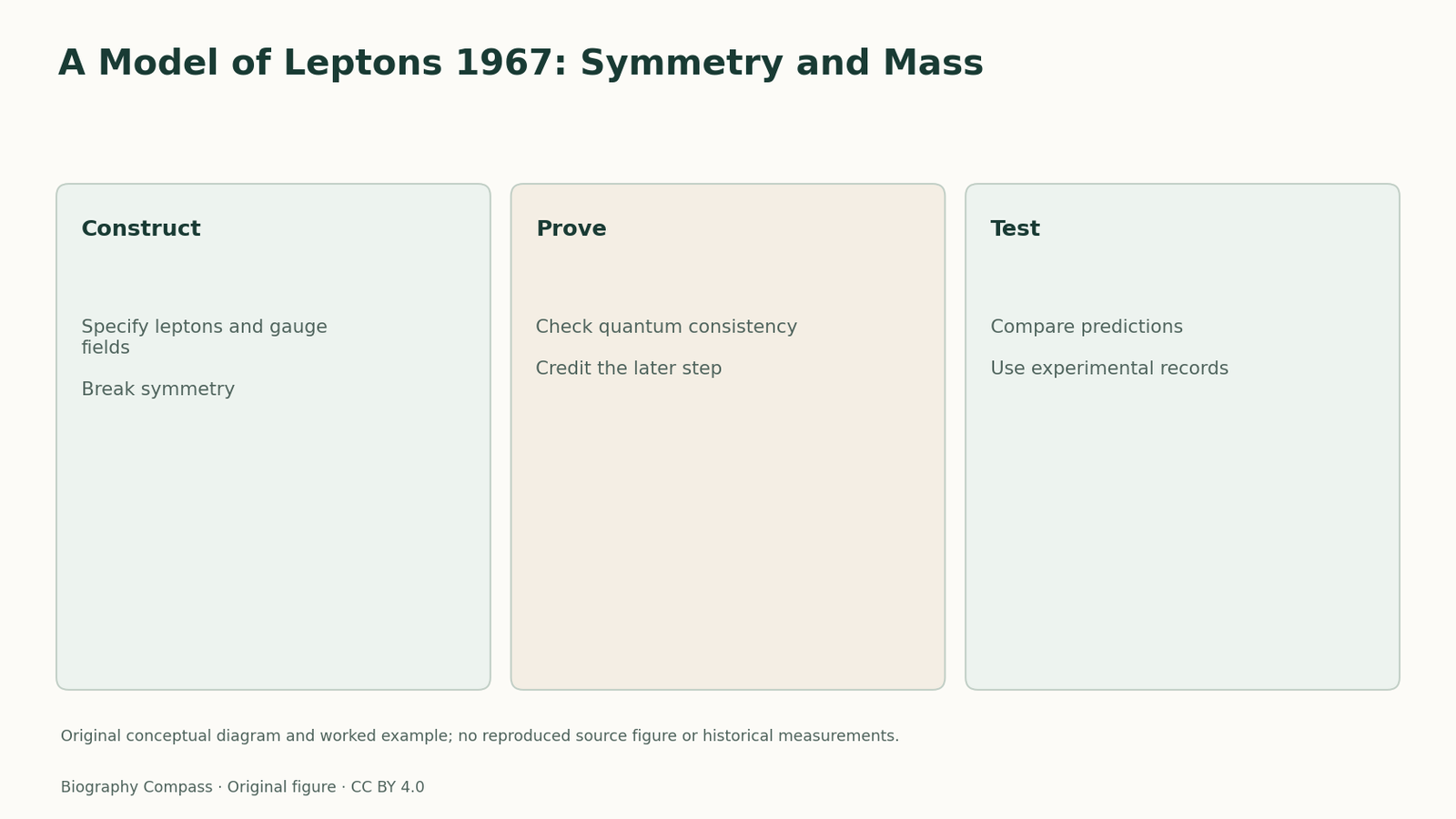
A fictional archive contains a model paper, a later proof about its calculation rules and a detector report compatible with one predicted process. Can any one of those records replace the other two? No. The model specifies the proposed structure; the proof addresses a mathematical property under stated assumptions; the detector report concerns an observed process. The exercise is an editorial comparison, not a substitute for an electroweak calculation. Its supported answer asks what each record establishes before combining them into a historical conclusion. If the model paper ends by asking whether a property holds, a later proof should be credited as a later development, even when a modern textbook presents both together. Likewise, mathematical consistency alone does not create the experimental evidence needed to establish that a theory describes nature.
Continue the chronology
Related history guides
The GIM Mechanism 1970: A Missing Flavour Change
Read the 1970 Glashow–Iliopoulos–Maiani model as a suppression mechanism, with an original amplitude exercise separating a theoretical cancellation from detection.
Read the timeline1964–2012Higgs 1964: A Mechanism Before a Detection
Connect Higgs’s 1964 mechanism with the separate 2012 ATLAS and CMS reports, using an original exercise to distinguish prediction, excess and particle properties.
Read the timelineBiography context
Explore United States through connected lives
Connected biographies
Researchers and related approaches
1933–2021
Steven Weinberg
Theoretical physicist and electroweak researcherSteven Weinberg connected gauge symmetry and spontaneous symmetry breaking in a 1967 lepton model that became central to electroweak theory.Read biographyQuick answers
Common questions
- Did the short 1967 model contain the entire later Standard Model?
- No. Its immediate construction had a specified lepton scope.
- Are a consistency proof and a detector observation interchangeable?
- No. They establish different properties through different evidence.
Primary and institutional sources
How this history was checked
The references below distinguish the original study from later explanations. The worked exercise and comparison are newly written for this article. This article was reviewed on 8 November 2026.