
The short answer
How did the 1964 symmetry-breaking proposal differ from the 2012 collider evidence?
Read the evidence
Different records within the same investigation
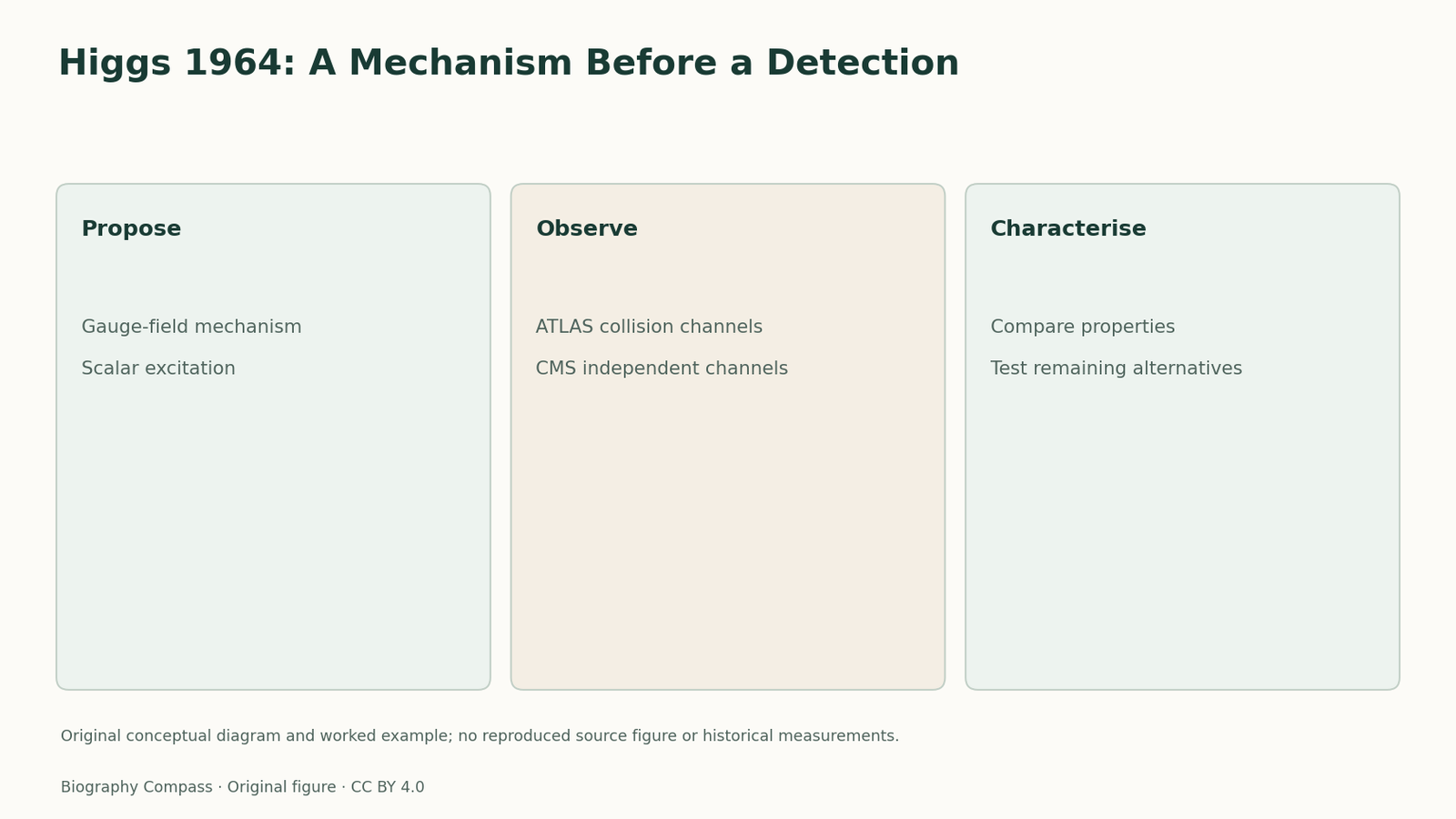
The following comparison distinguishes the specific questions answered by the inspected records.
| Record or test | What it establishes | What remains different |
|---|---|---|
| 1964 field-theory paper | Provides a mass mechanism and scalar excitation. | Contains no collider observation. |
| ATLAS 2012 report | Measures a new neutral-boson signal and compatibility. | Does not alone measure every particle property. |
| CMS 2012 report | Supplies an independent new-boson observation. | Further characterisation remains a distinct task. |
The 1964 record was a theoretical mechanism
Higgs’s paper addressed symmetry breaking in a gauge theory and the appearance of massive vector excitations. It also identified a scalar mode associated with the field. The paper’s argument was not an observation of a particle in an accelerator. Its contribution was to show how a particular theoretical structure could work and what kinds of excitations it contained. This is a more precise statement than saying the paper directly measured where all mass comes from.
Sources for this section: [1]
ATLAS reported evidence in collision data
The ATLAS 2012 paper combined several search channels and reported evidence for a new neutral boson, with behaviour compatible with a Standard Model Higgs boson. The abstract describes both the observed excess and its statistical treatment. These were measurements made with a detector and collision samples, not a repetition of the 1964 calculation. The experimental claim therefore depended on reconstructed decay products, backgrounds and the combined evidence from the analysed channels.
Sources for this section: [2]
CMS supplied an independent experimental record
The CMS 2012 paper reported a new boson through its own detector and analysis, with the strongest mass information coming from high-resolution decay channels. Its abstract also used the two-photon decay to constrain possible spin. The ATLAS and CMS reports were independent experimental contributions to the same discovery. Reading both alongside the theoretical paper makes the evidential chain visible while preserving the fact that identifying a new particle and measuring all its properties are not a single undifferentiated step.
An original prediction-and-measurement exercise
Suppose a fictional model predicts a neutral scalar, while an experiment finds a new resonance compatible with some of that model’s expected decay patterns. Which claim is immediately strongest: “a new resonance was observed” or “every property of the proposed scalar has been measured”? The first follows from the stated observation; the second requires additional tests. Now add an independent experiment observing compatible behaviour. That strengthens the evidence while leaving specific unmeasured properties as further questions. This exercise invents no Higgs mass, significance or detector yield. Its supported answer separates a theoretical mechanism, an experimentally observed signal and a programme of characterisation. It also asks which specific measurement distinguishes the model’s scalar from alternatives, rather than treating agreement with one prediction as complete proof of every feature.
Continue the chronology
Related history guides
The GIM Mechanism 1970: A Missing Flavour Change
Read the 1970 Glashow–Iliopoulos–Maiani model as a suppression mechanism, with an original amplitude exercise separating a theoretical cancellation from detection.
Read the timeline1967–1979A Model of Leptons 1967: Symmetry and Mass
Read A Model of Leptons in its original scope, distinguishing gauge structure, symmetry breaking and the later proof of renormalisability through a worked exercise.
Read the timelineBiography context
Explore Geneva–French border, CERN LHC through connected lives
Connected biographies
Researchers and related approaches
1929–2024
Peter Higgs
Theoretical physicistPeter Higgs developed a 1964 symmetry-breaking mechanism; the 2012 ATLAS and CMS observations supplied a separate experimental milestone for its scalar boson.Read biography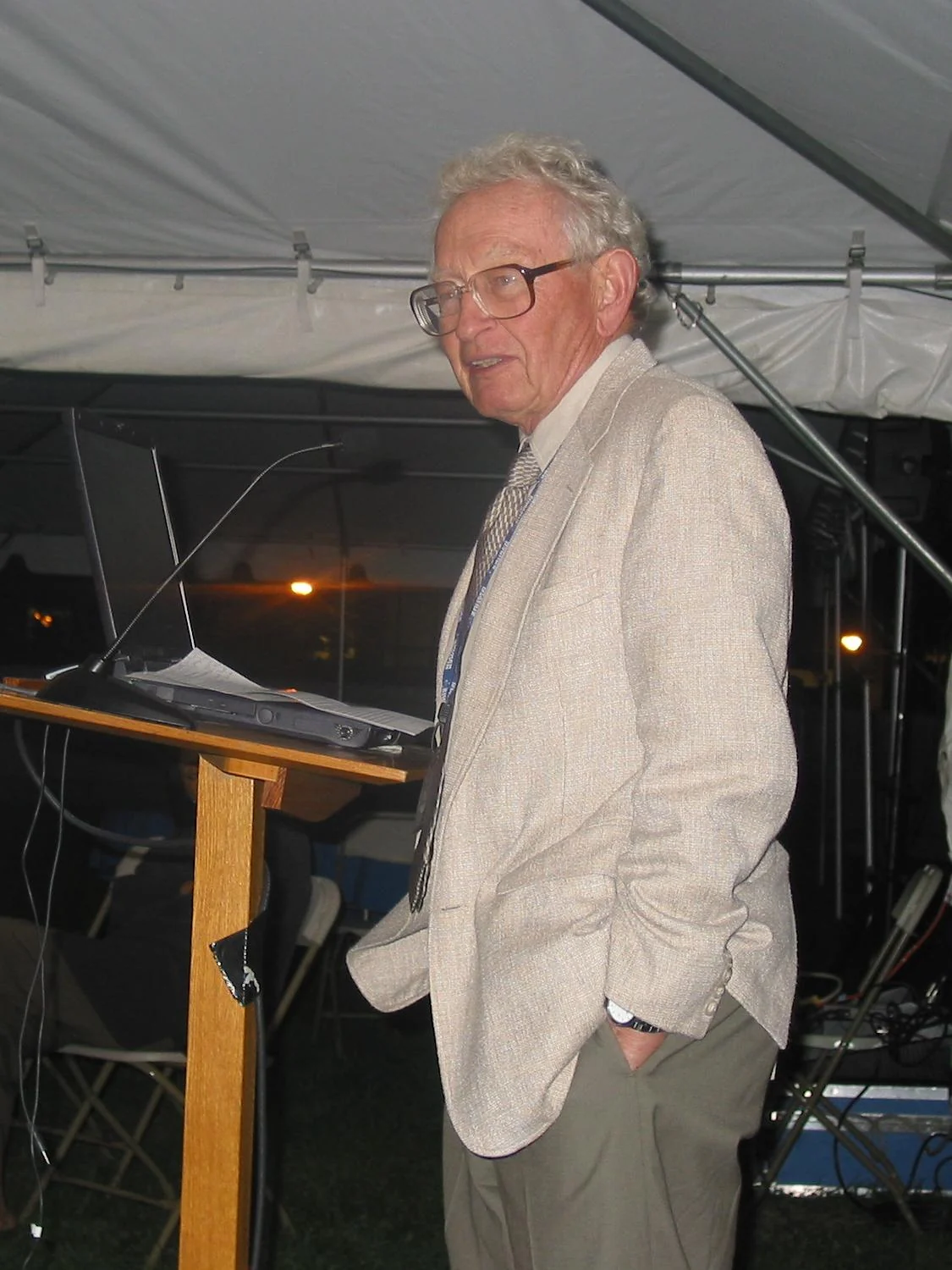
1923–2020
Philip Anderson
Condensed-matter theoretical physicistPhilip Anderson developed condensed-matter theory through Bell Laboratories, Cambridge and Princeton, connecting microscopic models with collective material behaviour.Read biographyQuick answers
Common questions
- Were the 1964 paper and 2012 results the same kind of evidence?
- No. One was a theoretical mechanism; the others reported detector observations.
- Does the mechanism explain every contribution to mass identically?
- No. Its specific gauge-theory role should not be expanded into that universal claim.
Primary and institutional sources
How this history was checked
The references below distinguish the original study from later explanations. The worked exercise and comparison are newly written for this article. This article was reviewed on 8 November 2026.
- Physical Review Letters, 1964Broken Symmetries and the Masses of Gauge Bosons
- ATLAS Collaboration, 2012Observation of a new particle in the search for the Standard Model Higgs boson with the ATLAS detector at the LHC
- CMS Collaboration, 2012Observation of a new boson at a mass of 125 GeV with the CMS experiment at the LHC
- Nobel Prize OutreachPeter Higgs — Nobel lecture
- Nobel Prize OutreachPeter Higgs — Facts
- Nobel Prize OutreachPeter Higgs — Biographical