
The short answer
How did machinery and practical expertise move from Waltham into the early Lowell mills?
Read the records together
Evidence, functions and interpretation
Compare the particular records and mechanisms discussed in this study.
| Record or mechanism | What it establishes | The distinct question |
|---|---|---|
| 1824 move | Links Moody and practical expertise with Lowell. | A personal move is not the same event as incorporation. |
| 1825 ownership stage | Identifies the institutional base of the shop. | A new owner does not imply entirely new machinery or skills. |
| 1845 company | Establishes later independent incorporation. | It occurred after Moody’s 1831 death. |
A machine shop supported a textile system
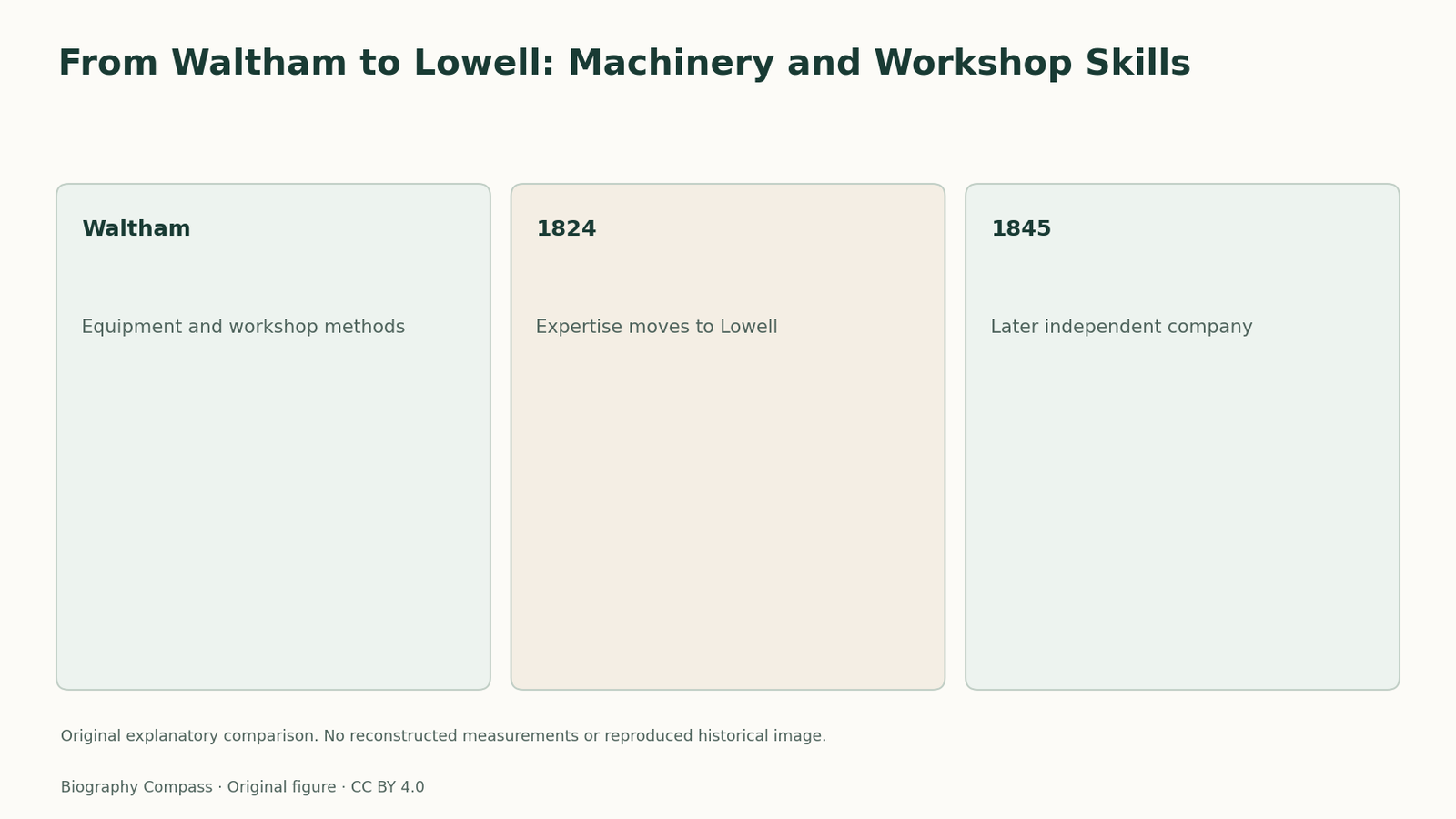
The Waltham mill needed machinery that could be built, repaired and adapted. Its workshop therefore performed a different function from the textile operations it served. A spinning frame produces yarn; a machine shop can make or modify parts used by that frame. The distinction is useful because industrial expansion depended on the capacity to reproduce equipment, not only to operate one successful mill. Moody’s practical experience placed him within that supporting layer of the manufacturing system.
The early Lowell mills drew on Waltham capacity
Dublin’s handbook account explains that machinery for the first Lowell mills was produced at Waltham. Moody moved to Lowell in 1824. This sequence connects an older workshop with a new industrial location through both equipment and expertise. It was not simply a case of a new town discovering machinery independently. The transfer gave the expanding undertaking access to established practical experience. The material objects mattered, but so did people who understood how they were made and how faults or changes could be addressed.
Sources for this section: [2]
Ownership changed without erasing the practical lineage
The handbook traces the shop through the Merrimack Manufacturing Company and, in 1825, the Proprietors of Locks and Canals. These ownership arrangements concerned the institutional base of mechanical work. They were not new dates of birth for every tool or skill in the shop. A history that follows only corporate names could miss the continuity of practical knowledge. A history that follows only Moody could miss the resources and authority supplied by the organisations around him. Both lines are necessary to explain the transfer.
Sources for this section: [2]
1845 belongs to the institution’s later history
The independent Lowell Machine Shop was incorporated in 1845, fourteen years after Moody’s death. That later milestone explains the institution’s subsequent identity, but does not extend his personal career. The shop also broadened its activities over time. Keeping the dates separate prevents later developments from being credited backwards to an earlier mechanic. It makes the real achievement clearer: Moody helped create and move a practical capability that other people and organisations could continue using after him.
An original workshop-transfer problem
Imagine that a new mill acquires a set of machines but no drawings, repair tools or trained mechanics. Compare that purchase with a transfer including machinery, patterns, tools and experienced workers. Which arrangement offers more capacity to reproduce and adapt equipment? The checked answer is the second, because it transfers methods as well as finished objects. This is an original explanatory comparison, not an inventory recovered from Moody’s workshop. Now place 1824,1825 and 1845 on separate lines: personal move, documented ownership stage and later independent company. The separation keeps biography, institutional control and manufacturing capability from being confused.
Continue the chronology
Related history guides
Pawtucket’s Spinning Mill: From Skills to Operation
Explore how Slater, investors and local craftspeople brought cotton spinning into operation at Pawtucket, distinguishing the 1790 venture from its 1793 building.
Read the timeline1813–1815Waltham’s Integrated Mill: Company, Power and Cloth
Explore the Boston Manufacturing Company’s early Waltham mill, separating its formation, building and integration of spinning and weaving under shared management.
Read the timelineBiography context
Explore United States through connected lives
Paul Moody
Paul Moody was a mechanic and textile-machinery organiser, known for developing machinery at Waltham and transferring practical workshop expertise into Lowell’s early industrial expansion.
Explore the biographiesWider contextRichard Arkwright
Read Richard Arkwright’s cotton manufacturer and factory organiser career as a separate contextual comparison.
Explore the biographiesConnected biographies
People and wider context
1779–1831
Paul Moody
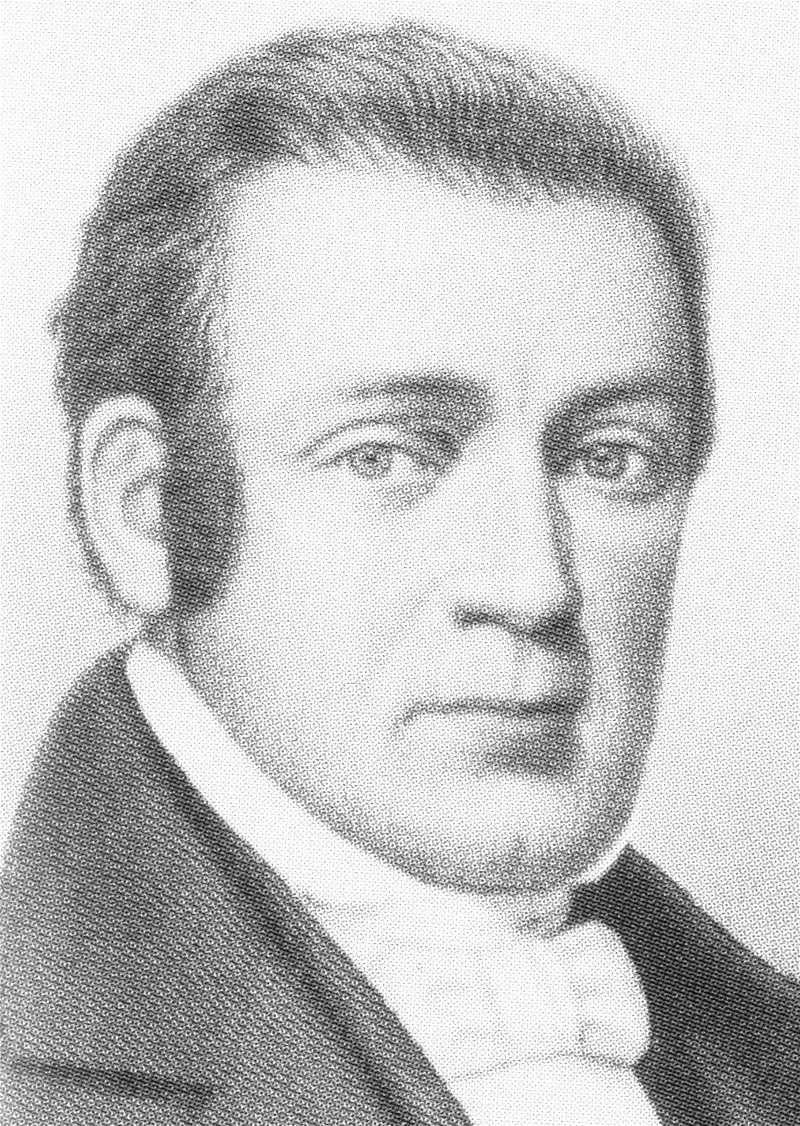
Mechanic and textile-machinery organiserPaul Moody was a mechanic and textile-machinery organiser, known for developing machinery at Waltham and transferring practical workshop expertise into Lowell’s early industrial expansion.Read biography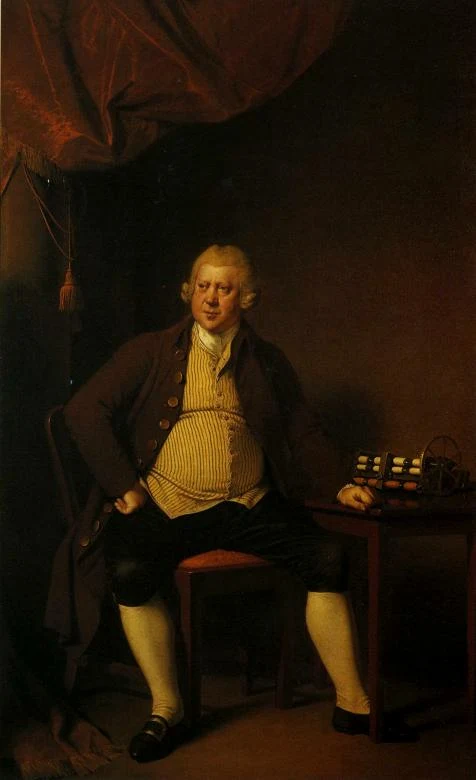
1732–1792
Richard Arkwright
Cotton manufacturer and factory organiserRichard Arkwright combined spinning machinery, water power, finance and supervised labour in an influential factory system. His mills transformed cotton manufacturing, while disputed patents, child labour and global cotton supplies complicate the image of a solitary self-made inventor.Read biographyQuick answers
Common questions
- Why was a machine shop important to textile manufacture?
- It supplied the ability to make, repair and adapt equipment used by the mills.
- Did Moody establish the independent 1845 Lowell Machine Shop?
- He died in 1831. The 1845 incorporation belongs to the later institution, not to his personal activity.
Primary and institutional sources
How this history was checked
Primary records, institutional catalogues and historical interpretation answer different questions. The comparison and worked example are original editorial analysis. This article was reviewed on 8 November 2026.