
The short answer
What equipment, finance and operating work were required at the early Pawtucket spinning mill?
Read the records together
Evidence, functions and interpretation
Compare the particular records and mechanisms discussed in this study.
| Record or mechanism | What it establishes | The distinct question |
|---|---|---|
| 1790 operating account | Establishes working spinning and a commercial partnership. | It does not date the surviving mill building. |
| 1793 building record | Establishes a purpose-built physical base. | It need not be the first date of production. |
| Workforce study | Adds recruitment, wages and supervision to machinery. | Mechanical success alone does not describe labour conditions. |
The immediate problem was reliable spinning
The Pawtucket partners needed machinery that could turn prepared cotton into usable yarn. Slater’s apprenticeship supplied familiarity with the operating sequence and its mechanical requirements. The Rhode Island account describes earlier equipment that had failed to meet expectations, so this was a problem of bringing a system into dependable use. Capital alone could purchase materials, but could not determine every adjustment. Conversely, technical experience needed a workshop, materials and people capable of making components. The venture joined those requirements in one operating business.
Sources for this section: [3]
Local construction turned experience into equipment
The historical account names Sylvanus Brown and members of the Wilkinson family among the local practical contributors. Such work gave form to the spinning system in Rhode Island. The important partnership was therefore broader than an investor handing money to an inventor. Making parts, assembling equipment and testing operation were necessary stages. Describing those stages explains why the local mechanical network belongs in the story. It also avoids a misleading assumption that a successful mill was simply shipped across the Atlantic as a finished object.
1790 and 1793 identify different milestones
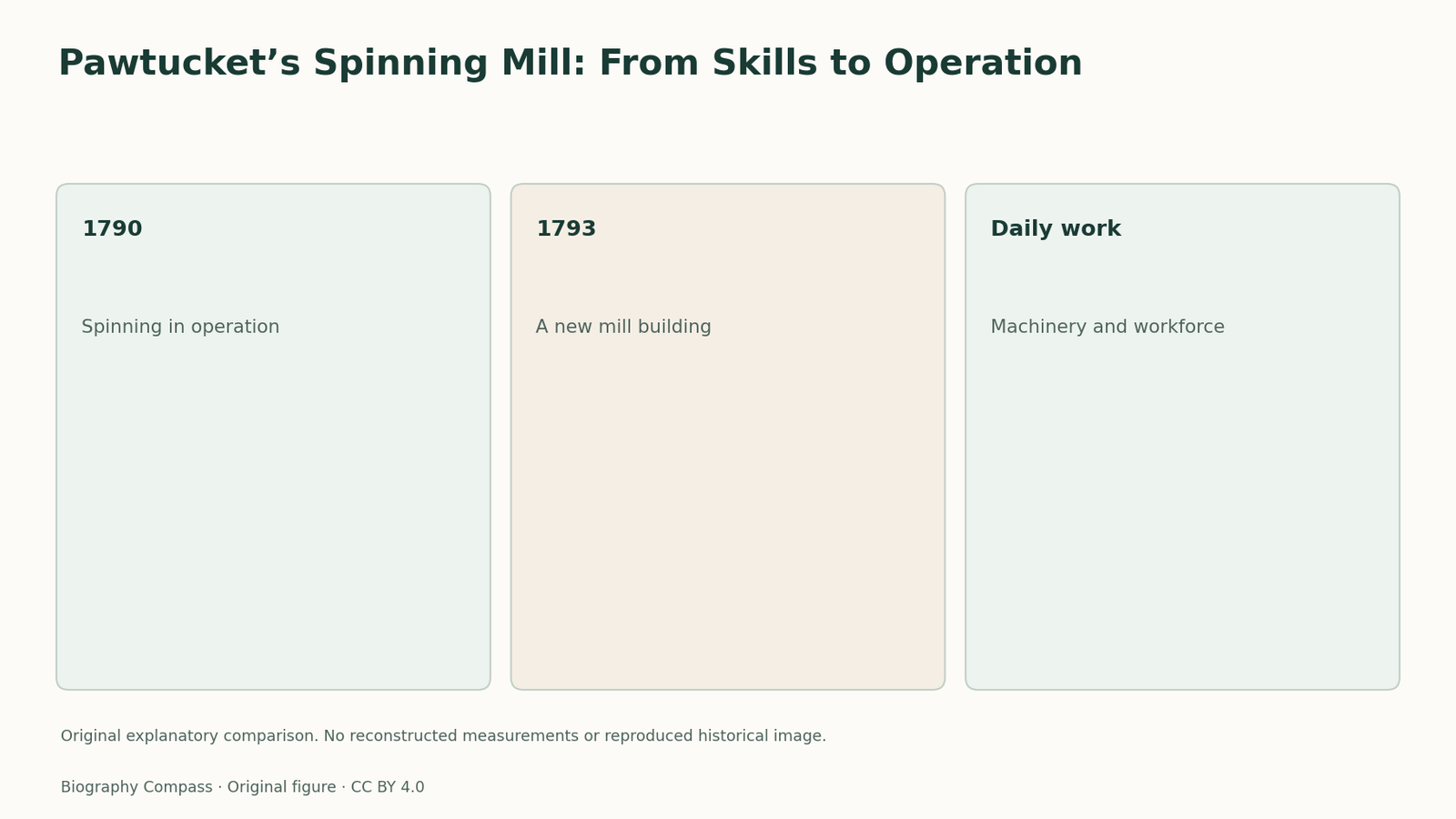
Spinning began in December 1790 in an adapted setting, while the new mill building followed in 1793. The state’s historical documentation distinguishes those events. One date establishes an operating achievement; the other records the creation of a more permanent physical base. A building history and an industrial history can consequently give different opening dates without necessarily disagreeing. Readers should ask what opened: the commercial operation, the machinery in a rented space, or a purpose-built mill. Each answer describes a real but different event.
The yarn also required sustained human work
The National Park Service’s account examines the early workforce, including children and the payment arrangements involving parents. It also traces difficulties maintaining a stable labour force. A working machine did not remove the need to recruit and supervise people. The distinction between spinning yarn and weaving cloth is equally important: this venture’s spinning achievement was a stage in textile production, not evidence that every operation from raw cotton to finished fabric took place together. Its commercial significance came from making that stage operate repeatedly.
An original production-chain exercise
Place these hypothetical records in order: a mechanic’s component drawing, a trial of a spinning frame, an entry for yarn produced, and a contract for a new mill building. The checked answer places drawing before trial and output, but the building contract need not precede the first output if production initially uses adapted premises. Now ask whether a yarn record proves that cloth was woven at the same site. It does not: a different production stage requires separate evidence. This exercise uses the documented 1790–1793 distinction to explain how industrial milestones should be read.
Continue the chronology
Related history guides
Waltham’s Integrated Mill: Company, Power and Cloth
Explore the Boston Manufacturing Company’s early Waltham mill, separating its formation, building and integration of spinning and weaving under shared management.
Read the timeline1814–1845From Waltham to Lowell: Machinery and Workshop Skills
Trace machinery and practical expertise from Waltham to Lowell in the 1820s, separating Paul Moody’s move from later ownership and machine-shop incorporation.
Read the timelineBiography context
Explore United States through connected lives
Samuel Slater
Samuel Slater was a cotton manufacturer and mill organiser, known for applying English spinning experience at Pawtucket with Rhode Island investors and craftspeople, then developing a network of mills.
Explore the biographiesWider contextRichard Arkwright
Read Richard Arkwright’s cotton manufacturer and factory organiser career as a separate contextual comparison.
Explore the biographiesConnected biographies
People and wider context
1768–1835
Samuel Slater
Cotton manufacturer and mill organiserSamuel Slater was a cotton manufacturer and mill organiser, known for applying English spinning experience at Pawtucket with Rhode Island investors and craftspeople, then developing a network of mills.Read biography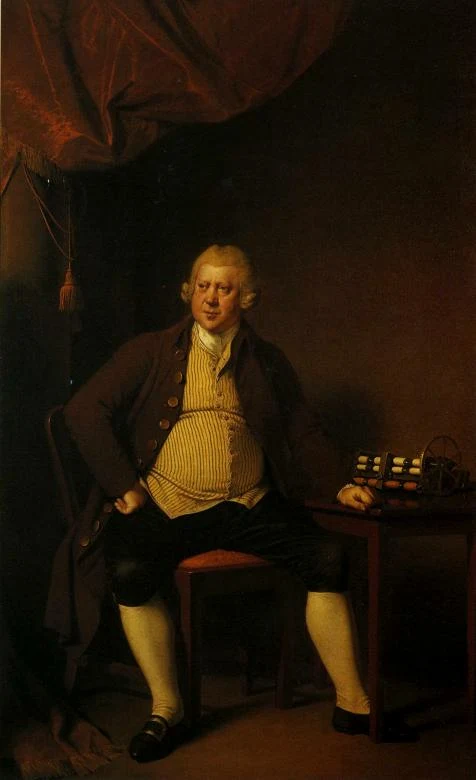
1732–1792
Richard Arkwright
Cotton manufacturer and factory organiserRichard Arkwright combined spinning machinery, water power, finance and supervised labour in an influential factory system. His mills transformed cotton manufacturing, while disputed patents, child labour and global cotton supplies complicate the image of a solitary self-made inventor.Read biographyQuick answers
Common questions
- Did the Pawtucket operation begin in the 1793 building?
- The operation began in 1790 before the new mill building followed in 1793.
- What did the early machinery produce?
- It spun cotton into yarn; spinning is a different stage from weaving yarn into cloth.
Primary and institutional sources
How this history was checked
Primary records, institutional catalogues and historical interpretation answer different questions. The comparison and worked example are original editorial analysis. This article was reviewed on 8 November 2026.