
The short answer
A garden can be a place of labour, a frame for looking outward and an enclosure imagined as temporary. Two short poems by Ursula Bethell let a reader test those possibilities in the words themselves.
Compare the evidence
Keep the record’s object in view
These records answer different questions.
| Record | Establishes | Does not establish |
|---|---|---|
| Poems | Voice, sequence, comparisons and changes of scale. | A complete literal record of an afternoon. |
| Catalogue | Publishing identity and edition metadata. | An interpretation of every image or pronoun. |
| Place record | A documented home and garden. | The exclusive meaning of a literary work. |
Chronology
A timeline of the turning points
Documented home
Rise Cottage with Effie Pollen.
Publication
London edition as Evelyn Hayes.
Read the temporal sequence
Work from the poem’s actions and comparisons.
Identify the text before assigning its meaning
The National Library identifies From a Garden in the Antipodes as a London publication by Sidgwick & Jackson in 1929, issued as Evelyn Hayes, Bethell’s pseudonym. This article reads the complete short Foreword and Pause in a transcription linked to that collection, not every poem or a modern collected edition.
Catalogue information answers questions about publishing identity. It leaves the interpretation of the poems to a different kind of reading. Two short texts cannot stand for everything Bethell wrote, but their limited scale is useful: each change of action or perspective can be checked without pretending to survey the entire collection.
Sources for this section: [1]
Foreword moves from a report to a wish
The opening addresses Ruth directly. Ordinary tools and tasks locate poetry in physical work; the reader is not initially asked to stand outside the garden admiring a view. A change of scale follows as winds and trees enter the speaker’s attention. The speaker then wishes for a form of music that has not simply been claimed as an achievement.
The important movement is grammatical as well as visual: an account of what has been told gives way to a conditional desire. A reading that calls this merely confident celebration misses the hesitation. Equally, that hesitation does not cancel the poem’s deliberate making. The poem already exists while it imagines another form of expression.
Pause changes the value of an enclosure
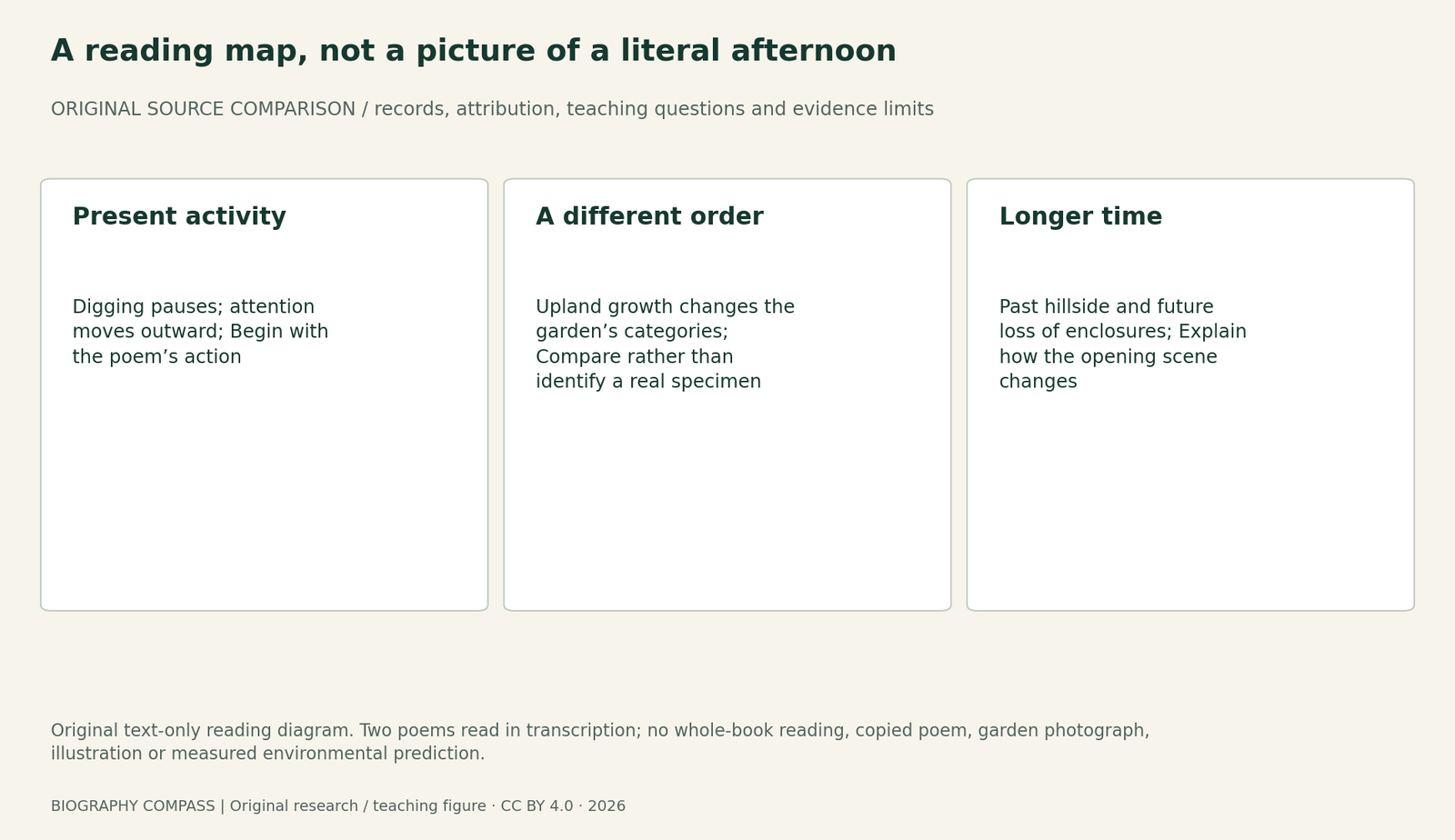
Pause begins with digging interrupted by looking at the mountains. The speaker’s muscles relax, but attention becomes more demanding. Upland vegetation is described without the cultivated garden’s division between welcome growth and weeds. The contrast invites the reader to notice that a garden’s categories are human arrangements, not the only possible order.
The poem then looks backward to a less enclosed hillside and forward beyond the speaker’s life. Its ending imagines the disappearance of human boundaries. This does not turn the poem into a prediction with a measurable deadline. It makes the present garden temporary within a longer material history, and changes the force of the opening act of digging.
Use place evidence as context, not a master key
Heritage New Zealand associates Rise Cottage and its garden with Bethell and Effie Pollen between 1924 and 1934. That locates a documented working environment. It cannot, by itself, identify every plant in a poem or prove that every first-person sentence reports a single literal afternoon.
Nor does placing a poem inside a national literary story settle its questions. An outward look can coexist with attachment to a cultivated home. Reading the sequence of actions, comparisons and time shifts gives the interpretation a firmer basis than turning a biographical address into the answer to every line.
Exercise and one worked answer
Create a three-row reading map for Pause: present activity; alternative order beyond the enclosure; imagined future. For each row identify an action or comparison, then explain what changes in the reader’s understanding. Write a 70–90 word caption without copying lines or claiming that the poem proves a universal national attitude.
One original answer is: “The speaker begins as someone working inside a garden, then looks toward growth that does not depend on the garden’s rules. A backward glance and an imagined future weaken the sense that the enclosure is permanent. The setting remains particular, but the temporal movement makes a larger argument about human arrangements. The poem therefore offers more than an attractive view: it asks readers to reconsider the boundaries through which that view is organised.”
Continue the chronology
Related history guides
Patu!: person records, film identity and versions
Compare a person-authority summary with Patu!’s catalogue and festival records, then repair captions that confuse subjects, release dates and versions.
Read the timeline1994 recording · 1997 object · 2011 masteringWhat an instrument record cannot tell you about a recording
Compare a Te Papa instrument record with Te Ku Te Whe’s production credits, separating makers, recording roles, dates and claims that need sound evidence.
Read the timelineBiography context
Explore New Zealand through connected lives
Connected biographies
People connected with these records
1874–1945
Ursula Bethell
Poet and social workerUrsula Bethell developed a distinctive poetic practice from gardening, travel, religious belief and life with Effie Pollen in Christchurch.Read biographyQuick answers
Common questions
- Was the whole 1929 collection read?
- No. The scope is the two named short poems and the stated contextual records.
- Does a known address resolve every image?
- No. Place evidence and close reading answer different questions.
Primary and institutional sources
How this history was checked
Readings cover the two named poem transcriptions and selected catalogue/place records. Other poems, letters and modern introductions were not read. This article was reviewed on 29 October 2026.
- National Library of New ZealandFrom a garden in the Antipodes: 1929 catalogue
- Ursula Bethell / Wikisource transcriptionForeword: original 1929 poem, transcription
- Ursula Bethell / Wikisource transcriptionPause: original 1929 poem, transcription
- Heritage New Zealand Pouhere TaongaRise Cottage and Garden: list 1921