
The short answer
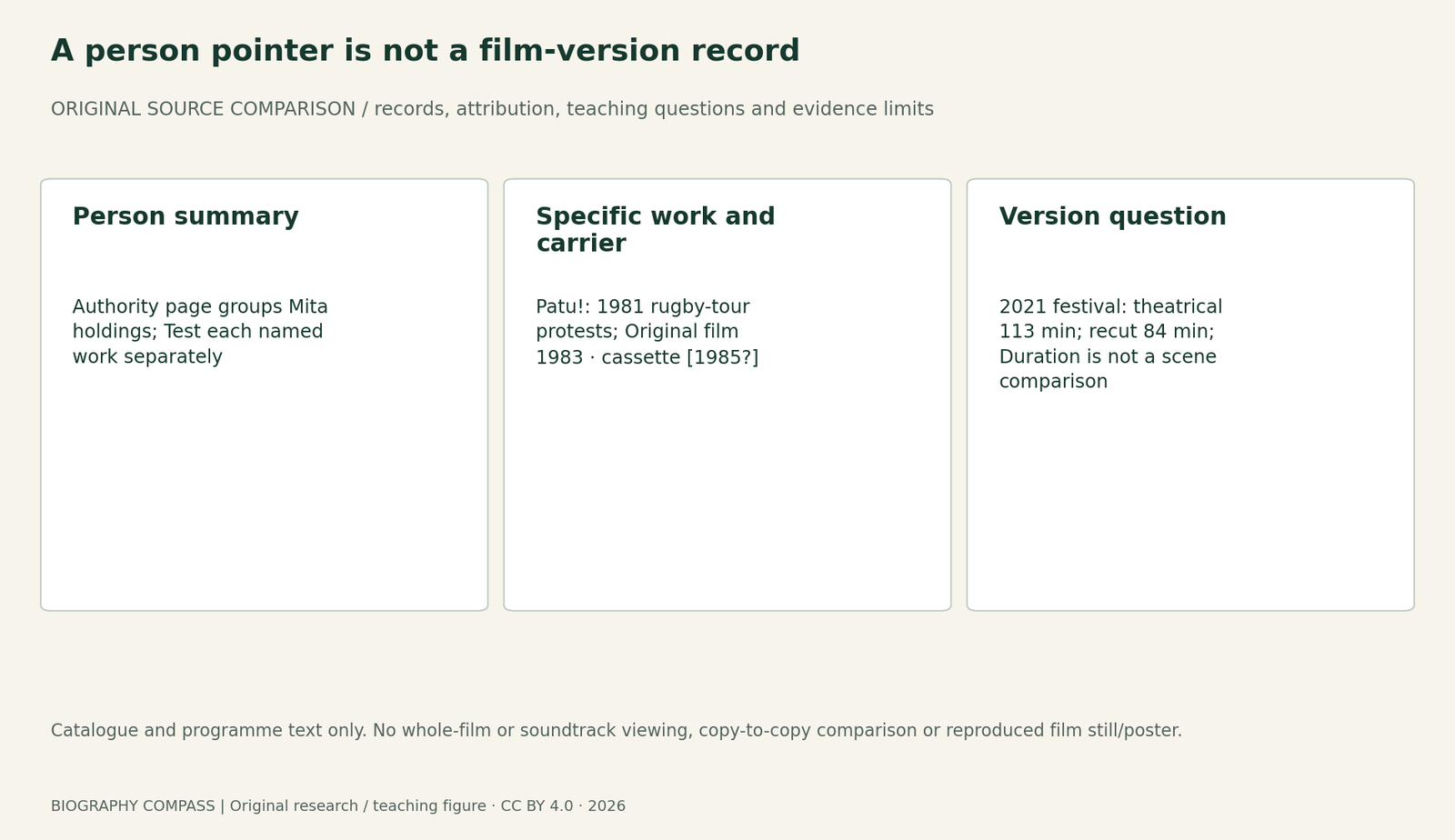
A useful archive can contain an unreliable shortcut. Patu! provides a concrete case for separating a person’s summary, a particular film, a carrier and a later screening version.
Compare the evidence
Keep the record’s object in view
These records answer different questions.
| Record | Establishes | Does not establish |
|---|---|---|
| Person authority | Name and related holdings; short biographical summary. | A reliable substitute for every related film’s subject. |
| Cassette record | Subject, credits, carrier and estimated publication. | The full distribution history or every print’s contents. |
| Festival entry | Named screening version and preservation context. | A comparison of every sequence across all copies. |
Chronology
A timeline of the turning points
Bastion Point filming
A separate collaborative project.
Patu! release
Distinguished from the cassette’s publication.
Preserved theatrical version
Festival lists 113 minutes.
The misleading shortcut is attached to a person
The National Library’s Merata Mita authority page describes Patu as being about land issues at Bastion Point. The page identifies a person and gathers related holdings; it is not a shot-by-shot description of a film. Its short account should therefore be tested against a record for the named work.
The selected film records identify Patu! with the rugby-tour protests. That does not establish that every version contains no Bastion Point material: such a claim would require identified copies and viewing. The records alone cannot tell us whether the authority writer intended a shorthand or confused titles. They do show why the short description is insufficient for precise film identification.
A specific film record changes the answer
The library’s Patu! videocassette record instead describes the 1981 South African rugby tour, protests and confrontation with police. It names Merata Mita as director/producer and Annie Collins as editor, and distinguishes an original 1983 motion-picture release from a cassette publication dated [1985?].
Kōmako separately connects Bastion Point: Day 507 with Mita, Leon Narbey and Gerd Pohlmann and the filming of the 1978 removal of protesters. That supports keeping the projects distinct. It does not require claiming that either complete film has been watched for this article.
A runtime belongs to a version and a carrier
The 2021 festival record describes a newly preserved 113-minute theatrical version of Patu! and an 84-minute international recut.
The library describes an 84-minute videocassette. A shared runtime may help a search, but is not alone proof that two copies contain precisely the same frames or soundtrack.
The chronology needs several verbs: the events occurred; the film premiered; a particular carrier was published; a preserved version screened. None can silently replace the others. A catalogue’s question mark also matters: the bracketed cassette year is an estimate, not a newly established premiere date.
Exercise: repair four research cards
Draft four deliberately faulty cards. A: “Patu! is the Bastion Point land documentary because Mita’s person page says so.” B: “Patu! premiered in 1985 because that date appears on the cassette record.” C: “The preserved version proves what every earlier audience saw.” D: “A runtime difference tells us exactly which sequences were removed.”
For each card, identify the record being used, the object it describes and the extra evidence that would be needed. Then write one short replacement catalogue note. Keep the alternative film title, uncertain cassette date and version labels separate. The task is to improve a research statement, not to rank the politics or artistry of an unseen film.
Reference answer: improve the pointer, retain the limit
A confuses the person summary with film identification. B turns a carrier’s estimated publication year into an original-release date. C erases version history. D infers a sequence-level account from a duration alone. Exact content comparison would require identified copies and a documented comparison, not subtraction of two catalogue numbers.
One original replacement is: “Use the specific Patu! record for its rugby-tour subject and original release; retain the cassette’s estimated date as a carrier detail. Identify the screening version separately. The person authority is a route to related holdings, not a substitute for those work records.” This wording repairs the research method without inventing a viewing experience.
Continue the chronology
Related history guides
What an instrument record cannot tell you about a recording
Compare a Te Papa instrument record with Te Ku Te Whe’s production credits, separating makers, recording roles, dates and claims that need sound evidence.
Read the timeline1929 poems · selected modern catalogue and place contextReading Bethell’s garden beyond a picturesque scene
Read the temporal and spatial moves of Bethell’s Foreword and Pause, comparing the poems with publication and place records rather than treating scenery as proof.
Read the timelineBiography context
Explore New Zealand through connected lives
Connected biographies
People connected with these records
1942–2010
Merata Mita
Filmmaker and Indigenous screen mentorMerata Mita brought Māori perspectives to film and mentored Indigenous filmmakers.Read biography1947–
Gaylene Preston
Film director, writer and producerGaylene Preston explores testimony, memory and New Zealand lives across drama and documentary.Read biographyQuick answers
Common questions
- Does [1985?] change the original release to 1985?
- No. The record separately identifies an original 1983 motion-picture release.
- Can runtime alone identify deleted scenes?
- No. That requires comparison of identified versions.
Primary and institutional sources
How this history was checked
The sources distinguish person and film records, carriers and a festival screening. No whole-film or copy-to-copy analysis is claimed. This article was reviewed on 29 October 2026.