
The short answer
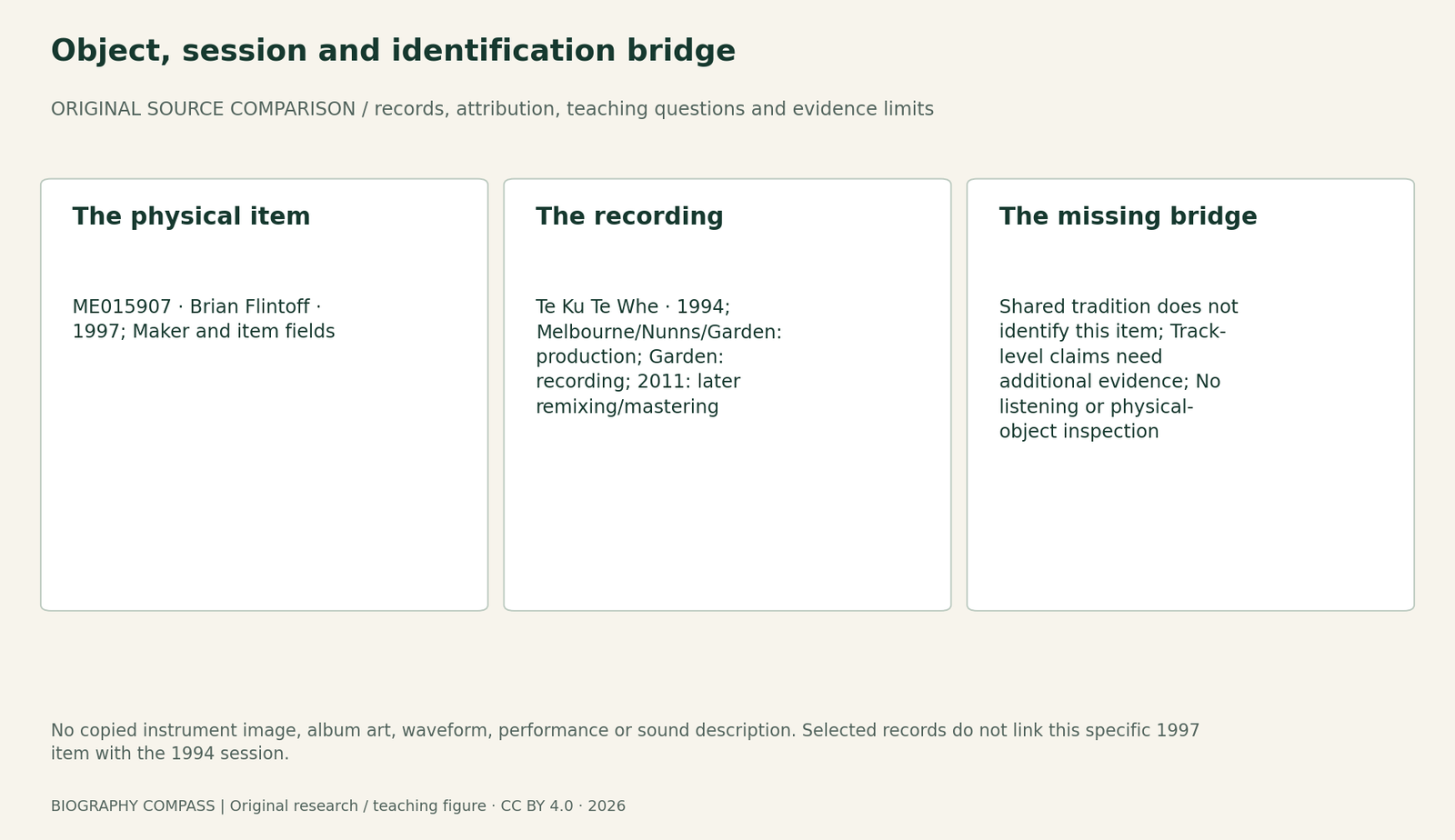
An instrument, a recording session and a catalogue page are different objects. Reading their records together can reveal collaboration while leaving an honest gap between a physical item and a heard performance.
Compare the evidence
Keep the record’s object in view
These records answer different questions.
| Record | Establishes | Does not establish |
|---|---|---|
| Museum item | Named object, maker, date and physical fields. | The instrument inventory of an unrelated recording session. |
| Label credits | Recording personnel and production stages. | A museum registration number for each heard instrument. |
| Context account | A network of making, teaching and performance. | A substitute for track-level or object-level identification. |
Chronology
A timeline of the turning points
Recording
Studio session credited to Steve Garden.
Object record
Flintoff production and gift fields.
Later production work
Remixing/mastering, not a newly established session.
Begin with a named physical item
Te Papa’s record ME015907 names a pūtōrino and attributes its production to Brian Flintoff in 1997. Its fields identify materials, dimensions and a gift credit. These are claims about a catalogued object. They do not name every musician who has played a related kind of instrument.
The distinction protects the maker’s credit as well as the performer’s. A photograph or a familiar instrument name can tempt a reader to connect an object with a famous recording. That connection needs its own evidence. A registration number is an identifier for this item, not a label for all instruments of its type.
Sources for this section: [1]
Read the recording’s separate roles
Rattle dates Te Ku Te Whe to 14 June 1994. It names Hirini Melbourne, Richard Nunns and Steve Garden as producers, with Garden recording the session at Progressive Music Studio. The page separately identifies remixing and mastering in 2011. These dates and roles belong to the recording’s production history.
The credits show why performer, producer and engineer should not be treated as interchangeable labels. A person can hold more than one role, and several people can share a role. Neither circumstance makes an unnamed maker disappear or proves that a later museum object was present in the studio.
Sources for this section: [2]
Compare dates without inventing a lineage
The object’s 1997 production date and the session’s 1994 date do not document an item-to-session connection. They also describe different acts: making a physical instrument and recording a performance. The 2011 mastering reference is another production event, not a claim that Melbourne and Nunns returned for a new performance together then.
RNZ places Melbourne’s work with Nunns and Flintoff within the revival of both making and playing taonga pūoro. That provides a collaborative context. It does not supply an inventory of instruments used on each track, and this article has not listened to the album or inspected the object.
Exercise: match claims to the necessary evidence
Consider three original research captions: A names Flintoff as maker of the museum item; B identifies Garden as recording engineer; C says the museum item’s particular sound can be heard on a named album track. Which selected record supports A or B? What separate bridge is missing from C?
Now prepare a four-column note: claim; object or activity; supporting field; unresolved question. Keep three questions distinct: who made this item, who worked on this recording, and what happened in a particular performance. If you have only the selected text records, do not invent a listening description to fill the last column.
Continue the chronology
Related history guides
Patu!: person records, film identity and versions
Compare a person-authority summary with Patu!’s catalogue and festival records, then repair captions that confuse subjects, release dates and versions.
Read the timeline1929 poems · selected modern catalogue and place contextReading Bethell’s garden beyond a picturesque scene
Read the temporal and spatial moves of Bethell’s Foreword and Pause, comparing the poems with publication and place records rather than treating scenery as proof.
Read the timelineBiography context
Explore New Zealand through connected lives
Connected biographies
People connected with these records
1949–2003
Hirini Melbourne
Composer, educator and taonga pūoro practitionerHirini Melbourne connected Māori-language education, song composition and the revival of taonga pūoro through teaching, performance and collaboration.Read biographyQuick answers
Common questions
- Does a producer credit mean sole authorship of every sound?
- No. Recording roles can overlap and be shared.
- Does the selected object record identify an album track?
- No. It documents item ME015907, not that recording connection.
Primary and institutional sources
How this history was checked
Sources identify an instrument item and recording roles. The object and audio were not inspected; conclusions stay with the text records. This article was reviewed on 29 October 2026.