
The short answer
Which bank began in 1935, and what changed at each stage of the 2001–2002 combination?
Original source comparison
One annual label, several documentary stages
Keep institutional identity separate from transaction status.
| Record | Useful evidence | Limit or next record |
|---|---|---|
| UOB milestones | UCB’s incorporation/opening and1965rename;2001acquisition label. | Does not provide every legal or operational integration step. |
| NLB’s Lien introduction | OUB’s distinct1947founding/1949opening and Lien’s1995retirement. | Reference guide is not a full takeover file. |
| 2001 chairman’s statement | Offer, all-share acquisition and legal-merger dates. | Issuer narrative; no complete contract or competition assessment. |
Chronology
A timeline of the turning points
Incorporation
United Chinese Bank incorporated.
Opening
UCB began operations.
Rename
UCB became United Overseas Bank.
Friendly offer announced
UOB and OUB announced the proposed takeover.
Wholly owned
OUB became a wholly owned subsidiary.
Legal merger
The report records the legal merger taking effect.
Start with names that look deceptively similar
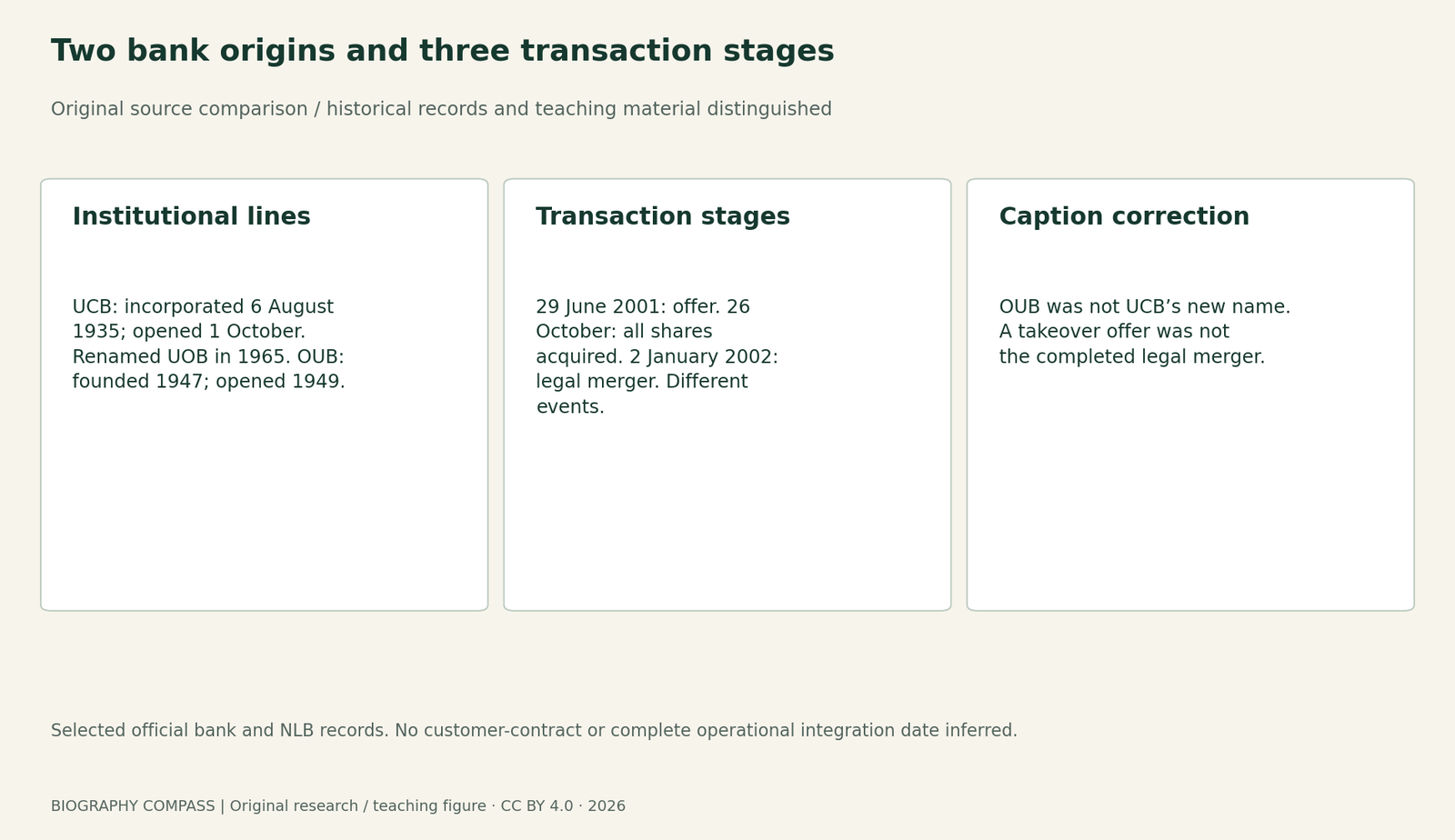
United Chinese Bank, United Overseas Bank and Overseas Union Bank are not three successive names of one institution. UOB’s chronology records United Chinese Bank’s incorporation on 6 August 1935 and opening on 1 October. It became United Overseas Bank in 1965. NLB separately dates Lien Ying Chow’s founding of Overseas Union Bank to 1947 and its opening to 1949. Make two institutional lines before drawing any merger arrow. The initials UCB, UOB and OUB are compact labels, but the almost reversed words can hide a consequential error about which organisation existed and who founded it.
Distinguish an institution from its leaders
Wee Kheng Chiang led UCB’s seven-person founding group; Wee Cho Yaw later succeeded him as chairman in 1974. Lien Ying Chow founded OUB and retired as its group chairman and director in 1995. These roles do not establish who held every office during the later takeover. A founder, serving chairman, chief executive and shareholder occupy different positions in the historical account. Naming a person should be followed by the dated responsibility being described. This keeps an institutional comparison from becoming a story in which founders personally perform every subsequent corporate action.
An announced offer was one stage in 2001
UOB’s contemporaneous chairman’s statement says the banks held a press conference on 29 June 2001 to announce a friendly takeover offer, supported by OUB’s principal shareholders. It also describes a conditional offer using cash and UOB shares. Those details establish the proposal and the support described by its issuer. They should not be made to mean that all shares had already been acquired that day. Read the verb and its object together: announcing an offer is evidence of an offer announcement, while completion requires a later statement or transaction record.
Sources for this section: [3]
Full ownership preceded the legal merger
The same report dates OUB’s becoming a wholly owned subsidiary to 26 October 2001, when all issued share capital had been acquired. It then places the legal merger on 2 January 2002. This sequence matters: a company can be wholly owned while still being described as a subsidiary, before the legal combination takes effect. The annual report supplies an explicit issuer account of both stages. The complete offer circular, approval documents and individual customer contracts were not read here, so the lesson does not infer every operational integration date or every contractual consequence.
Sources for this section: [3]
Read a later milestone beside the contemporary statement
A retrospective chronology is useful for seeing decades at a glance, but its short label “acquires OUB” does not carry the same detail as the 2001 report. Conversely, the chairman’s statement emphasises the acquiring bank’s strategic achievement and is not an independent evaluation of competition or service quality. Use the sources together at the level each supports. A clean research note can contain an annual acquisition label and three dated transaction stages. It need not force every publication to use one date for all purposes, nor treat a short summary as legally exhaustive.
Original exercise: repair a misleading exhibit caption
An exhibit draft says: “OUB was UCB’s new name in 1965; the two banks legally merged when the offer was announced in June 2001.” Prepare a correction using six dated cards from the records: 6 August 1935 incorporation; 1 October 1935 opening; 1965 rename; 29 June 2001 offer; 26 October 2001 full ownership; 2 January 2002 legal merger. Assign each card to the correct institutional line or transaction stage. Then write two short captions: one explaining the 1935 bank’s identity, the other explaining the combination. Do not add a date for branch-system migration, since these records do not establish it.
Reference answer: preserve two origins and three stages
The first caption should say that United Chinese Bank was incorporated and opened in 1935, and was renamed United Overseas Bank in 1965. OUB belongs on its own line, founded in 1947 and opened in 1949. The second caption should distinguish the 29 June 2001 offer announcement, 26 October full ownership and 2 January 2002 legal merger. The original draft fails both tests: it confuses an institution’s name and collapses a process into one event. A useful conclusion is therefore precise without being overloaded. Further operational questions should be paired with dated integration or customer records rather than answered by extending the merger date beyond its evidence.
Continue the chronology
Related history guides
NIPSEA’s Paint Partnership: Technology, Markets and the Factory
What did each partner contribute to local paint production, and what do the factory figures establish?
Read the timeline1963–2013Wing Tai’s Garment Workers: Training and Transition
When a company leaves manufacturing, how can its records show what happened to its workers?
Read the timelineBiography context
Explore Singapore through connected lives
Wee Kheng Chiang
Place the 1935 bank in its regional trading context.
Explore the biographiesRead the later leaderWee Cho Yaw
Follow the career that included the 2001–2002 transaction.
Explore the biographiesRead OUB’s founderLien Ying Chow
Keep OUB’s separate origin and founder’s retirement visible.
Explore the biographiesConnected biographies
Business lives in context
1890–1978
Wee Kheng Chiang
Sarawak entrepreneur and Singapore bank co-founderWee Kheng Chiang built trading and banking connections between Sarawak and Singapore and led the group that founded United Chinese Bank.Read biography1929–2024
Wee Cho Yaw
Banker and community leaderWee Cho Yaw led UOB through regional expansion and acquisitions while serving Singapore’s education and Chinese community institutions.Read biography1906–2004
Lien Ying Chow
Banker, hotelier and educational benefactorLien Ying Chow built Overseas Union Bank and supported educational institutions and a foundation that continued beyond his banking career.Read biographyQuick answers
Common questions
- Which date is the merger date?
- For the legal merger, the contemporary UOB report specifies 2 January 2002.2001 also matters for the offer and acquisition.
- Was OUB the 1965 name of UCB?
- No. UCB became UOB. OUB had a separate founding and opening history.
Primary and institutional sources
How this history was checked
The exercises and reference answers are original teaching material based on the named records. Company histories, first-person recollections and contemporary reports answer different questions; their limits remain explicit. This article was reviewed on 27 October 2026.