
The short answer
What did each partner contribute to local paint production, and what do the factory figures establish?
Original source comparison
People, production and corporate structure
The source types establish different parts of the history.
| Record | Useful evidence | Limit or next record |
|---|---|---|
| 2025 memorial | Early paint work,founder’s role and death date. | Commemorates Goh;does not assign every formulation or measure all outcomes. |
| 2021 partnership history | Engineers,local operations,factory capacity and venture chronology. | Issuer account,not laboratory records or production logs. |
| Original annualisation | 300×12=3,600tons of nominal annual capacity. | Conditional arithmetic;no measured annual output or utilisation. |
Chronology
A timeline of the turning points
Joint venture
Pan Malaysia Paint Industry established.
Factory ceremony
The company dates its completion ceremony.
Consolidation
NIPSEA business became a consolidated subsidiary.
Full ownership
NIPSEA business became wholly owned.
Ask what the partnership contributed to production
A founder’s paint business and a factory capable of making coatings are connected, but they are not identical evidence objects. NIPSEA’s 2025 memorial describes Goh Cheng Liang’s early paint mixing and his entrepreneurial role. Nippon Paint’s 2021 historical account instead explains a joint venture combining technical cooperation, capital and local operations. The first foregrounds a person; the second describes an organisational arrangement. The reader’s question is therefore practical: which work did each participant supply, and what additional evidence would be needed to identify responsibility for a particular formulation or manufacturing process?
Separate the 1962 venture from the 1965 factory ceremony
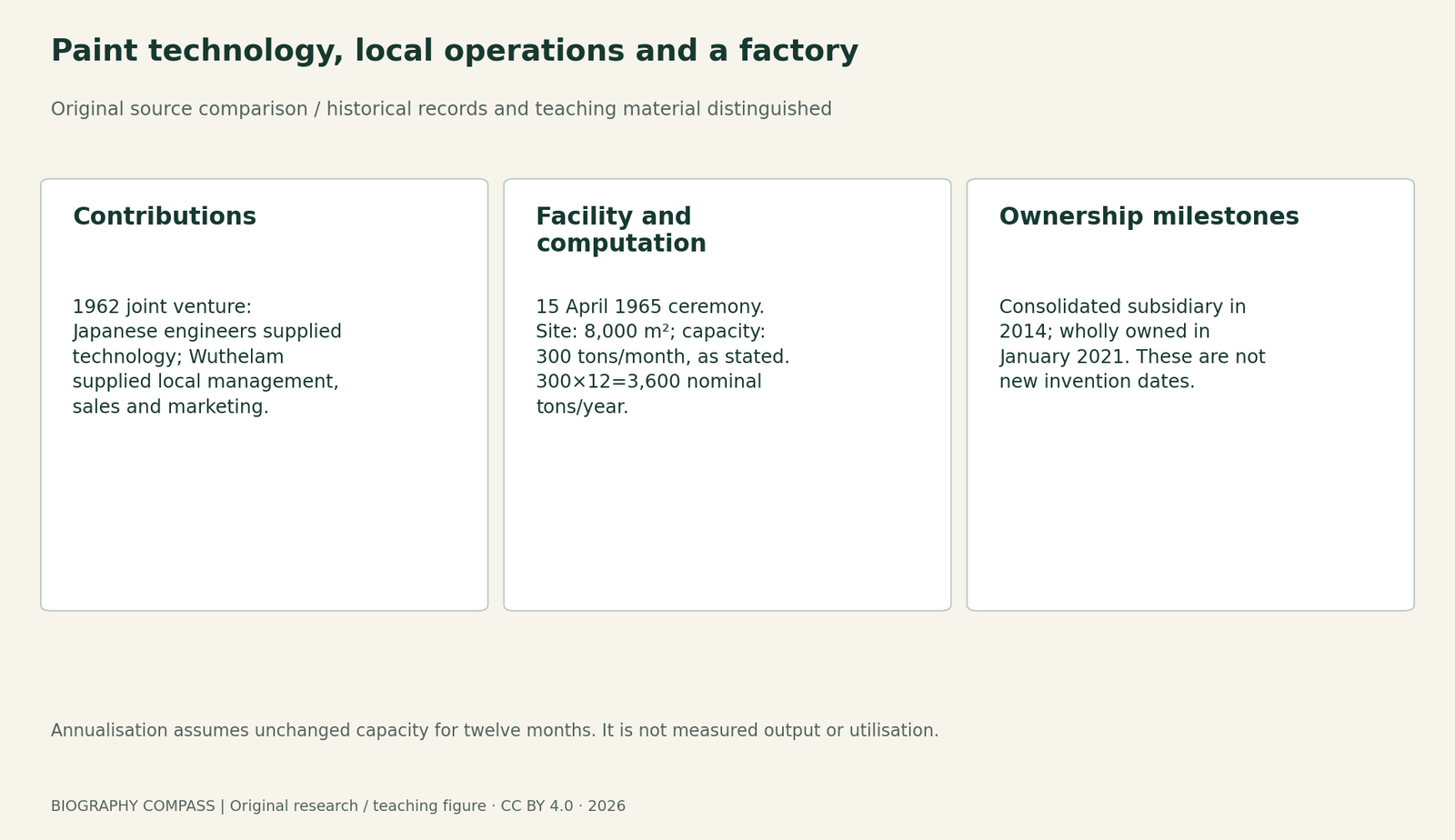
Nippon Paint dates the establishment of Pan Malaysia Paint Industry to 1962, and the factory’s completion ceremony to 15 April 1965. The account links the investment to shipping costs, delivery times, regional construction demand and proposed import tariffs. These are reasons given by the company for producing closer to the market. They should remain attributed explanations rather than an independent causal test of the whole paint industry. The venture date establishes a partnership milestone; the ceremony establishes a later facility milestone. Neither automatically dates the invention of a coating or proves the first day of every production line.
Sources for this section: [1]
Give technical and market work their own verbs
The report says Japanese engineers provided paint technology and production know-how at local sites. It describes Wuthelam’s role in local management, sales and marketing. A useful annotation might therefore distinguish supplied technology, organised local operations and developed distribution. These activities can reinforce each other without becoming interchangeable. An entrepreneur’s ability to build a market does not mean he personally devised every chemical formulation; engineering expertise alone also does not explain customer access or distribution. The source supplies a division of work worth preserving, while product-specific authorship would require laboratory, patent, design or technical records not examined here.
Sources for this section: [1]
Capacity is a facility characteristic, not an output log
For the new factory, the account gives an 8,000-square-metre site and 300 tons-per-month production capacity. Site area and capacity measure different things. Neither provides actual sales or the amount manufactured in a stated calendar year. The figure is useful because it describes the scale the company assigned to the facility. But actual output would depend on operating time, product mix, maintenance, orders and other conditions not measured by this historical paragraph. A researcher seeking utilisation should look for production records with a matching period and scope rather than treating the opening description as an annual operating return.
Sources for this section: [1]
Later ownership did not erase collaborative origins
The 2021 account distinguishes the NIPSEA business becoming a consolidated subsidiary in 2014 from becoming wholly owned inJanuary 2021. These are ownership and reporting milestones, not claims that the paint chemistry was newly invented in either year. The report also contains competitive and forward-looking statements serving an investor-relations purpose. The memorial serves a different commemorative purpose. Both can support bounded historical claims; neither is an independent measure of all environmental, employment or customer outcomes. A careful source comparison keeps the contributor, legal company, date and kind of evidence attached to each sentence.
Original exercise: annotate a factory display
A display combines three statements: “Goh personally invented the factory’s paints”; “the 300-ton monthly capacity proves 3,600 tons were produced in the first full year”; and “full ownership in 2021 means there was no earlier partnership.” For each statement, identify the unsupported step and rewrite it using the records. Calculate the simple annual capacity equivalent, stating the assumption needed. Do not invent a historical utilisation rate or substitute a speculative output total. Finally, name one additional record that could help test a claim about actual production and one that could help investigate technical contribution.
Reference answer: calculate a limit, then label it
The source identifies engineers’ technology and Wuthelam’s local operations, so the display cannot establish sole technical authorship. 300 tons per month multiplied by twelve months equals 3,600 tons of nominal annual capacity, assuming the same stated capacity throughout twelve months. That is a computed equivalent, not observed production or sales. The 2021 ownership milestone followed an earlier partnership beginning in 1962; it does not cancel that history. Matched-period factory logs could help establish output. Technical reports, formulation notebooks or relevant patent records could help investigate contributions, while still requiring careful attention to collective work and the scope of each document.
Sources for this section: [1]
Continue the chronology
Related history guides
UCB, UOB and OUB: Founding, Takeover and Legal Merger
Which bank began in 1935, and what changed at each stage of the 2001–2002 combination?
Read the timeline1963–2013Wing Tai’s Garment Workers: Training and Transition
When a company leaves manufacturing, how can its records show what happened to its workers?
Read the timelineBiography context
Explore Singapore through connected lives
Connected biographies
Business lives in context
1927–2025
Goh Cheng Liang
Paint-industry entrepreneur and philanthropistGoh Cheng Liang helped build a paint business through a partnership that combined Japanese production technology with local operating and market knowledge.Read biographyQuick answers
Common questions
- Did the factory actually produce 3,600 tons in a year?
- That is a capacity equivalent calculated from 300 tons per month, not an observed output total.
- Does the guide claim a complete technical archive was read?
- No. The acquired historical narrative and memorial were read; technical drawings, formulation books and operating logs were not.
Primary and institutional sources
How this history was checked
The exercises and reference answers are original teaching material based on the named records. Company histories, first-person recollections and contemporary reports answer different questions; their limits remain explicit. This article was reviewed on 27 October 2026.