
The short answer
The Tuol Sleng Genocide Museum preserves records associated with S-21, the Khmer Rouge security center in Phnom Penh. Its archive documents an institution as well as individual lives. UNESCO registered the archive in 2009, and a later project preserved hundreds of thousands of pages while creating searchable access to digitized records.
Compare the records
Three different kinds of archival work
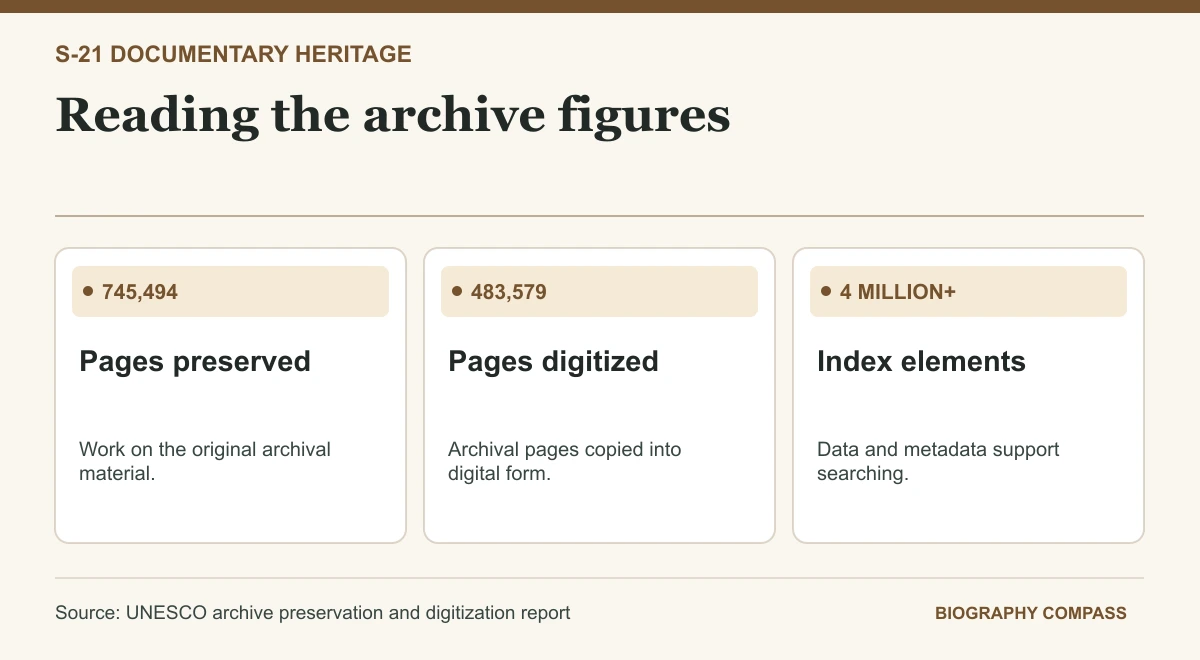
UNESCO’s project figures describe different activities. The counts have separate units.
| Work | Project result | What the result counts |
|---|---|---|
| Preservation | 745,494 pages | Physical pages preserved |
| Digitization | 483,579 pages | Pages digitized |
| Indexing | Over four million data and metadata elements | Information used to identify and search the digital records |
Chronology
A timeline of the turning points
Tuol Sleng opens as a museum
The former S-21 site and surviving records begin a new public role.
Nomination dossier describes the archive
The submission inventories documentary materials and describes preservation needs.
UNESCO registers the archive
The documents enter the international Memory of the World Register.
An initial project phase concludes
UNESCO reports separate totals for physical preservation and digitization.
What the S-21 records can establish
The archive includes photographs, written files and records created in the course of detention. A photograph can establish that an image was made and retained by the institution. An intake list or other register may help identify a person or a date. The circumstances of each record still matter. A forced confession records an act of coercion and has to be evaluated against other evidence before anyone treats a statement within it as reliable.
Preservation and digitization answer different questions
Physical preservation concerns the condition of the original records. Digitization creates copies that can be consulted with reduced handling of those originals. UNESCO's project report gives a total of 745,494 pages preserved and 483,579 pages digitized. It separately reports more than four million data and metadata elements indexed. A reader should retain the unit attached to each number because a single page can contribute more than one piece of searchable information.
Sources for this section: [1]
What registration did for this archive
The 2009 registration belongs to UNESCO's documentary heritage program. The nomination describes why the archive needed coordinated preservation and how the surviving documents connect to the history of S-21. Later preservation work led to a bilingual site for public consultation. The continuing value of the physical archive lies partly in having objects and records available for re-examination if a transcription, date or identification in the digital index needs correction.
Continue the chronology
Related history guides
How Luang Prabang’s Buddhist Photographs Were Preserved
Follow the provenance and digitization of historical photographs preserved at Buddhist monasteries in Laos.
Read the timeline2006 onwardHow the Bophana Center Rebuilt Access to Cambodian Film
Compare preservation of records from one institution with Bophana’s audiovisual recovery.
Read the timeline1997–2022The Khmer Rouge Tribunal Explained
Read how evidence and testimony entered the tribunal’s legal process.
Read the timelineConnected biographies
People connected to this history

1946—2011
Vann Nath
Painter, writer and S-21 survivorThe painter who survived S-21 because of his artistic skill, created a visual record of the prison and became a crucial tribunal witness.Read biographyQuick answers
Common questions
- When did the Tuol Sleng archive enter Memory of the World?
- UNESCO inscribed the documentary archive on its register in 2009.
- How much of the archive was digitized?
- UNESCO reports 483,579 pages digitized and 745,494 pages preserved through the project it documented.
Primary and institutional sources
How this history was checked
Dates, legal milestones and historical claims are checked against the official and institutional records below. This article was reviewed on 19 November 2026.