
The short answer
How did a cash crisis become a labour conflict, and what did the June 1950 settlement actually change? Compare the chronology, the employment figures and the different purposes of management and labour accounts.
Original evidence comparison
Three records answer different questions
Perspective does not make a record useless; it makes its purpose part of the reading.
| Country | What the record helps establish | What it cannot establish alone |
|---|---|---|
| Corporate history | Payment arrears, reconstruction arrangements, dated executive decisions and detailed settlement categories. | The full range of individual worker experiences or an independent audit of every management interpretation. |
| 1952 labour yearbook | Near-contemporary labour concerns, no-redundancy undertaking and collective action. | The complete later financial recovery or every personal motive in management. |
| 24 June court reasons | A specific conflict over alteration of work rules and required union participation. | The legal character of every departure or the cause of Toyota’s subsequent recovery. |
| Current union memory | How the institution commemorates the dispute and its lessons today. | The precise language and priorities of every union participant in 1950. |
Chronology
A timeline of the turning points
Cash and employment bargain
A bank syndicate provides support; labour and management agree to cooperate and avoid job cuts.
Sales company and conflict
Toyota Motor Sales is established on 3 April; the reconstruction proposal includes job cuts and wage reductions.
Resignation and settlement
Kiichiro and two other executives resign; the labour-management settlement is signed on 10 June.
New demand and new management
Ishida’s presidency and military procurement belong to the later recovery chronology.
The initial problem included collecting cash
Toyota’s retrospective history explains that sales on instalments expanded after the return to free-market vehicle sales in 1949. Payments did not arrive as quickly as vehicles left the company. Wages, suppliers and debts still required cash. On 23 December, labour and management agreed to cooperate in rationalisation, with the company undertaking to avoid job cuts and the union accepting a basic-wage reduction. A 24-bank syndicate provided year-end funds subject to a reconstruction plan. These transactions explain why manufacturing more vehicles was not by itself an answer: unpaid sales and obligations could leave a technically capable producer short of operating funds.
Sources for this section: [1]
Separating sales funds was an institutional change
Toyota Motor Sales was established on 3 April 1950 with Shotaro Kamiya as president. The plan aimed to separate sales and manufacturing funds, improve instalment finance and align output with the market. Toyota’s account reproduces Kiichiro’s February remarks about the finance industry’s lack of confidence in how funds would be used. This is evidence of management’s diagnosis, not proof that the reorganisation immediately solved it. Banks, sales executives and the union participated in arrangements around the new company. Giving that work to a founder alone would obscure the people and financial relationships through which the change could operate.
Sources for this section: [2]
Labour’s objection concerned a broken undertaking
The Labour Year Book of Japan 1952 was published in October 1951, close to the events. Its labour-history account describes the 22 April proposal for 1,600 job cuts, branch-plant closures and a wage reduction. It emphasises the union’s reliance on the previous December’s no-redundancy undertaking and records workplace meetings and coordinated action with other union branches. Its language is that of labour conflict and resistance, while Toyota’s later history stresses reconstruction. Reading the two together identifies a substantive dispute over employment commitments and the distribution of the costs of adjustment, rather than merely a misunderstanding between otherwise harmonious partners.
Sources for this section: [3]
The settlement combined departures and management change
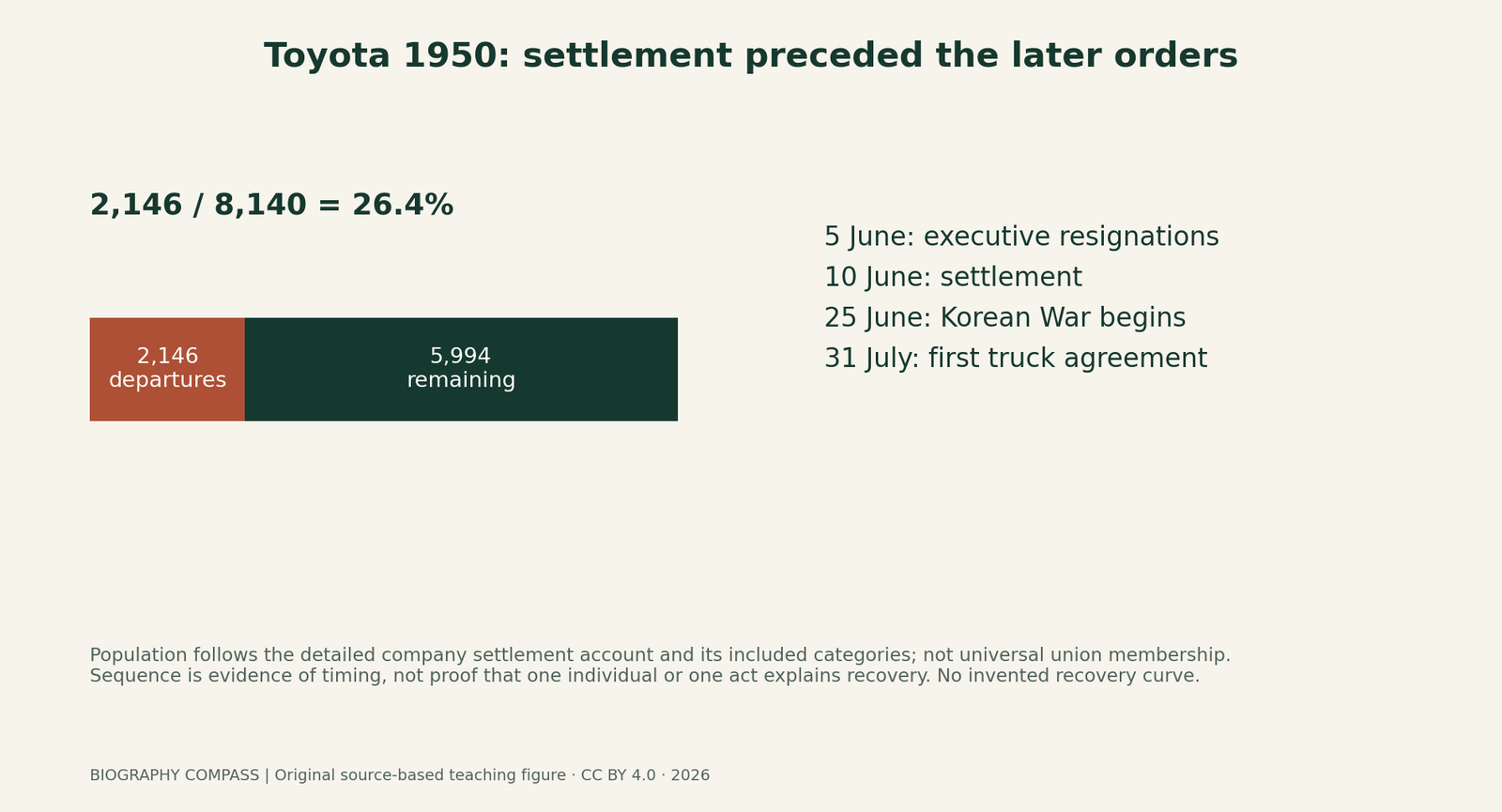
Toyota’s detailed account separates Kiichiro’s May announcement of intention to resign from his resignation with Kazuo Kumabe and Kohachiro Nishimura on 5 June. The memorandum signed on 10 June accepted voluntary departures, some reinstatement, help finding work and a further wage reduction. The history reports 2,146 departures, including 378 at the closing Tokyo plants, and 5,994 remaining staff, including 350 in sales. These categories sum to 8,140. They do not use the same scope as every rounded retelling of 1,500 or the original 1,600 proposal. Taizo Ishida’s formal appointment followed in July.
Sources for this section: [4]
A contemporary case reveals a separate procedural conflict
A Nagoya District Court decision of 24 June 1950, preserved in a labour-case database, concerned changes to Toyota’s work rules. The reasons excerpt discusses failure to obtain the union’s required participation and the binding character of the existing rules. This narrow record makes workers’ institutional claims visible alongside the settlement. It is not a judgement on every reconstruction measure, and it does not establish that all individual departures had one identical legal character. For historical reading, its value is to show that the dispute also involved procedures and authority within the workplace, beyond the headline number of jobs.
Sources for this section: [5]
Settlement and recovery belong on different dates
The Korean War began on 25 June, after the settlement. Toyota’s history dates a first agreement for 1,000 BM trucks to 31 July, followed by further orders. It also quotes the company’s April–September 1950 business report on improving results and demand. This sequence prevents military orders from becoming the cause of an earlier agreement or Kiichiro from becoming the sole author of recovery after leaving office. The current union’s anniversary message remembers the great dispute through a lesson of mutual trust. That is a later institutional memory; the contemporary yearbook preserves a more adversarial picture of workers’ concerns.
Original exercise: audit the denominator and chronology
A caption claims: “Kiichiro’s resignation saved every job; exactly 1,600 of 8,140 workers left; Korean War orders ended the strike.” Repair it using three kinds of evidence. First calculate the percentage represented by the detailed account’s 2,146 departures and state which population the calculation uses. Next place the June settlement before or after the outbreak of war. Finally explain why a company history, a near-contemporary labour yearbook and a court-reasons excerpt should not be treated as interchangeable testimony. The exercise checks a numerical and documentary reading, not an evaluation of an individual worker’s legal position.
Reference answer: retain the costs as well as the recovery
The detailed categories give 2,146 divided by 8,140, about 26.4 percent. This is a share of the combined population implied by that account, including the specified plant and sales categories; it is not a universal union-membership rate. The settlement on 10 June preceded the war’s outbreak on 25 June and the July truck agreement. Resignation, departures, wage changes, new management and subsequent orders were distinct events. Management’s retrospective explanation, labour’s contemporary account and the court’s procedural reasons answer different questions. A sound caption states those events and costs rather than replacing them with a single rescuer.
Continue the chronology
Related history guides
The Super Cub: design, factories and sales
Compare another vehicle company’s organisation of products, production and customer access.
Read the timeline1959–1969Kyocera’s early ceramic parts
Compare the accumulation of production capabilities with the separate challenge of financing an enterprise.
Read the timelineBiography context
Explore Japan through connected lives
Connected biographies
People, products and institutions
1894–1952
Kiichiro Toyoda
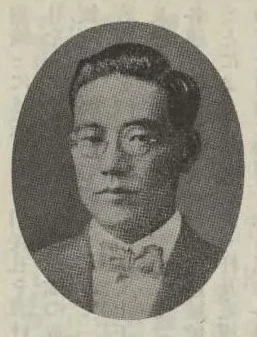
Mechanical engineer and Toyota Motor founderKiichiro Toyoda helped develop automatic looms before directing the Toyoda group’s move into automobile manufacturing. His work depended on engineers, financial backing, sales leadership and government policy; the 1950 crisis ended his presidency.Read biography1910–1988
Takeo Fujisawa
Business executive and Honda co-founderTakeo Fujisawa organised finance, distribution and long-term management at Honda. Joining in 1949, after the company’s incorporation, he became the commercial partner whose decisions helped turn motorcycles into a scalable international business.Read biographyQuick answers
Common questions
- Why not use one total for all accounts of job losses?
- Proposals, rounded summaries and the detailed final account may cover different groups. This guide labels the final account’s categories instead of treating the figures as equivalent.
- Did the Korean War end Toyota’s labour dispute?
- The settlement was signed on 10 June 1950. The war began on 25 June, and Toyota’s first truck-supply agreement followed in July; the later demand helped recovery.
Primary and institutional sources
How this history was checked
Institutional histories, technical records and contemporary documents support this guide. The comparisons, figure and exercise are original teaching aids; corporate retrospectives are identified where they supply the evidence. This article was reviewed on 27 October 2026.
- Toyota, 75 Years of ToyotaEmerging business management crisis
- Toyota, 75 Years of ToyotaEstablishment of Toyota Motor Sales Co., Ltd.
- Ohara Institute for Social Research, Hosei University; originally Jiji TsushinshaThe Labour Year Book of Japan 1952, section on All-Japan Automobile Industry Workers Union disputes; published 30 October 1951
- Toyota, 75 Years of ToyotaResignation of President Kiichiro Toyoda: settlement memorandum and employment figures
- Japan Federation of Labour Standards Associations, Labour Standards Case DatabaseToyota Motor case, Nagoya District Court decision, 24 June 1950, case 1950 (Yo) 230: reasons excerpt
- Toyota, 75 Years of ToyotaSpecial Demand Caused by Korean War, including quotation from the 22nd Business Report
- Toyota Motor Workers’ Union80th anniversary: executive committee chair’s message