
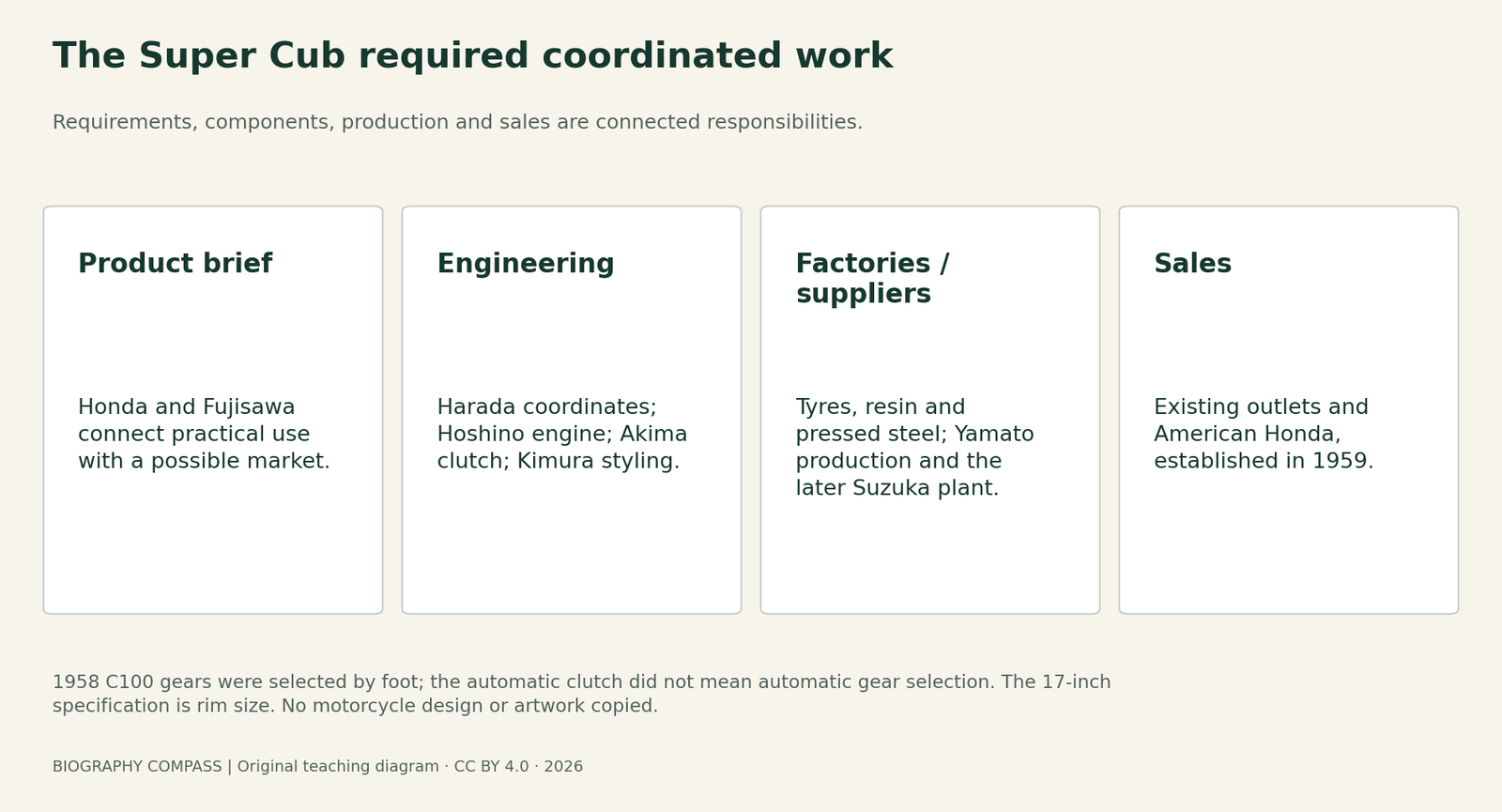
The short answer
What had to work together for the Super Cub C100 to become a widely used motorcycle? Separate the customer brief, engineering tasks, suppliers, factory capacity and sales organisation behind its August 1958 launch.
Original contribution comparison
A usable machine needed several kinds of work
The same people could participate in several discussions, but their responsibilities were distinct.
| Country | Principal work | Connection to the customer |
|---|---|---|
| Direction and brief | Honda and Fujisawa set priorities for a small, accessible motorcycle. | Define the use cases and the expected market. |
| Engineering coordination | Harada coordinated specialists; Hoshino and Akima addressed engine and clutch tasks. | Make reliable power and easier control possible. |
| Body and suppliers | Kimura, chassis specialists, tyre makers, moulders and other suppliers developed interdependent parts. | Provide proportions, mounting ease and durable manufacture. |
| Factories and sales | Yamato and later Suzuka supplied production; dealers and American Honda connected the product to users. | Make the motorcycle obtainable and support its adoption. |
Chronology
A timeline of the turning points
A new small-machine brief
Honda and Fujisawa travel in Europe and refine the next product’s requirements.
Specialist development
Engine, clutch, frame and industrial-design work proceed together.
Sales begin
The C100 launches with a four-stroke engine and a clutch operated without a hand lever.
Sales and production expand
American Honda starts operations; Suzuka adds manufacturing capacity in 1960.
A broad market changed the design problem
Soichiro Honda and Takeo Fujisawa’s European trip in 1956 helped sharpen a brief for a small motorcycle suited to Japanese conditions. The company wanted usable power, quiet and economical operation, an approachable body and less complicated clutch control. A market brief is not a finished mechanism. It tells engineers which problems matter and which combinations of features a customer might value. Fujisawa’s responsibility for management and selling informed that brief; Honda’s technical direction shaped the response. Neither role makes the other engineering and production participants incidental to the result.
Sources for this section: [1]
Named specialists turned the brief into mechanisms
Honda’s detailed history identifies Yoshiro Harada as the project coordinator and Daiji Hoshino as the engine designer. The near-horizontal engine layout created cooling and cylinder-head packaging problems. Akira Akima’s work addressed a different difficulty: coordinating the centrifugal clutch with changing gears and starting. Kiyoshi Kawashima also helped with the mechanism. The clutch removed the left-hand lever while the rider still selected gears by foot. Calling it a fully automatic motorcycle would erase that distinction. These tasks show how an easy experience for a rider could require considerable complexity inside the machine.
Sources for this section: [2]
Styling and suppliers shaped manufacturability
Industrial designer Jozaburo Kimura related the body’s proportions to wheel size, straddling space and a low-mounted engine. The team sought 17-inch rims with tyres suited to the intended rider and roads; the rim diameter must not be confused with the tyre’s overall outside diameter. New sizes needed a willing tyre supplier. Polyethylene fenders and leg shields also required cooperation from moulders, with Honda supplying moulds. Pressed-steel parts and seats came through further contributors. What looked like one recognisable object was therefore a coordinated set of industrial decisions, including work outside Honda itself.
Sources for this section: [3]
Capacity had to follow the product
Honda’s official anniversary chronology dates Super Cub C100 sales to August 1958 at the Yamato plant and the start of Suzuka production to 1960. It specifies a 49 cc, four-stroke OHV engine with a quoted output of 4.5 horsepower. These product and factory records are more useful for dates than a dramatic remembered sales forecast. A forecast expresses confidence; a plant opening establishes new capacity; neither alone gives the number of saleable machines produced. The manufacturing question is how the firm obtained components, assembled the motorcycle and maintained quality as orders grew.
Sources for this section: [4]
A sales network preceded the Super Cub
Fujisawa’s earlier Cub F-Type campaign helped create access to bicycle shops. The 1952 F-Type was an auxiliary engine for a bicycle, so its outlet campaign is not the C100’s launch. Honda’s history describes a staged direct-mail offer, bank support for payment and the clerical work of addressing thousands of letters. That organisation gave the later company relationships through which small motorcycles could reach users. Product continuity and product difference both matter here: a familiar name and sales network could be reused, while the complete 1958 machine required its own engineering and manufacturing effort.
Sources for this section: [5]
Exports required another organisation to learn
American Honda was established in 1959 under Kihachiro Kawashima. The local staff had to recruit dealers and adapt selling to a market where small motorcycles were unfamiliar. Honda’s account records a slow first few months rather than immediate fulfilment of its initial sales goal. Later advertising involved people outside the founding partnership, including agency specialists. Comparing this with the Japanese launch shows why an available factory does not automatically create a market. The founders could authorise expansion, but local staff and dealers supplied relationships, information and everyday decisions that could not simply be exported with the machine.
Sources for this section: [6]
Original exercise: repair a five-sentence label
A draft museum label makes five claims: Fujisawa invented the engine; automatic clutch meant no gear changes; 17 inches describes the outside tyre diameter; the 1952 mailing launched the Super Cub C100; and a sales forecast proves factory output. Classify each problem as attribution, mechanism, measurement, chronology or evidence. Then replace two claims with descriptions naming the appropriate work or record. Use the comparison table to keep design, manufacturing and selling distinct while showing where they depended on one another. The exercise is newly written; it is not a reproduction of a Honda training document.
Reference answer: connect the contributions accurately
The first is attribution: Hoshino designed the engine under Honda’s technical direction. The second confuses mechanism: the centrifugal clutch removed the hand lever, while gears remained foot-selected. The third confuses rim and tyre dimensions. The fourth is chronology: F-Type distribution in 1952 preceded C100 sales in August 1958. The fifth mistakes intention for an operating record. A stronger label would identify Harada’s coordination, Akima’s clutch work and Kimura’s industrial design, then connect them to suppliers, Yamato and Suzuka production and Fujisawa’s commercial organisation. Ease for the rider emerged from work across the system.
Continue the chronology
Related history guides
Kyocera’s early ceramic parts
Compare material processing and customer specifications with the motorcycle’s network of parts and suppliers.
Read the timeline1949–1951Toyota’s financial and labour crisis
Compare why manufacturing capacity and sales finance had to be managed together.
Read the timelineBiography context
Explore Japan through connected lives
Connected biographies
People, products and institutions
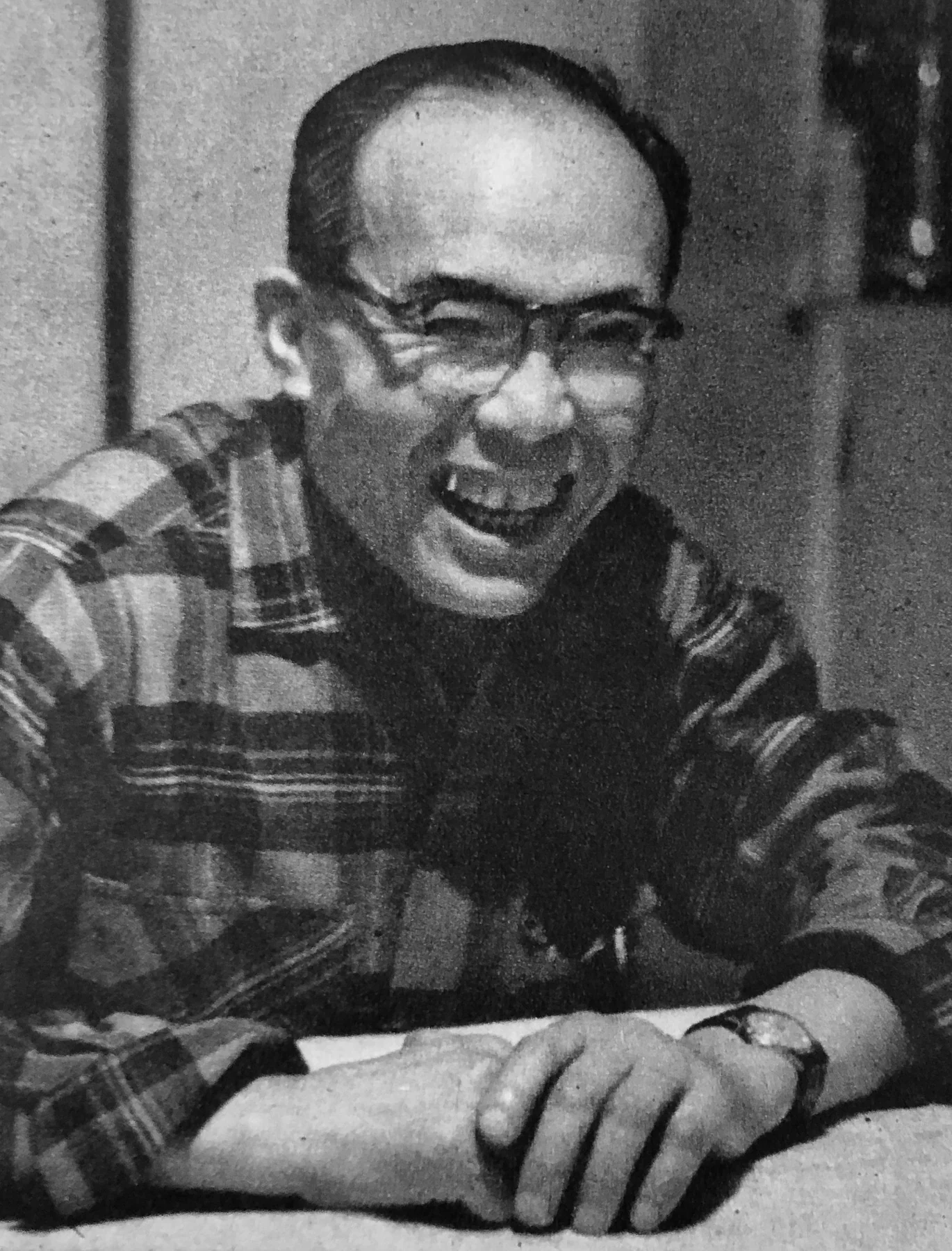
1906–1991
Soichiro Honda
Industrialist and founder of Honda Motor Co.Soichiro Honda moved from vehicle repair and piston-ring manufacture into a motorcycle company with an international reach. His technical leadership worked alongside Takeo Fujisawa’s commercial organization and the contributions of specialist engineering teams.Read biography1910–1988
Takeo Fujisawa
Business executive and Honda co-founderTakeo Fujisawa organised finance, distribution and long-term management at Honda. Joining in 1949, after the company’s incorporation, he became the commercial partner whose decisions helped turn motorcycles into a scalable international business.Read biographyQuick answers
Common questions
- Was the Super Cub fully automatic?
- The original C100 had a centrifugal clutch without a hand lever, but riders still changed gears using a foot control.
- Did sales start in 1958 or 1959?
- Honda’s official anniversary chronology and detailed heritage account both date Japanese C100 sales to August 1958. Exports to the United States began in 1959.
Primary and institutional sources
How this history was checked
Institutional histories, technical records and contemporary documents support this guide. The comparisons, figure and exercise are original teaching aids; corporate retrospectives are identified where they supply the evidence. This article was reviewed on 27 October 2026.
- Honda Cub StoriesThe Birth of the Super Cub, part 1: engine and transmission
- Honda corporate historyQuality Products have no International Boundaries / 1956
- Honda Cub StoriesThe Birth of the Super Cub, part 2: body, tyres and suppliers
- Honda newsroomHonda Celebrates 50th Anniversary of Super Cub Motorcycle, 23 July 2008
- Honda corporate historyUsing Direct Mail to Develop Sales Outlets for the Cub F-Type / 1952
- Honda corporate historyEstablishing American Honda Motor Co. / 1959