
The short answer
How did state selection make stimulated emission exceed absorption in the ammonia maser?
Read the evidence
Prepared medium, working device, measured result
The maser records distinguish a mechanism from the performance of a particular apparatus.
| Record or test | What it establishes | What remains different |
|---|---|---|
| State selector in the lecture | Explains how excited ammonia molecules were preferentially delivered. | Heating an equilibrium gas is not the same preparation. |
| 1954 report | Records the operating molecular oscillator and named team. | A short announcement is not a complete performance specification. |
| 1955 analysis | Separates measured operation from theoretical limits for different uses. | A predicted limiting noise figure is not a universal measured value. |
Selecting molecules instead of heating everything
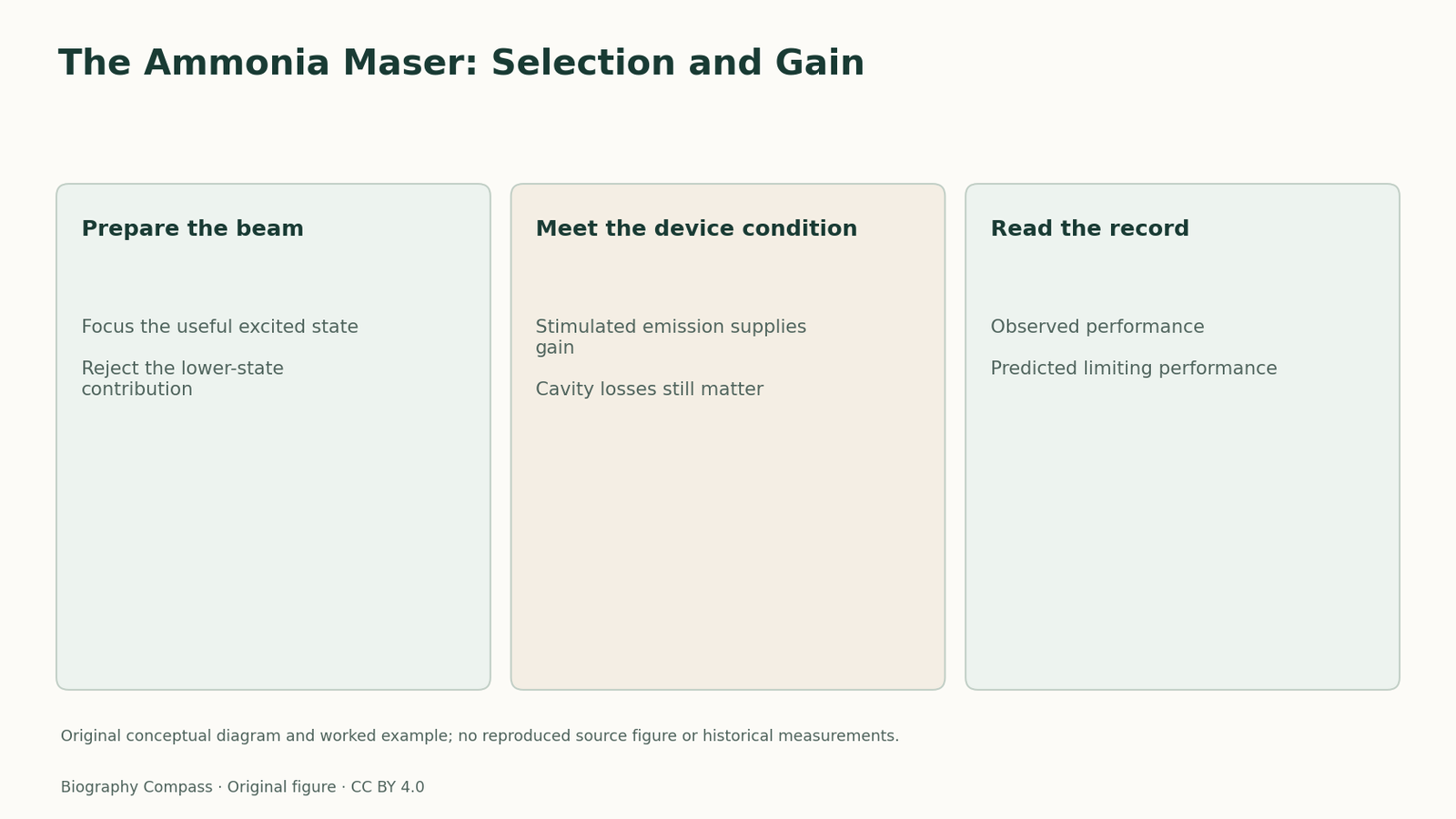
The ammonia maser did not work by making a gas arbitrarily hot. Townes’s lecture describes an inhomogeneous electric field that focused molecules in the desired excited state toward a resonant cavity while rejecting molecules in the lower state. The beam reaching the cavity was therefore different from an ordinary equilibrium population. That distinction is the physical purpose of the selector. Increasing the total amount of gas without preserving the useful state balance would not reproduce the same conditions for amplification.
Sources for this section: [4]
A cavity and a supply of excited states
Inside the resonant cavity, the selected molecules could give energy to a microwave field through stimulated emission. A useful device also needed that gain to overcome losses. This is a more demanding condition than saying that individual molecules can emit radiation. The 1954 announcement identified the operating system and its authors, while the fuller 1955 paper discussed amplifier, oscillator and spectrometer uses. Those functions share physical ingredients but ask different performance questions: amplification, sustained oscillation and the resolution of a spectroscopic measurement.
Performance records and a later explanation
The 1955 abstract reports experimental performance and theoretical expectations separately. It discusses frequency stability and spectrometer resolution, while describing a limiting amplifier noise figure as something approachable under specified conditions. The distinction is useful: a predicted limit is not automatically the achieved performance of every configuration. Townes’s 1964 lecture explains the state selection and credits the colleagues who realised the first apparatus. A retrospective explanation can clarify the mechanism, while the contemporary paper remains the record for the particular performance claims made at that time.
A beam-selection exercise
Imagine two invented beams containing the same total number of molecules. Beam A has been selected so that the relevant upper state is favoured; Beam B retains a population dominated by the lower state. A student claims that equal particle numbers guarantee equal microwave gain. The supported answer rejects that claim because the balance between stimulated emission and absorption depends on the states, not just the head count. Now give Beam A a cavity with losses larger than the available gain. A favourable population still does not guarantee sustained oscillation. These examples isolate two independent requirements—preparing the medium and meeting the device’s loss condition. They contain no reconstructed historical population counts or invented output-power measurements.
Continue the chronology
Related history guides
The 1958 Optical Maser: Proposal and Device
Examine Schawlow and Townes’s optical-maser proposal, its resonator and mode selection, while separating design calculations from a working laser.
Read the timeline1949–1950; retrospective lecture 1989Ramsey’s Separated Fields and Interference
Compare Ramsey’s 1950 resonance calculation with his later explanation of separated fields, including phase coherence and a worked timing exercise.
Read the timelineBiography context
Explore United States through connected lives
Connected biographies
Researchers and related approaches
1915–2015
Charles Townes
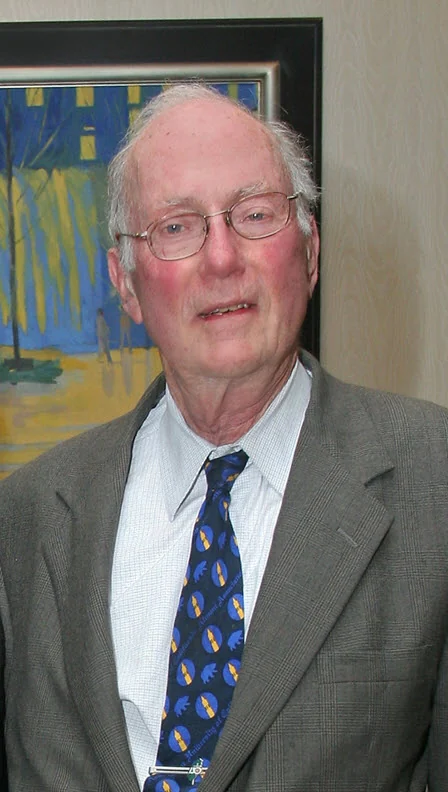
Physicist and maser researcherCharles Townes connected wartime microwave work with spectroscopy, leading the Columbia maser project and later collaborating on the optical-maser proposal.Read biography1918–2007
Arthur Kornberg
Biochemist and DNA-replication researcherKornberg's group isolated DNA polymerase from bacteria in 1956.Read biographyQuick answers
Common questions
- Why were molecular states selected?
- The beam needed a favourable excited-state population so stimulated emission could exceed absorption at the relevant transition.
- Does a favourable population guarantee oscillation?
- No. The gain also has to overcome the losses in the resonator and output arrangement.
Primary and institutional sources
How this history was checked
The 1954 announcement, 1955 analysis and Townes’s lecture are used for different evidential roles. The worked beam comparison is original. This article was reviewed on 7 November 2026.
- University of California Academic SenateCharles Hard Townes: In Memoriam
- Gordon, Zeiger and Townes / American Physical SocietyMolecular Microwave Oscillator and New Hyperfine Structure in the Microwave Spectrum of NH3
- Gordon, Zeiger and Townes / American Physical SocietyThe Maser—New Type of Microwave Amplifier, Frequency Standard, and Spectrometer
- Charles H. Townes / Nobel LectureProduction of Coherent Radiation by Atoms and Molecules
- Schawlow and Townes / American Physical SocietyInfrared and Optical Masers
- Nobel Prize OutreachCharles Townes — Facts
- Nobel Prize OutreachCharles Townes — Biographical