
The short answer
Why did a difference between DNA-fragment patterns matter more than simply finding antibody RNA? Read the limited comparison in the 1976 paper, then separate its inference from a later teaching model of segment combinations.
Original source comparison
Do not swap the evidence and the model
Match each observation to the question it can actually answer.
| Evidence | What the evidence supports | What it does not establish |
|---|---|---|
| Different DNA-fragment patterns | Supports an inference about DNA organisation in the specified sources. | A direct film of every B cell rearranging its genome. |
| Three V choices and two J choices | Six pairs under the declared teaching rule. | A measured human antibody count. |
| 1987 prize | Records the recipient and citation. | A replacement author list for the 1976 paper. |
Chronology
A timeline of the turning points
Original comparison
Hozumi and Tonegawa published the mouse DNA-fragment study in PNAS.
MIT move
Tonegawa moved from Basel to MIT.
Nobel recognition
The full Medicine Prize recognised the genetic principle behind antibody diversity.
Start with a physical question about inherited information
Hozumi and Tonegawa’s 1976 paper addresses the relationship between variable-region and constant-region sequences in immunoglobulin genes. Its first page identifies the Basel Institute for Immunology in Switzerland and a comparison involving mouse material. Before attributing the result to a national research setting or a later institute, check that address and date. The question was not simply whether an antibody-producing cell contained antibody messenger RNA. The authors wanted evidence about whether the underlying DNA organisation differed between an embryonic genome and an antibody-producing cell source.
Sources for this section: [1]
The sources and probes defined the comparison
The acquired first page describes DNA from early mouse embryos and the MOPC321 plasmacytoma, a kappa-light-chain producer. After DNA was divided into fragments, hybridisation tests located sequences corresponding to variable and constant regions. These are specific cell sources and molecular targets, rather than a census of every antibody gene in an organism. The original abstract distinguishes two hybridising components in embryo DNA from a smaller single component in tumour DNA that hybridised with both kinds of sequence. A change in RNA abundance alone would not establish this difference in the physical arrangement of genomic DNA.
Sources for this section: [1]
The interpretation had a defined reach
The authors interpreted the result as evidence that sequences separated in embryonic DNA had become joined during immune-cell differentiation. That is an important inference from the specified pattern; it is not a direct time-lapse recording of one normal B cell. Nor does this first-page comparison by itself establish every step of the later V(D)J account. The paper’s variable/constant terminology and the later description of variable, diversity and joining segments answer connected questions at different explanatory levels. Light and heavy chains also do not use an identical set of segment types.
Try a separate segment-choice model
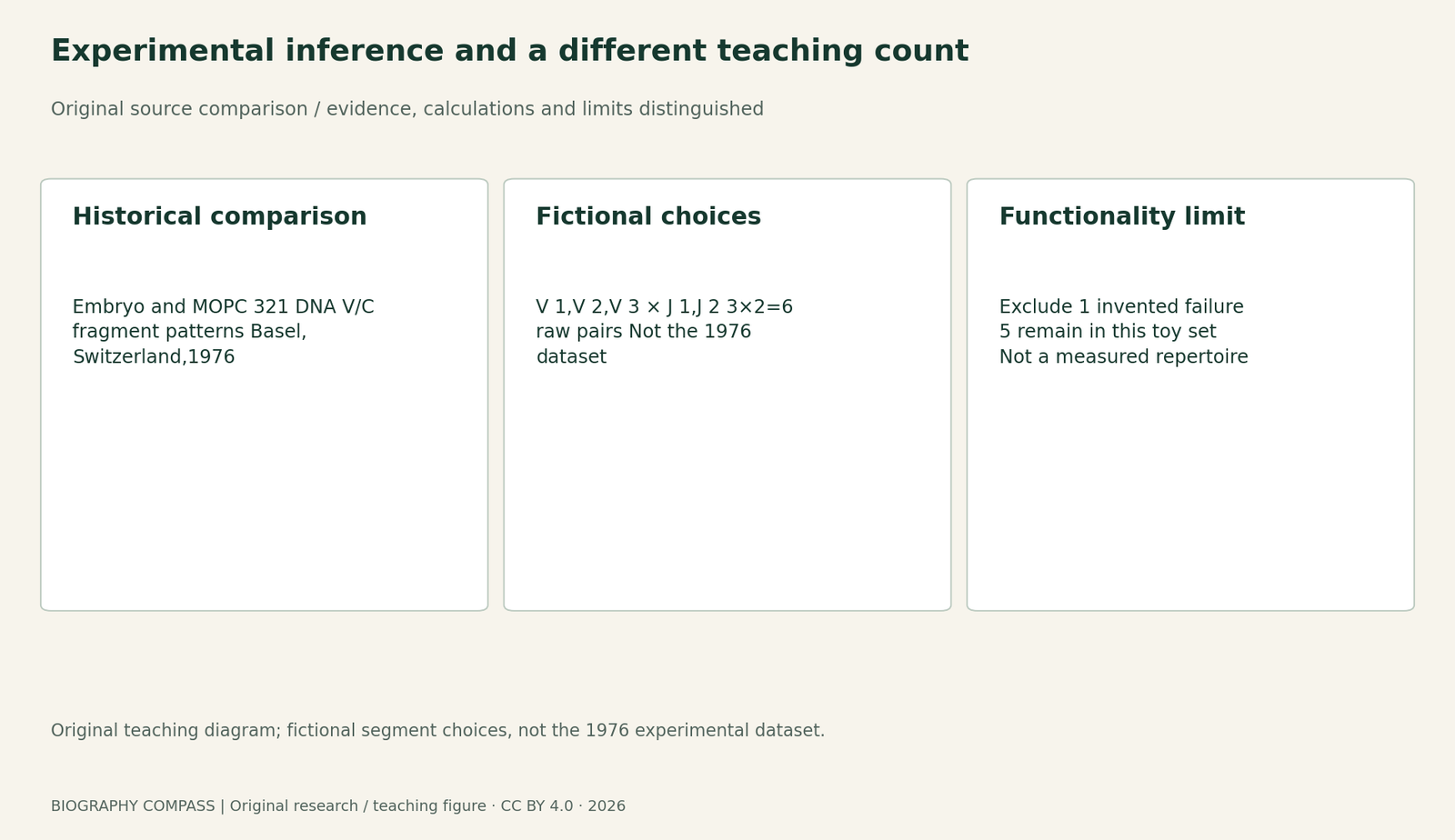
The figure’s counting example is newly invented and is not a reconstruction of the 1976 data. Imagine a simplified light-chain variable-region model with three possible V segments and two J segments. Permit one choice from each set and, for this exercise only, assume every pair can be selected. List the pairs. How many raw combinations are possible? If one resulting sequence fails a hypothetical functionality check, how many remain? Finally, decide whether either count tells you the number of distinct antibodies a real person makes, or demonstrates the exact DNA rearrangement observed in the paper.
Sources for this section: [1]
Reference answer: a product is not an observed repertoire
The pairs are V1–J1, V1–J2, V2–J1, V2–J2, V3–J1 and V3–J2:3×2=6 possible combinations under the stated rule. Removing one specified nonfunctional result leaves 5 in this fictional set. Neither number is a measured repertoire. The model omits additional diversity processes, selection and other chains, and has no experimental embryo/tumour fragment measurements. It illustrates how combinations can multiply possibilities; it does not supply independent evidence that rearrangement occurred. The historical comparison and the counting exercise therefore support different conclusions even though both concern antibody diversity.
Recognition and collaboration are separate records
The 1987 Nobel Prize went to Tonegawa for the genetic principle behind antibody diversity. The 1976 paper names both Nobumichi Hozumi and Susumu Tonegawa, while Tonegawa’s autobiographical account describes a larger research group and subsequent work. The prize citation should not erase the paper’s author list or turn one experiment into the whole programme. Tonegawa’s later MIT neuroscience career is another distinct chapter. MIT’s 2026 obituary and the updated Nobel facts establish that he died on 11 July 2026; an older award-era present-tense biography is not evidence of a current appointment.
What was actually compared here
This guide uses the original paper’s acquired first page, including abstract, authors, address and introductory question, plus selected participant and institutional passages. It does not claim to have reanalysed the original gels or read every method and figure. The diagram and segment choices are original teaching material, not copied experimental data. A useful next reading is Honjo’s antibody-diversification biography, which distinguishes class switching and later immune regulation from the initial assembly problem. Keeping those mechanisms separate is more informative than calling every change to an antibody gene the same discovery.
Continue the chronology
Related history guides
Does Autophagosome Accumulation Show a Faster Process?
Compare a different primary-source question and its explicitly bounded teaching exercise.
Read the timeline1992–2018What Did the Early PD-1 Experiments Actually Establish?
Compare a different primary-source question and its explicitly bounded teaching exercise.
Read the timelineBiography context
Explore Switzerland through connected lives
Connected biographies
People behind the work
1939–2026
Susumu Tonegawa
Molecular biologist and neuroscientistSusumu Tonegawa used molecular biology to investigate how an inherited genome could support an enormous range of antibodies. His later work at MIT moved into neuroscience and memory. He died on 11 July 2026, after a career spanning Japanese, American and Swiss laboratories.Read biography
1942–
Tasuku Honjo
Physician-scientist and molecular immunologistTasuku Honjo investigated how immune cells change antibody genes and how immune responses are restrained. His group’s PD-1 research developed from gene-expression experiments into genetic tests of immune regulation, before later therapeutic applications.Read biographyQuick answers
Common questions
- Was the decisive 1976 work performed at MIT?
- No. The acquired paper lists the Basel Institute for Immunology in Switzerland.
- Are the six pairs experimental data?
- No. They are a fictional counting example with explicitly limited assumptions.
Primary and institutional sources
How this history was checked
Compare the identified original texts, participant accounts and institutional records; the teaching examples are separately labelled. This article was reviewed on 27 October 2026.
- Nobumichi Hozumi and Susumu Tonegawa; Purdue Fort Wayne hosted original-paper copyEvidence for somatic rearrangement of immunoglobulin genes coding for variable and constant regions, PNAS 73, 3628–3632 (1976)
- Nobel Foundation; Susumu TonegawaSusumu Tonegawa: autobiographical account
- Nobel FoundationSusumu Tonegawa: Nobel Prize facts
- Anne Trafton; MIT NewsMIT Professor Susumu Tonegawa dies at 86, 15 July 2026
- Nobel Foundation; Tasuku HonjoTasuku Honjo: autobiographical account