
The short answer
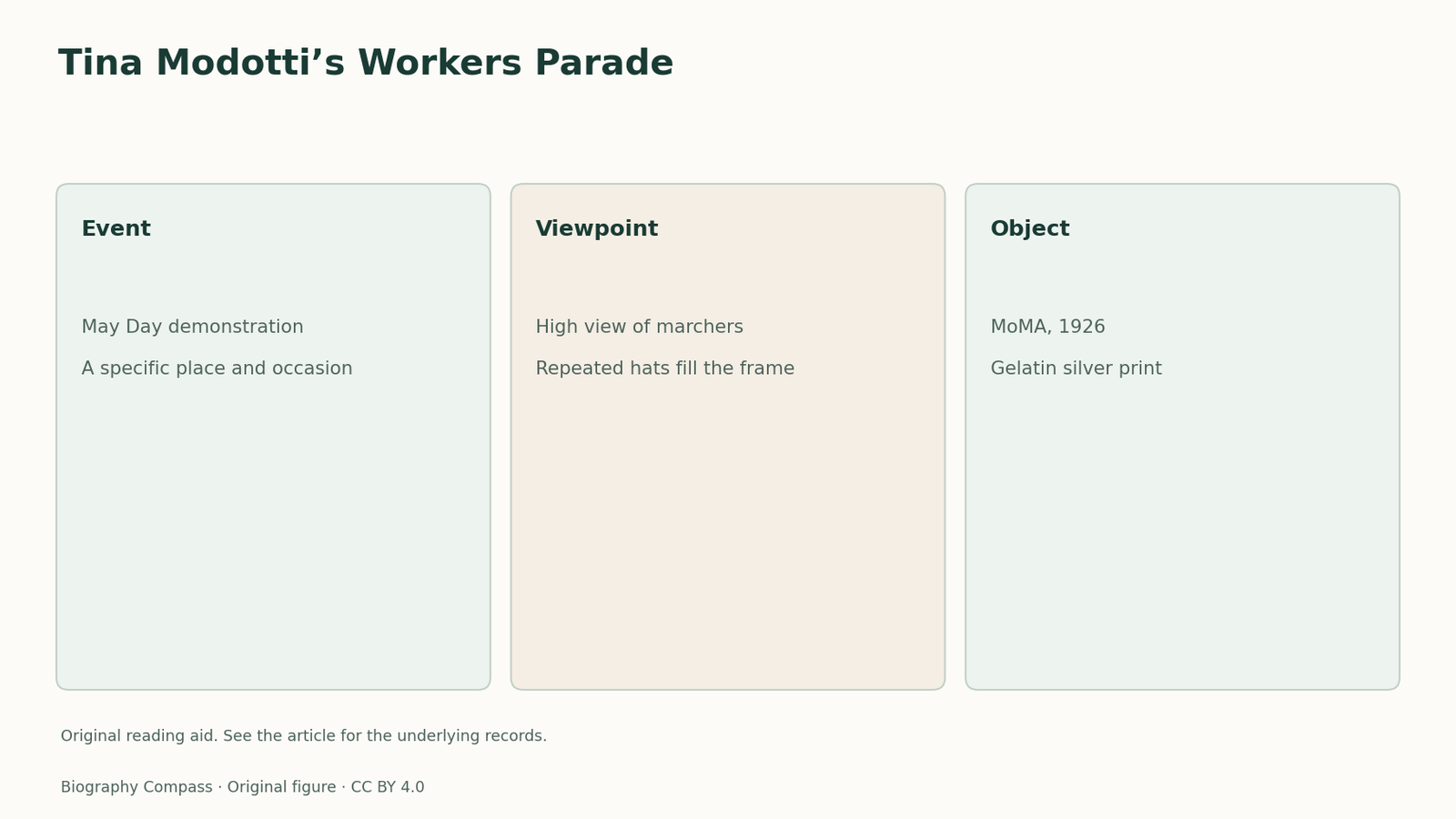
Modotti’s high viewpoint gives a demonstration the shape of a pattern. The museum record, the event and the organization of the frame offer different ways to read the image.
Compare the evidence
Keep formal and historical evidence together
The label, curator’s interpretation and comparison print answer different questions.
| Record or element | What can be checked | What it helps explain |
|---|---|---|
| MoMA object record | 1926 gelatin silver print | Title, date and medium |
| Respini’s account | May Day, high view and repeated hats | Historical setting and visual structure |
| Worker’s Hands | 1927 palladium print | Another scale and framing of labor |
The event and the picture have different boundaries
MoMA identifies Workers Parade as a 1926 gelatin silver print. Curator Eva Respini places the photograph at a May Day demonstration. That event identification gives context for the repeated forms in the picture. The edges of the photograph define the part of the event Modotti made available to viewers. A reader should distinguish what the photograph allows someone to see from what the full demonstration might have included. The camera could record only one view, so a claim about the whole procession would need other pictures, an account of the event or a record of the organizers.
A high viewpoint gives the crowd a structure
Respini draws attention to the absence of faces and a horizon and to the way hats fill the frame. As a visual exercise, follow a few of the repeating outlines from one part of the image to another. An interruption in the pattern can carry emphasis because the other forms are related. The high viewpoint brings many people into a single arrangement, while the tight frame gives little space for locating one individual. This explains how the composition can make collective presence the subject even before a viewer has read the historical identification of the parade.
Sources for this section: [5]
Compare a close view with the overhead view
MoMA also holds Worker’s Hands, a palladium print dated 1927. Compare the two works by describing what happens at their edges. One gives a group of people through repeated partial forms. The other makes particular hands the main visual material. Both use selection to concentrate attention on aspects of work and collective life. The photographs can be read together without assuming they appeared in the same publication or arose from the same assignment. A direct record of publication would be necessary before assigning either image to a particular magazine issue or claiming that both shared an original audience. On a comparison sheet, give each picture its own date and medium. The act of writing those fields can expose an assumption that a visual similarity alone would otherwise leave untested.
Keep the caption and the object available for checking
An object title and a description of an event are not the same field. Begin a citation with Modotti’s name and MoMA’s object title, then record the year and medium. Use Respini’s account for the May Day setting and for a specific interpretation of the view. If a title in another publication differs, keep the two phrasings attached to their own sources until there is evidence about who supplied them. This method keeps the visual reading close to the image while making the archival claim easy to verify. It also leaves room for the way editors and museums can change a photograph’s audience.
Continue the chronology
Related history guides
Reading Edward Weston’s Pepper No. 30
Compare museum copies of Edward Weston’s Pepper No. 30 and distinguish the 1930 negative, the later printer credits and the composition of the photograph.
Read the timeline1937–1938The Jersey Homesteads Mural and Its Makers
Read the Jersey Homesteads mural by Ben Shahn with Bernarda Bryson through its school setting, scenes of immigration and labor, and the cooperative.
Read the timelineBiography context
Explore Mexico City, Mexico through connected lives
Connected biographies
Photographers and related work
1896–1942
Tina Modotti
Photographer and film actorTina Modotti moved from Italy to California and then to Mexico, where she developed a photographic practice around work, art and public life.Read biography1886–1958
Edward Weston
Photographer and printmakerEdward Weston built a career from portrait photography, experiments in Mexico and sustained studies of natural forms in California.Read biography1890–1976
Paul Strand
Photographer and filmmakerA photographer and filmmaker who made close attention to place part of a sustained collaborative practice.Read biographyQuick answers
Common questions
- When was Workers Parade made?
- MoMA dates it 1926 and identifies the event as a May Day demonstration.
- Why do the hats matter to the composition?
- The high viewpoint and tight frame make the repeated hats a major visual pattern and shift attention to the group.
Primary and institutional sources
How this history was checked
Dates, legal milestones and historical claims are checked against the official and institutional records below. This article was reviewed on 13 November 2026.
- Moderna MuseetTina Modotti
- Region of Emilia-RomagnaTina Modotti
- Museum of Modern ArtTina Modotti
- J. Paul Getty MuseumEdward Weston: Enduring Vision
- Museum of Modern ArtTina Modotti. Workers Parade
- Museum of Modern ArtWorker’s Hands
- Museum of Modern ArtTina Modotti exhibition announcement
- Museum of Modern ArtWorkers Parade
- Museum of Modern ArtExploring Indigenism and the Avant-Garde
- University of UdineModotti, Tina biography