
The short answer
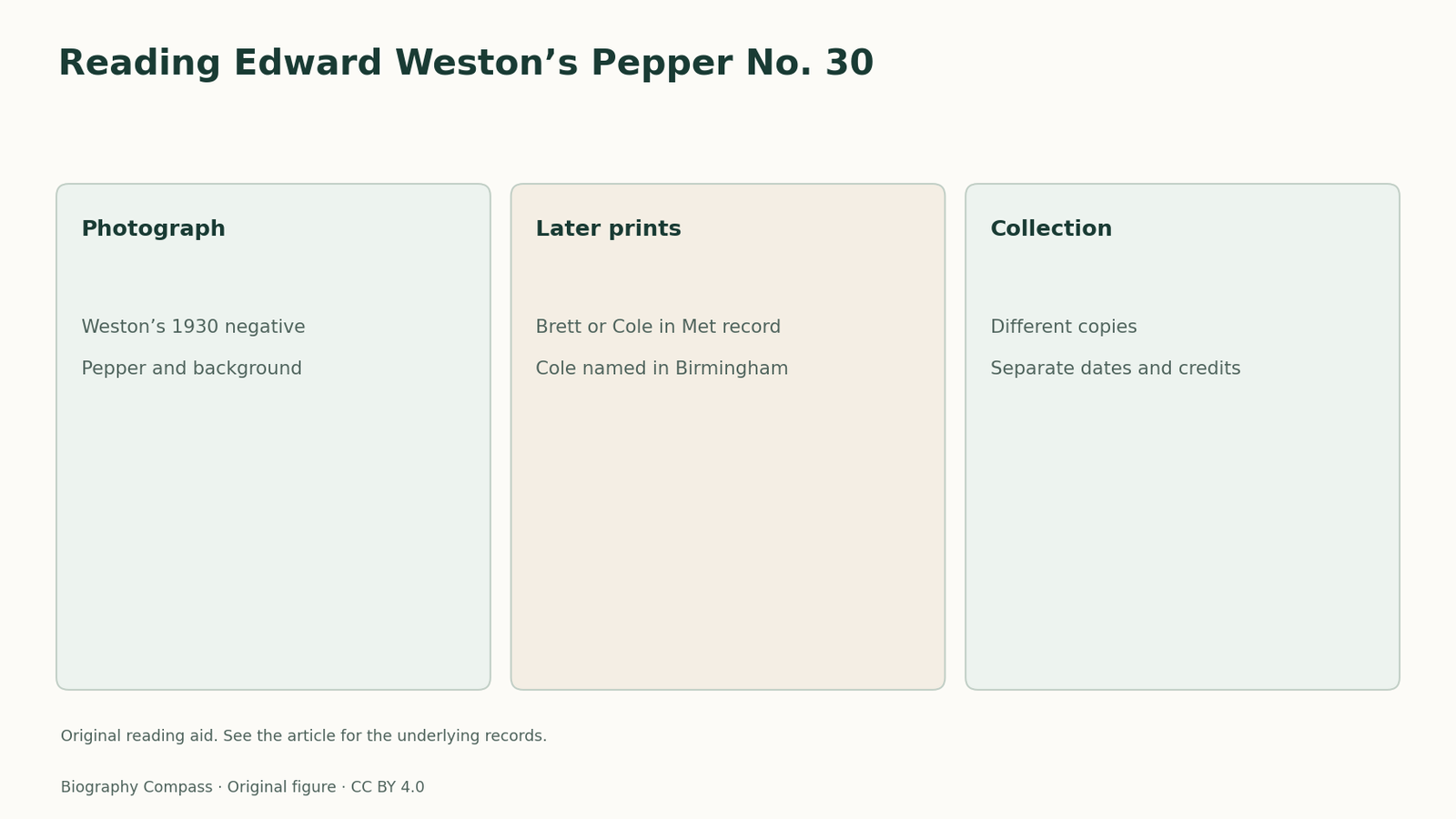
A pepper photographed in 1930 produced more than one physical print. Catalog dates and printer credits help explain how a familiar image reached different collections.
Compare the evidence
Compare individual Pepper No. 30 objects
Negative and print fields identify different stages of production.
| Record or element | Date evidence | Printer or holding information |
|---|---|---|
| Met 57.519.11 | 1930, printed about 1954 | Brett or Cole Weston |
| Birmingham 2006.14 | 1930 negative, printed later | Cole Weston, named on label |
| SFMOMA 39.208 | Created 1930, acquired 1939 | Individual museum copy and gift credit |
One image and several objects
Pepper No. 30 names an image Weston made in 1930. It also appears on collection pages that describe separate physical objects. The Met records a gelatin silver print made around 1954 and gives Brett or Cole Weston as possible printer. Birmingham’s record identifies Cole, and quotes the label on the reverse that credits Edward for the negative and Cole for the print. The two catalog entries do not assign the same degree of certainty to the maker of the print. Preserve the uncertainty in the Met record when describing that object, and use Birmingham’s more specific attribution for its own copy.
Use the daybook to place the still life in time
SFMOMA supplies a transcript that places Weston’s enthusiasm for a pepper in his daybook of 8 August 1930. The Getty’s exhibition account describes his repeated attention to vegetables after moving to Carmel. Together these sources support reading the photograph as part of a study. An ordinary object can be worked on several times. Shifts in its position, light or surroundings give the photographer a way to decide what difference each change makes to the finished picture. The diary records the maker’s attention to the subject, while the prints make it possible for a later reader to consider the results of that attention.
What a reader can compare in the composition
Look at the pepper’s contour where the lit surface meets the surrounding dark. Then follow the transitions of tone across the middle of the object. The Nelson-Atkins collection describes convex and concave shapes in its copy. A reader who traces those areas can compare where the picture makes the vegetable appear solid and where it allows the outline to merge with the background. That is a specific formal reading. It does not require a claim that the object was transformed into a different subject. It also leaves the reader able to recognize that a digitized image may differ from a print seen directly.
Read the credit as a record of work
Create two columns for a comparison: the negative and the physical print. Place the 1930 date with the negative when the catalog uses it that way, then record the date range and printer for the object you are describing. The SFMOMA object gives a 1939 acquisition date, which establishes that its copy had already reached the museum by that time. Birmingham supplies a signed printer credit, and the Met supplies an approximate later print date. Those facts tell a useful history of production and acquisition without giving every print the same maker or date. They also identify whose labor a citation should acknowledge. An accession number keeps that credit attached to the correct print when the work is discussed elsewhere.
Continue the chronology
Related history guides
Tina Modotti’s Workers Parade
Read Tina Modotti’s 1926 Workers Parade through its overhead viewpoint, May Day setting, object record and contrast with her close studies of hands.
Read the timeline1932Alma Lavenson’s Self-Portrait with Hands
Read Alma Lavenson’s 1932 Self-Portrait through the hands, camera and separate museum records that describe the print, inscriptions and scale.
Read the timelineBiography context
Explore United States through connected lives
Connected biographies
Photographers and related work
1886–1958
Edward Weston
Photographer and printmakerEdward Weston built a career from portrait photography, experiments in Mexico and sustained studies of natural forms in California.Read biography1896–1942
Tina Modotti
Photographer and film actorTina Modotti moved from Italy to California and then to Mexico, where she developed a photographic practice around work, art and public life.Read biography1883–1976
Imogen Cunningham
PhotographerA photographer whose long practice joined technical knowledge with sustained curiosity about people and natural forms.Read biographyQuick answers
Common questions
- Did Weston print every copy of Pepper No. 30?
- Museum records identify later printers for some copies. Birmingham credits Cole Weston.
- What does 1930 refer to?
- It is the date of the image or negative. The actual print may have been made later.
Primary and institutional sources
How this history was checked
Dates, legal milestones and historical claims are checked against the official and institutional records below. This article was reviewed on 13 November 2026.
- J. Paul Getty MuseumEdward Weston: Enduring Vision
- Center for Creative PhotographyEdward Weston Archive
- J. Paul Getty MuseumEdward Weston
- Museum of Modern ArtTina Modotti
- Metropolitan Museum of ArtPepper #30
- Birmingham Museum of ArtPepper #30
- San Francisco Museum of Modern ArtPepper No. 30
- Nelson-Atkins Museum of ArtPepper No. 30
- Metropolitan Museum of ArtPepper No. 35