
The short answer
There are two well-sourced answers to the question of how many people Timor-Leste counted in 2004. The first accompanied the announcement of early results in Dili. The second appears in the national statistical institute’s series for comparing censuses. Their labels and publication dates explain which number to cite.
Compare the records
Choose the figure that answers the question
The contemporary announcement and the later statistical table describe the same census at different stages.
| Figure | Where it appears | Suitable use |
|---|---|---|
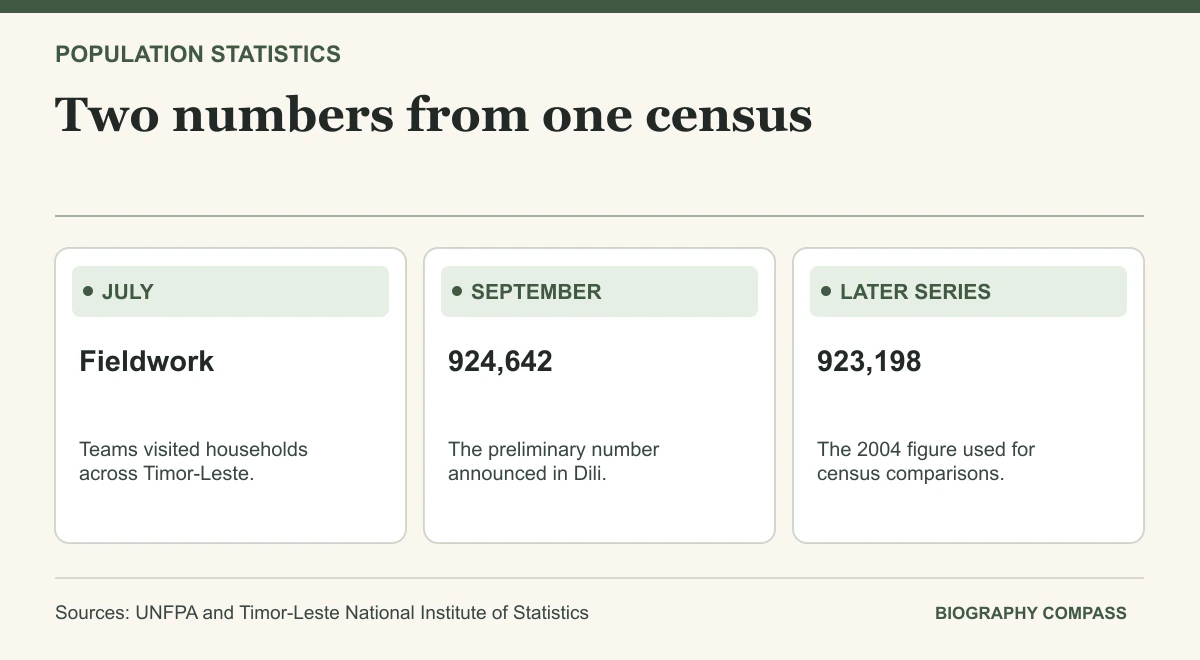
| 924,642 | UNFPA’s account of the preliminary announcement. | Reconstruct what officials reported in September 2004. |
| 923,198 | Historical census series in the 2022 main report. | Compare 2004 with subsequent census years. |
| 1,444 | Difference between those two figures. | Describe the numerical difference without assuming its cause. |
Chronology
A timeline of the turning points
Households enumerated
Nearly four thousand enumerators worked across the country.
Early count announced
Prime Minister Mari Alkatiri presented the preliminary figures in Dili.
Comparative series
The later report lists 923,198 for 2004 and 1,066,409 for 2010.
Getting to the household
UNFPA describes nearly four thousand enumerators visiting more than 190,000 households from 11 to 30 July. In mountainous areas without road access, teams travelled on foot or relied on animals and boats. The account also describes plotting GPS locations against aerial photographs to identify houses that might have been missed. A population total began with a practical question about whether a team had reached each settlement.
The number people heard in September
At the September announcement, the preliminary population was 924,642. A historian describing what ministers, reporters or residents learned at that moment should retain the figure and identify it as preliminary. Changing it to the number in a later statistical table would silently alter the content of the announcement. The early report is evidence of what was known and communicated at that stage of processing.
The number to use for a trend
The institute’s later comparative series assigns 923,198 people to the 2004 census and 1,066,409 to 2010. Use those two values from the same table when calculating the increase between censuses. The early and later 2004 totals differ by 1,444. Neither number by itself explains which records changed or why. Any claim about the source of the revision would require processing documentation beyond these published totals.
Continue the chronology
Related history guides
Connected biographies
People connected to this history
1949—
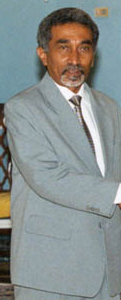
Mari Alkatiri
FRETILIN leader and former prime ministerA founding FRETILIN figure and exile diplomat who led the first constitutional government after independence and returned briefly as prime minister in 2017.Read biographyQuick answers
Common questions
- Which figure belongs in a historical census series?
- The 2022 national census main report uses 923,198 for 2004.
- Was 924,642 a separate census?
- It was the preliminary population reported from the same 2004 enumeration.
Primary and institutional sources
How this history was checked
Dates, legal milestones and historical claims are checked against the official and institutional records below. This article was reviewed on 19 November 2026.