
The short answer
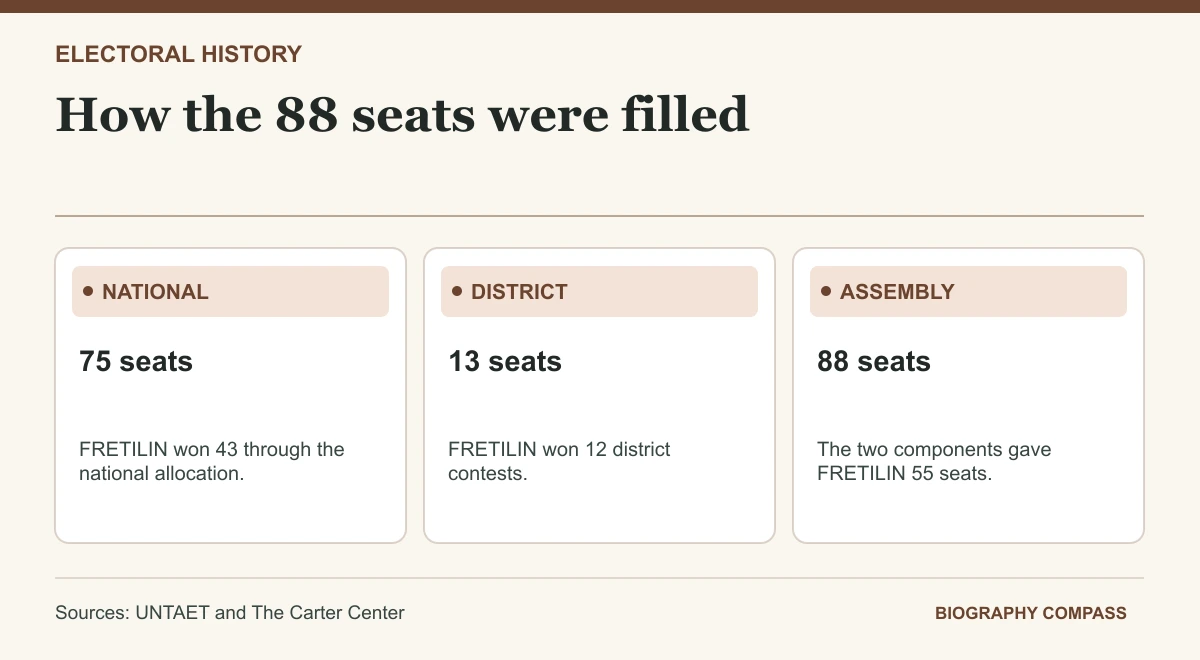
Two votes on the same day could contribute to two different parts of Timor-Leste’s Constituent Assembly. In August 2001 voters chose national representation and a district representative. Combining the results explains how FRETILIN won fifty-five seats in the body charged with drafting a constitution.
Compare the records
Rebuild the seat total
Applying the two allocation rules separately explains why a party’s share of all seats can differ from its national vote share.
| Component | All seats | FRETILIN seats |
|---|---|---|
| National representation | 75 | 43 |
| District representation | 13 | 12 |
| Full assembly | 88 | 55 |
Chronology
A timeline of the turning points
Electoral regulation
UNTAET issued the rules for electing a constituent assembly.
Polling day
Voters selected national and district representatives.
Results announced
The chief electoral officer presented the results in Dili.
Two ballots answered two questions
The national component distributed seventy-five seats by proportional representation. A separate contest in each of thirteen districts chose one representative. A party that attracted votes across the country could gain national seats even where it did not win a district. Conversely, winning a district produced one seat regardless of the size of the winning margin. The electoral regulation provides the rule needed to read the results table.
Where fifty-five came from
FRETILIN obtained forty-three of the nationally allocated seats and won twelve district seats. Adding those totals gives fifty-five out of eighty-eight, or 62.5 per cent of the assembly. That percentage measures seats. It cannot be substituted for the party’s share of votes on the national ballot. The difference is particularly clear in this election because a large majority of the district contests went to one party.
Why August 1999 and August 2001 appear together
The election was held on the second anniversary of the 1999 popular consultation. In 1999 voters had answered a question about a proposed autonomy arrangement. In 2001 they were choosing representatives who would prepare a constitution under the UN transition. The familiar date links the two events in public memory. Their ballot papers, institutions and results belong to different stages in the restoration of independence.
Continue the chronology
Related history guides
Counting Timor-Leste: How to Read the Two 2004 Census Totals
Compare the electorate with the wider resident population counted in 2004.
Read the timeline1999Timor-Leste Referendum 1999: Vote, Result and Violence
Read the question voters answered on 30 August 1999.
Read the timeline1999–2002UNTAET and Timor-Leste Independence, 1999–2002
Place the assembly election in the broader UN transition.
Read the timelineConnected biographies
People connected to this history
Quick answers
Common questions
- How many district seats were there?
- Each of the thirteen districts elected one representative.
- How did FRETILIN reach fifty-five seats?
- It won forty-three national seats and twelve district seats.
Primary and institutional sources
How this history was checked
Dates, legal milestones and historical claims are checked against the official and institutional records below. This article was reviewed on 19 November 2026.